An expanded edition with the full analyst notes, AI geopolitics briefings, paper deep dives, and every item kept in the current front-page run.
3AI briefings
3AI Geopolitics
5Research papers
11Total analyzed
AI Deep Dive
A dedicated daily topic chosen from the strongest AI signals in the run, with a TL;DR and a fuller analytical read.
Topic of the day
AI developer agents and coding workflows
TL;DR: AI developer agents and coding workflows is today's clearest AI theme: China pushes OpenClaw "one-person companies" with millions in AI agent subsidies leads the signal, and related coverage suggests the shift is moving from isolated...
Why now: The topic shows up across The Decoder and The Decoder, MarkTechPost, which means the same operating pressure is appearing through multiple lenses instead of only one announcement.
AI developer agents and coding workflows deserves the slower read today because the supporting items cluster around china, agent, benchmark. China pushes OpenClaw "one-person companies" with millions in AI agent subsidies matters because it affects the policy, supply-chain, or security constraints around AI development, especially across china, agent. The combined signal suggests teams should treat this as a real operating change rather than background noise.
Analyst notes
The Decoder: China pushes OpenClaw "one-person companies" with millions in AI agent subsidies points to China pushes OpenClaw "one-person companies" with millions in AI agent subsidies matters because it affects the...
The Decoder: Luma AI's new Uni-1 image model tops Nano Banana 2 and GPT Image 1.5 on logic-based benchmarks points to Luma AI's new Uni-1 image model tops Nano Banana 2 and GPT Image 1.5 on logic-based benchmarks...
MarkTechPost: NVIDIA AI Releases Nemotron-Terminal: A Systematic Data Engineering Pipeline for Scaling LLM Terminal Agents points to NVIDIA AI Releases Nemotron-Terminal: A Systematic Data Engineering Pipeline for...
China pushes OpenClaw "one-person companies" with millions in AI agent subsidies matters because it affects the policy, supply-chain, or security constraints around AI development, especially across china, agent.
Technical takeaways
Primary signals: china, agent.
Source context: The Decoder published or updated this item on 03/14/2026.
Europe’s factory floors have a new kind of colleague. BMW Group has deployed humanoid robots in manufacturing in Germany for the first time, launching a pilot project at its Leipzig plant with AEON–a wheeled humanoid built by Hexagon Robotics. It is the first automotive...
BMW puts humanoid robots to work in Germany–and Europe’s factories are watching matters because it affects the policy, supply-chain, or security constraints around AI development, especially across europe, robotics.
Technical takeaways
Primary signals: europe, robotics.
Source context: AI News published or updated this item on 03/13/2026.
A defense official reveals how AI chatbots could be used for targeting decisions matters because it affects the policy, supply-chain, or security constraints around AI development, especially across defense, chatbot.
Technical takeaways
Primary signals: defense, chatbot.
Source context: MIT Tech Review AI published or updated this item on 03/12/2026.
AI Report
Software, model, and deployment stories with the strongest operator and platform signal in this edition.
Luma AI's new Uni-1 image model tops Nano Banana 2 and GPT Image 1.5 on logic-based benchmarks the-decoder.com
67/100Rank #2Novelty 7Depth 7Previously covered
Why it matters
Luma AI's new Uni-1 image model tops Nano Banana 2 and GPT Image 1.5 on logic-based benchmarks matters because it signals momentum in benchmark, gpt, model and may shift how teams prioritize models, tooling, or deployment choices.
Technical takeaways
Primary signals: benchmark, gpt, model.
Source context: The Decoder published or updated this item on 03/08/2026.
NVIDIA AI Releases Nemotron-Terminal: A Systematic Data Engineering Pipeline for Scaling LLM Terminal Agents MarkTechPost
67/100Rank #3Novelty 7Depth 7Previously covered
Why it matters
NVIDIA AI Releases Nemotron-Terminal: A Systematic Data Engineering Pipeline for Scaling LLM Terminal Agents matters because it signals momentum in agent, agents, llm and may shift how teams prioritize models, tooling, or deployment choices.
Technical takeaways
Primary signals: agent, agents, llm.
Source context: MarkTechPost published or updated this item on 03/10/2026.
Managing the economics of multi-agent AI now dictates the financial viability of modern business automation workflows. Organisations progressing past standard chat interfaces into multi-agent applications face two primary constraints. The first issue is the thinking tax;...
63/100Rank #11Novelty 6Depth 7Previously covered
Why it matters
How multi-agent AI economics influence business automation matters because it signals momentum in agent, agents and may shift how teams prioritize models, tooling, or deployment choices.
Technical takeaways
Primary signals: agent, agents.
Source context: AI News published or updated this item on 03/12/2026.
Source Desk
Stories drawn specifically from research blogs, first-party lab updates, practitioner newsletters, and selected AI outlets so the daily brief does not mirror the same headline across multiple platforms.
NVIDIA AI Releases Nemotron-Terminal: A Systematic Data Engineering Pipeline for Scaling LLM Terminal Agents MarkTechPost
67/100Rank #3Novelty 7Depth 7Previously covered
Why it matters
NVIDIA AI Releases Nemotron-Terminal: A Systematic Data Engineering Pipeline for Scaling LLM Terminal Agents matters because it signals momentum in agent, agents, llm and may shift how teams prioritize models, tooling, or deployment choices.
Technical takeaways
Primary signals: agent, agents, llm.
Source context: MarkTechPost published or updated this item on 03/10/2026.
Europe’s factory floors have a new kind of colleague. BMW Group has deployed humanoid robots in manufacturing in Germany for the first time, launching a pilot project at its Leipzig plant with AEON–a wheeled humanoid built by Hexagon Robotics. It is the first automotive...
BMW puts humanoid robots to work in Germany–and Europe’s factories are watching matters because it affects the policy, supply-chain, or security constraints around AI development, especially across europe, robotics.
Technical takeaways
Primary signals: europe, robotics.
Source context: AI News published or updated this item on 03/13/2026.
A defense official reveals how AI chatbots could be used for targeting decisions matters because it affects the policy, supply-chain, or security constraints around AI development, especially across defense, chatbot.
Technical takeaways
Primary signals: defense, chatbot.
Source context: MIT Tech Review AI published or updated this item on 03/12/2026.
China pushes OpenClaw "one-person companies" with millions in AI agent subsidies matters because it affects the policy, supply-chain, or security constraints around AI development, especially across china, agent.
Technical takeaways
Primary signals: china, agent.
Source context: The Decoder published or updated this item on 03/14/2026.
Research Desk
Paper summaries, methodology notes, limitations, and deep-dive bullets for the research items selected into the digest.
Paper briefHugging Face Papers / arXiv | 03/13/2026
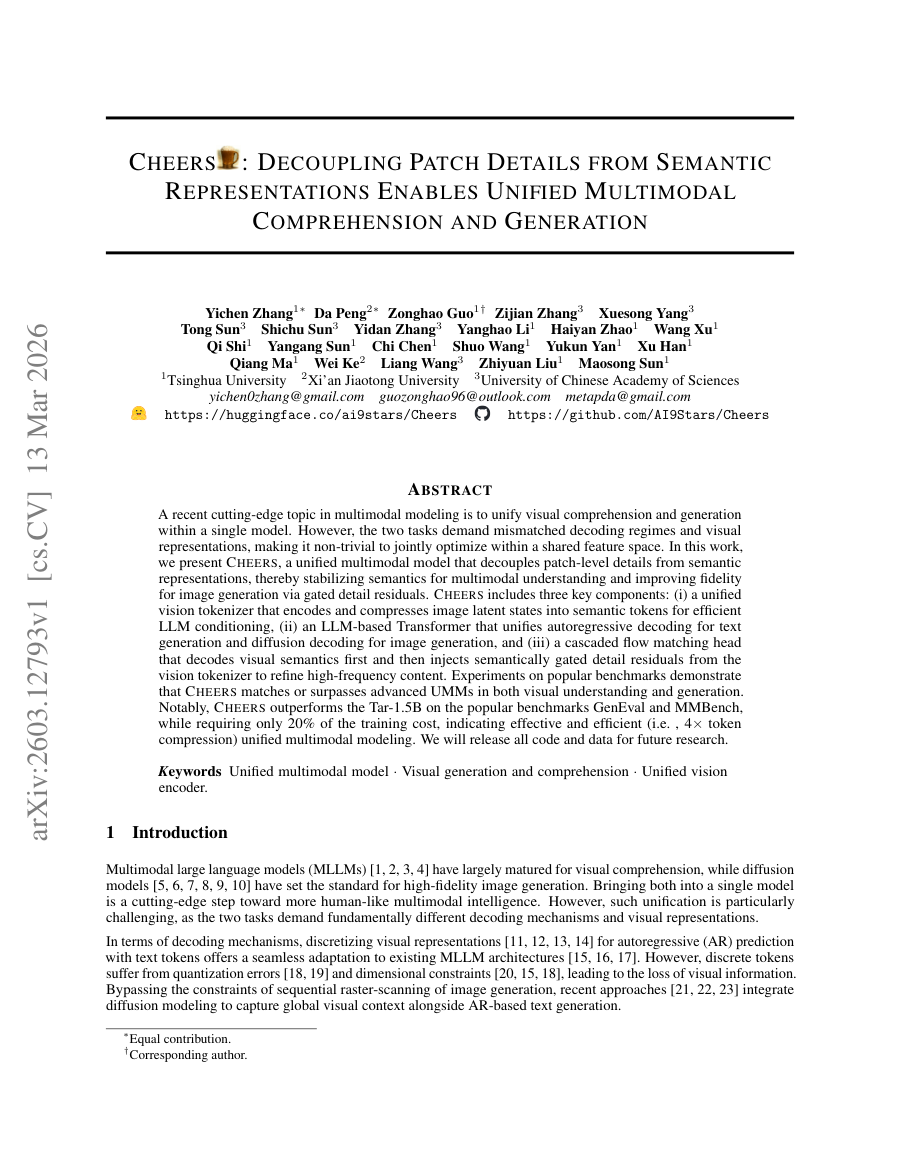
TL;DR: Cheers is a unified multimodal model that decouples visual details from semantic representations using a vision tokenizer, LLM-based Transformer, and cascaded flow matching head to achieve efficient joint...
Cheers is a unified multimodal model that decouples visual details from semantic representations using a vision tokenizer, LLM-based Transformer, and cascaded flow matching head to achieve efficient joint optimization for both visual understanding and generation tasks. A...
96/100Rank #5Novelty 10Depth 10
Problem
Cheers is a unified multimodal model that decouples visual details from semantic representations using a vision tokenizer, LLM-based Transformer, and cascaded flow matching head to achieve efficient joint optimization for both visual understanding and...
Method
In this work, we present Cheers, a unified multimodal model that decouples patch-level details from semantic representations, thereby stabilizing semantics for multimodal understanding and improving fidelity for image generation via gated detail residuals.
Results
Cheers is a unified multimodal model that decouples visual details from semantic representations using a vision tokenizer, LLM-based Transformer, and cascaded flow matching head to achieve efficient joint optimization for both visual understanding and generation tasks.
Watch-outs
The summary does not include concrete numbers, so the practical size of the gain and the tradeoff against latency or data cost are still unclear.
Deep dive
Problem framing: Cheers is a unified multimodal model that decouples visual details from semantic representations using a vision tokenizer, LLM-based Transformer, and cascaded flow matching head to achieve efficient joint optimization for both visual...
Method signal: In this work, we present Cheers, a unified multimodal model that decouples patch-level details from semantic representations, thereby stabilizing semantics for multimodal understanding and improving fidelity for image generation via gated...
Evidence to watch: Cheers is a unified multimodal model that decouples visual details from semantic representations using a vision tokenizer, LLM-based Transformer, and cascaded flow matching head to achieve efficient joint optimization for both visual...
Read-through priority: the PDF is available, so this is a good candidate for checking tables, ablations, and scaling tradeoffs beyond the abstract from Hugging Face Papers / arXiv.
Technical takeaways
Problem: Cheers is a unified multimodal model that decouples visual details from semantic representations using a vision tokenizer, LLM-based Transformer, and cascaded flow matching head to achieve efficient joint...
Approach: In this work, we present Cheers, a unified multimodal model that decouples patch-level details from semantic representations, thereby stabilizing semantics for multimodal understanding and improving...
Result signal: Cheers is a unified multimodal model that decouples visual details from semantic representations using a vision tokenizer, LLM-based Transformer, and cascaded flow matching head to achieve efficient...
Community traction: Hugging Face Papers shows 2 votes for this paper.
Be skeptical about
The summary does not include concrete numbers, so the practical size of the gain and the tradeoff against latency or data cost are still unclear.
Paper briefHugging Face Papers / arXiv | 03/13/2026
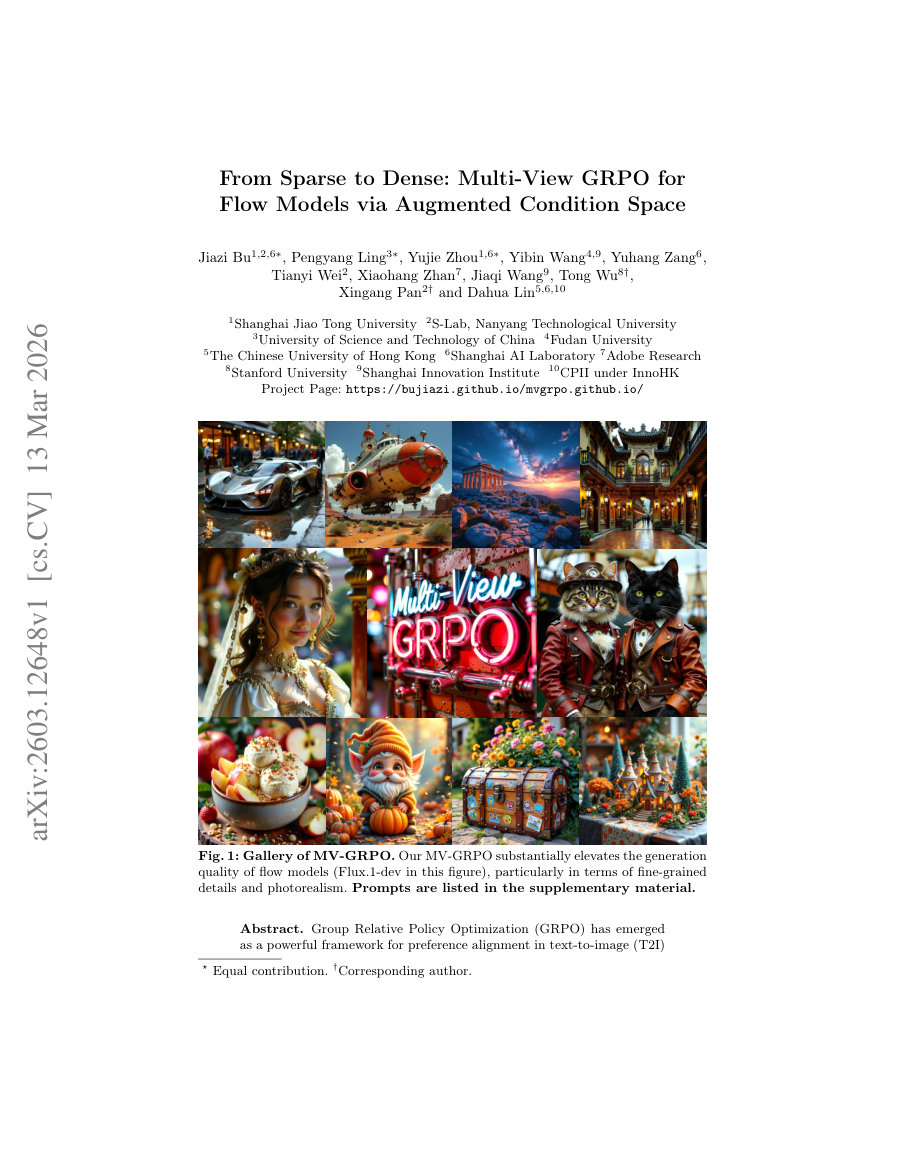
TL;DR: Multi-View GRPO enhances text-to-image flow model alignment by expanding condition space for richer reward mapping and improved sample relationship exploration.
Multi-View GRPO enhances text-to-image flow model alignment by expanding condition space for richer reward mapping and improved sample relationship exploration. Group Relative Policy Optimization (GRPO) has emerged as a powerful framework for preference alignment in...
93/100Rank #6Novelty 9Depth 10
Problem
Multi-View GRPO enhances text-to-image flow model alignment by expanding condition space for richer reward mapping and improved sample relationship exploration.
Method
To address this sparse single-view evaluation scheme, we propose Multi-View GRPO (MV-GRPO), a novel approach that enhances relationship exploration by augmenting the condition space to create a dense multi-view reward mapping .
Results
Multi-View GRPO enhances text-to-image flow model alignment by expanding condition space for richer reward mapping and improved sample relationship exploration.
Watch-outs
The summary does not include concrete numbers, so the practical size of the gain and the tradeoff against latency or data cost are still unclear.
Deep dive
Problem framing: Multi-View GRPO enhances text-to-image flow model alignment by expanding condition space for richer reward mapping and improved sample relationship exploration.
Method signal: To address this sparse single-view evaluation scheme, we propose Multi-View GRPO (MV-GRPO), a novel approach that enhances relationship exploration by augmenting the condition space to create a dense multi-view reward mapping .
Evidence to watch: Multi-View GRPO enhances text-to-image flow model alignment by expanding condition space for richer reward mapping and improved sample relationship exploration.
Read-through priority: the PDF is available, so this is a good candidate for checking tables, ablations, and scaling tradeoffs beyond the abstract from Hugging Face Papers / arXiv.
Technical takeaways
Problem: Multi-View GRPO enhances text-to-image flow model alignment by expanding condition space for richer reward mapping and improved sample relationship exploration.
Approach: To address this sparse single-view evaluation scheme, we propose Multi-View GRPO (MV-GRPO), a novel approach that enhances relationship exploration by augmenting the condition space to create a dense...
Result signal: Multi-View GRPO enhances text-to-image flow model alignment by expanding condition space for richer reward mapping and improved sample relationship exploration.
Community traction: Hugging Face Papers shows 3 votes for this paper.
Be skeptical about
The summary does not include concrete numbers, so the practical size of the gain and the tradeoff against latency or data cost are still unclear.
Paper briefHugging Face Papers / arXiv | 03/13/2026
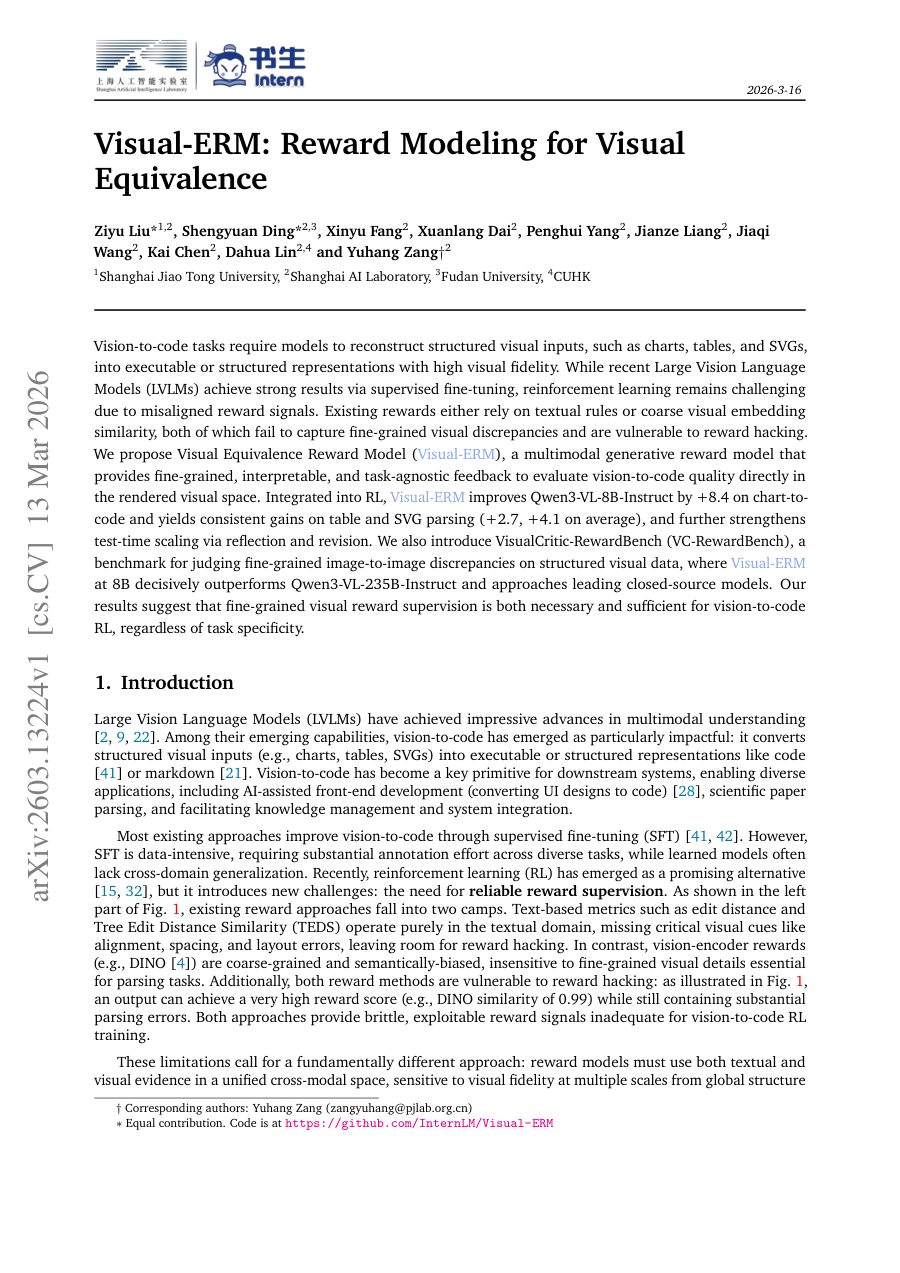
TL;DR: Visual-ERM, a multimodal generative reward model, provides fine-grained visual feedback for vision-to-code tasks, improving reinforcement learning performance and establishing a new benchmark for structured visual...
Visual-ERM, a multimodal generative reward model, provides fine-grained visual feedback for vision-to-code tasks, improving reinforcement learning performance and establishing a new benchmark for structured visual evaluation. Vision-to-code tasks require models to reconstruct...
83/100Rank #7Novelty 8Depth 9
Problem
Visual-ERM, a multimodal generative reward model, provides fine-grained visual feedback for vision-to-code tasks, improving reinforcement learning performance and establishing a new benchmark for structured visual evaluation.
Method
We propose Visual Equivalence Reward Model (Visual-ERM), a multimodal generative reward model that provides fine-grained, interpretable, and task-agnostic feedback to evaluate vision-to-code quality directly in the rendered visual space.
Results
Visual-ERM, a multimodal generative reward model, provides fine-grained visual feedback for vision-to-code tasks, improving reinforcement learning performance and establishing a new benchmark for structured visual evaluation.
Watch-outs
The summary does not include concrete numbers, so the practical size of the gain and the tradeoff against latency or data cost are still unclear.
Deep dive
Problem framing: Visual-ERM, a multimodal generative reward model, provides fine-grained visual feedback for vision-to-code tasks, improving reinforcement learning performance and establishing a new benchmark for structured visual evaluation.
Method signal: We propose Visual Equivalence Reward Model (Visual-ERM), a multimodal generative reward model that provides fine-grained, interpretable, and task-agnostic feedback to evaluate vision-to-code quality directly in the rendered visual space.
Evidence to watch: Visual-ERM, a multimodal generative reward model, provides fine-grained visual feedback for vision-to-code tasks, improving reinforcement learning performance and establishing a new benchmark for structured visual evaluation.
Read-through priority: the PDF is available, so this is a good candidate for checking tables, ablations, and scaling tradeoffs beyond the abstract from Hugging Face Papers / arXiv.
Technical takeaways
Problem: Visual-ERM, a multimodal generative reward model, provides fine-grained visual feedback for vision-to-code tasks, improving reinforcement learning performance and establishing a new benchmark for structured...
Approach: We propose Visual Equivalence Reward Model (Visual-ERM), a multimodal generative reward model that provides fine-grained, interpretable, and task-agnostic feedback to evaluate vision-to-code quality...
Result signal: Visual-ERM, a multimodal generative reward model, provides fine-grained visual feedback for vision-to-code tasks, improving reinforcement learning performance and establishing a new benchmark for...
Community traction: Hugging Face Papers shows 3 votes for this paper.
Be skeptical about
The summary does not include concrete numbers, so the practical size of the gain and the tradeoff against latency or data cost are still unclear.
Paper briefHugging Face Papers / arXiv | 03/13/2026
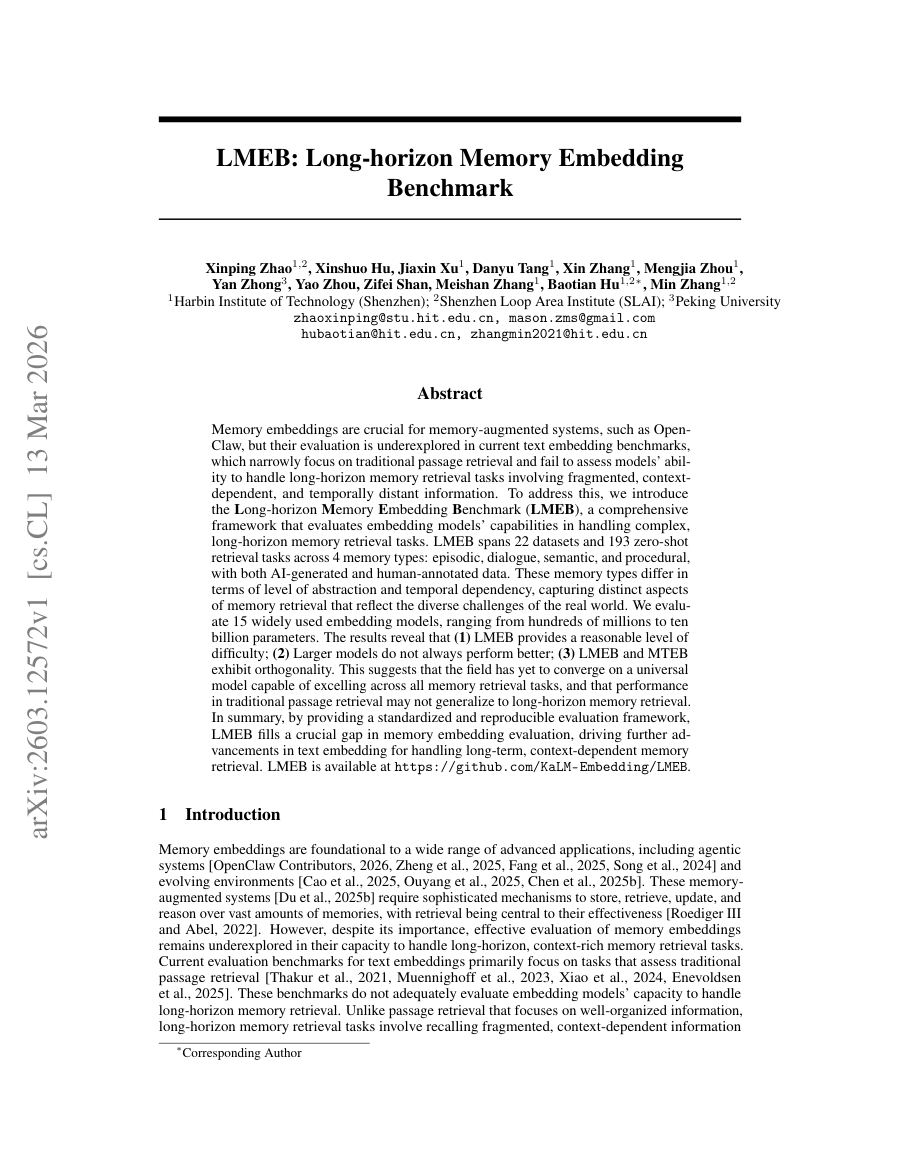
TL;DR: A new benchmark evaluates embedding models' ability to handle long-horizon memory retrieval tasks, revealing that performance in traditional passage retrieval does not generalize to complex memory retrieval scenarios.
A new benchmark evaluates embedding models' ability to handle long-horizon memory retrieval tasks, revealing that performance in traditional passage retrieval does not generalize to complex memory retrieval scenarios. Memory embeddings are crucial for memory-augmented systems...
76/100Rank #8Novelty 8Depth 8
Problem
A new benchmark evaluates embedding models' ability to handle long-horizon memory retrieval tasks, revealing that performance in traditional passage retrieval does not generalize to complex memory retrieval scenarios.
Method
To address this, we introduce the Long-horizon Memory Embedding Benchmark (LMEB), a comprehensive framework that evaluates embedding models ' capabilities in handling complex, long-horizon memory retrieval tasks.
Results
A new benchmark evaluates embedding models' ability to handle long-horizon memory retrieval tasks, revealing that performance in traditional passage retrieval does not generalize to complex memory retrieval scenarios.
Watch-outs
The summary does not include concrete numbers, so the practical size of the gain and the tradeoff against latency or data cost are still unclear.
Deep dive
Problem framing: A new benchmark evaluates embedding models' ability to handle long-horizon memory retrieval tasks, revealing that performance in traditional passage retrieval does not generalize to complex memory retrieval scenarios.
Method signal: To address this, we introduce the Long-horizon Memory Embedding Benchmark (LMEB), a comprehensive framework that evaluates embedding models ' capabilities in handling complex, long-horizon memory retrieval tasks.
Evidence to watch: A new benchmark evaluates embedding models' ability to handle long-horizon memory retrieval tasks, revealing that performance in traditional passage retrieval does not generalize to complex memory retrieval scenarios.
Read-through priority: the PDF is available, so this is a good candidate for checking tables, ablations, and scaling tradeoffs beyond the abstract from Hugging Face Papers / arXiv.
Technical takeaways
Problem: A new benchmark evaluates embedding models' ability to handle long-horizon memory retrieval tasks, revealing that performance in traditional passage retrieval does not generalize to complex memory retrieval...
Approach: To address this, we introduce the Long-horizon Memory Embedding Benchmark (LMEB), a comprehensive framework that evaluates embedding models ' capabilities in handling complex, long-horizon memory retrieval...
Result signal: A new benchmark evaluates embedding models' ability to handle long-horizon memory retrieval tasks, revealing that performance in traditional passage retrieval does not generalize to complex memory...
Community traction: Hugging Face Papers shows 14 votes for this paper.
Be skeptical about
The summary does not include concrete numbers, so the practical size of the gain and the tradeoff against latency or data cost are still unclear.
Paper briefHugging Face Papers / arXiv | 03/02/2026
TL;DR: SimRecon enables compositional scene reconstruction through a perception-generation-simulation pipeline with active viewpoint optimization and scene graph synthesizer modules to improve visual fidelity and physical...
SimRecon enables compositional scene reconstruction through a perception-generation-simulation pipeline with active viewpoint optimization and scene graph synthesizer modules to improve visual fidelity and physical plausibility. Compositional scene reconstruction seeks to...
70/100Rank #9Novelty 7Depth 8
Problem
However, naively combining these three stages leads to visual infidelity of generated assets and physical implausibility of the final scene, a problem particularly severe for complex scenes.
Method
In this paper, we propose SimRecon, a framework that realizes a "Perception-Generation-Simulation" pipeline towards cluttered scene reconstruction, which first conducts scene-level semantic reconstruction from video input, then performs single-object generation, and finally assembles these assets in the simulator.
Results
SimRecon enables compositional scene reconstruction through a perception-generation-simulation pipeline with active viewpoint optimization and scene graph synthesizer modules to improve visual fidelity and physical plausibility.
Watch-outs
The summary does not include concrete numbers, so the practical size of the gain and the tradeoff against latency or data cost are still unclear.
Deep dive
Problem framing: However, naively combining these three stages leads to visual infidelity of generated assets and physical implausibility of the final scene, a problem particularly severe for complex scenes.
Method signal: In this paper, we propose SimRecon, a framework that realizes a "Perception-Generation-Simulation" pipeline towards cluttered scene reconstruction, which first conducts scene-level semantic reconstruction from video input, then performs...
Evidence to watch: SimRecon enables compositional scene reconstruction through a perception-generation-simulation pipeline with active viewpoint optimization and scene graph synthesizer modules to improve visual fidelity and physical plausibility.
Read-through priority: the PDF is available, so this is a good candidate for checking tables, ablations, and scaling tradeoffs beyond the abstract from Hugging Face Papers / arXiv.
Technical takeaways
Problem: However, naively combining these three stages leads to visual infidelity of generated assets and physical implausibility of the final scene, a problem particularly severe for complex scenes.
Approach: In this paper, we propose SimRecon, a framework that realizes a "Perception-Generation-Simulation" pipeline towards cluttered scene reconstruction, which first conducts scene-level semantic reconstruction...
Result signal: SimRecon enables compositional scene reconstruction through a perception-generation-simulation pipeline with active viewpoint optimization and scene graph synthesizer modules to improve visual fidelity...
Community traction: Hugging Face Papers shows 2 votes for this paper.
Be skeptical about
The summary does not include concrete numbers, so the practical size of the gain and the tradeoff against latency or data cost are still unclear.
Full Feed
The complete analyzed stream for the run, useful when you want to scan everything instead of only the curated front page.
Luma AI's new Uni-1 image model tops Nano Banana 2 and GPT Image 1.5 on logic-based benchmarks the-decoder.com
67/100Rank #2Novelty 7Depth 7Previously covered
Why it matters
Luma AI's new Uni-1 image model tops Nano Banana 2 and GPT Image 1.5 on logic-based benchmarks matters because it signals momentum in benchmark, gpt, model and may shift how teams prioritize models, tooling, or deployment choices.
Technical takeaways
Primary signals: benchmark, gpt, model.
Source context: The Decoder published or updated this item on 03/08/2026.
NVIDIA AI Releases Nemotron-Terminal: A Systematic Data Engineering Pipeline for Scaling LLM Terminal Agents MarkTechPost
67/100Rank #3Novelty 7Depth 7Previously covered
Why it matters
NVIDIA AI Releases Nemotron-Terminal: A Systematic Data Engineering Pipeline for Scaling LLM Terminal Agents matters because it signals momentum in agent, agents, llm and may shift how teams prioritize models, tooling, or deployment choices.
Technical takeaways
Primary signals: agent, agents, llm.
Source context: MarkTechPost published or updated this item on 03/10/2026.
Managing the economics of multi-agent AI now dictates the financial viability of modern business automation workflows. Organisations progressing past standard chat interfaces into multi-agent applications face two primary constraints. The first issue is the thinking tax;...
63/100Rank #11Novelty 6Depth 7Previously covered
Why it matters
How multi-agent AI economics influence business automation matters because it signals momentum in agent, agents and may shift how teams prioritize models, tooling, or deployment choices.
Technical takeaways
Primary signals: agent, agents.
Source context: AI News published or updated this item on 03/12/2026.
China pushes OpenClaw "one-person companies" with millions in AI agent subsidies matters because it affects the policy, supply-chain, or security constraints around AI development, especially across china, agent.
Technical takeaways
Primary signals: china, agent.
Source context: The Decoder published or updated this item on 03/14/2026.
Europe’s factory floors have a new kind of colleague. BMW Group has deployed humanoid robots in manufacturing in Germany for the first time, launching a pilot project at its Leipzig plant with AEON–a wheeled humanoid built by Hexagon Robotics. It is the first automotive...
BMW puts humanoid robots to work in Germany–and Europe’s factories are watching matters because it affects the policy, supply-chain, or security constraints around AI development, especially across europe, robotics.
Technical takeaways
Primary signals: europe, robotics.
Source context: AI News published or updated this item on 03/13/2026.
A defense official reveals how AI chatbots could be used for targeting decisions matters because it affects the policy, supply-chain, or security constraints around AI development, especially across defense, chatbot.
Technical takeaways
Primary signals: defense, chatbot.
Source context: MIT Tech Review AI published or updated this item on 03/12/2026.
research paperHugging Face Papers / arXiv | 03/13/2026
TL;DR: Cheers is a unified multimodal model that decouples visual details from semantic representations using a vision tokenizer, LLM-based Transformer, and cascaded flow matching head to achieve efficient joint...
Cheers is a unified multimodal model that decouples visual details from semantic representations using a vision tokenizer, LLM-based Transformer, and cascaded flow matching head to achieve efficient joint optimization for both visual understanding and generation tasks. A...
96/100Rank #5Novelty 10Depth 10
Problem
Cheers is a unified multimodal model that decouples visual details from semantic representations using a vision tokenizer, LLM-based Transformer, and cascaded flow matching head to achieve efficient joint optimization for both visual understanding and...
Method
In this work, we present Cheers, a unified multimodal model that decouples patch-level details from semantic representations, thereby stabilizing semantics for multimodal understanding and improving fidelity for image generation via gated detail residuals.
Results
Cheers is a unified multimodal model that decouples visual details from semantic representations using a vision tokenizer, LLM-based Transformer, and cascaded flow matching head to achieve efficient joint optimization for both visual understanding and generation tasks.
Watch-outs
The summary does not include concrete numbers, so the practical size of the gain and the tradeoff against latency or data cost are still unclear.
Deep dive
Problem framing: Cheers is a unified multimodal model that decouples visual details from semantic representations using a vision tokenizer, LLM-based Transformer, and cascaded flow matching head to achieve efficient joint optimization for both visual...
Method signal: In this work, we present Cheers, a unified multimodal model that decouples patch-level details from semantic representations, thereby stabilizing semantics for multimodal understanding and improving fidelity for image generation via gated...
Evidence to watch: Cheers is a unified multimodal model that decouples visual details from semantic representations using a vision tokenizer, LLM-based Transformer, and cascaded flow matching head to achieve efficient joint optimization for both visual...
Read-through priority: the PDF is available, so this is a good candidate for checking tables, ablations, and scaling tradeoffs beyond the abstract from Hugging Face Papers / arXiv.
Technical takeaways
Problem: Cheers is a unified multimodal model that decouples visual details from semantic representations using a vision tokenizer, LLM-based Transformer, and cascaded flow matching head to achieve efficient joint...
Approach: In this work, we present Cheers, a unified multimodal model that decouples patch-level details from semantic representations, thereby stabilizing semantics for multimodal understanding and improving...
Result signal: Cheers is a unified multimodal model that decouples visual details from semantic representations using a vision tokenizer, LLM-based Transformer, and cascaded flow matching head to achieve efficient...
Community traction: Hugging Face Papers shows 2 votes for this paper.
Be skeptical about
The summary does not include concrete numbers, so the practical size of the gain and the tradeoff against latency or data cost are still unclear.
research paperHugging Face Papers / arXiv | 03/13/2026
TL;DR: Multi-View GRPO enhances text-to-image flow model alignment by expanding condition space for richer reward mapping and improved sample relationship exploration.
Multi-View GRPO enhances text-to-image flow model alignment by expanding condition space for richer reward mapping and improved sample relationship exploration. Group Relative Policy Optimization (GRPO) has emerged as a powerful framework for preference alignment in...
93/100Rank #6Novelty 9Depth 10
Problem
Multi-View GRPO enhances text-to-image flow model alignment by expanding condition space for richer reward mapping and improved sample relationship exploration.
Method
To address this sparse single-view evaluation scheme, we propose Multi-View GRPO (MV-GRPO), a novel approach that enhances relationship exploration by augmenting the condition space to create a dense multi-view reward mapping .
Results
Multi-View GRPO enhances text-to-image flow model alignment by expanding condition space for richer reward mapping and improved sample relationship exploration.
Watch-outs
The summary does not include concrete numbers, so the practical size of the gain and the tradeoff against latency or data cost are still unclear.
Deep dive
Problem framing: Multi-View GRPO enhances text-to-image flow model alignment by expanding condition space for richer reward mapping and improved sample relationship exploration.
Method signal: To address this sparse single-view evaluation scheme, we propose Multi-View GRPO (MV-GRPO), a novel approach that enhances relationship exploration by augmenting the condition space to create a dense multi-view reward mapping .
Evidence to watch: Multi-View GRPO enhances text-to-image flow model alignment by expanding condition space for richer reward mapping and improved sample relationship exploration.
Read-through priority: the PDF is available, so this is a good candidate for checking tables, ablations, and scaling tradeoffs beyond the abstract from Hugging Face Papers / arXiv.
Technical takeaways
Problem: Multi-View GRPO enhances text-to-image flow model alignment by expanding condition space for richer reward mapping and improved sample relationship exploration.
Approach: To address this sparse single-view evaluation scheme, we propose Multi-View GRPO (MV-GRPO), a novel approach that enhances relationship exploration by augmenting the condition space to create a dense...
Result signal: Multi-View GRPO enhances text-to-image flow model alignment by expanding condition space for richer reward mapping and improved sample relationship exploration.
Community traction: Hugging Face Papers shows 3 votes for this paper.
Be skeptical about
The summary does not include concrete numbers, so the practical size of the gain and the tradeoff against latency or data cost are still unclear.
research paperHugging Face Papers / arXiv | 03/13/2026
TL;DR: Visual-ERM, a multimodal generative reward model, provides fine-grained visual feedback for vision-to-code tasks, improving reinforcement learning performance and establishing a new benchmark for structured visual...
Visual-ERM, a multimodal generative reward model, provides fine-grained visual feedback for vision-to-code tasks, improving reinforcement learning performance and establishing a new benchmark for structured visual evaluation. Vision-to-code tasks require models to reconstruct...
83/100Rank #7Novelty 8Depth 9
Problem
Visual-ERM, a multimodal generative reward model, provides fine-grained visual feedback for vision-to-code tasks, improving reinforcement learning performance and establishing a new benchmark for structured visual evaluation.
Method
We propose Visual Equivalence Reward Model (Visual-ERM), a multimodal generative reward model that provides fine-grained, interpretable, and task-agnostic feedback to evaluate vision-to-code quality directly in the rendered visual space.
Results
Visual-ERM, a multimodal generative reward model, provides fine-grained visual feedback for vision-to-code tasks, improving reinforcement learning performance and establishing a new benchmark for structured visual evaluation.
Watch-outs
The summary does not include concrete numbers, so the practical size of the gain and the tradeoff against latency or data cost are still unclear.
Deep dive
Problem framing: Visual-ERM, a multimodal generative reward model, provides fine-grained visual feedback for vision-to-code tasks, improving reinforcement learning performance and establishing a new benchmark for structured visual evaluation.
Method signal: We propose Visual Equivalence Reward Model (Visual-ERM), a multimodal generative reward model that provides fine-grained, interpretable, and task-agnostic feedback to evaluate vision-to-code quality directly in the rendered visual space.
Evidence to watch: Visual-ERM, a multimodal generative reward model, provides fine-grained visual feedback for vision-to-code tasks, improving reinforcement learning performance and establishing a new benchmark for structured visual evaluation.
Read-through priority: the PDF is available, so this is a good candidate for checking tables, ablations, and scaling tradeoffs beyond the abstract from Hugging Face Papers / arXiv.
Technical takeaways
Problem: Visual-ERM, a multimodal generative reward model, provides fine-grained visual feedback for vision-to-code tasks, improving reinforcement learning performance and establishing a new benchmark for structured...
Approach: We propose Visual Equivalence Reward Model (Visual-ERM), a multimodal generative reward model that provides fine-grained, interpretable, and task-agnostic feedback to evaluate vision-to-code quality...
Result signal: Visual-ERM, a multimodal generative reward model, provides fine-grained visual feedback for vision-to-code tasks, improving reinforcement learning performance and establishing a new benchmark for...
Community traction: Hugging Face Papers shows 3 votes for this paper.
Be skeptical about
The summary does not include concrete numbers, so the practical size of the gain and the tradeoff against latency or data cost are still unclear.
research paperHugging Face Papers / arXiv | 03/13/2026
TL;DR: A new benchmark evaluates embedding models' ability to handle long-horizon memory retrieval tasks, revealing that performance in traditional passage retrieval does not generalize to complex memory retrieval scenarios.
A new benchmark evaluates embedding models' ability to handle long-horizon memory retrieval tasks, revealing that performance in traditional passage retrieval does not generalize to complex memory retrieval scenarios. Memory embeddings are crucial for memory-augmented systems...
76/100Rank #8Novelty 8Depth 8
Problem
A new benchmark evaluates embedding models' ability to handle long-horizon memory retrieval tasks, revealing that performance in traditional passage retrieval does not generalize to complex memory retrieval scenarios.
Method
To address this, we introduce the Long-horizon Memory Embedding Benchmark (LMEB), a comprehensive framework that evaluates embedding models ' capabilities in handling complex, long-horizon memory retrieval tasks.
Results
A new benchmark evaluates embedding models' ability to handle long-horizon memory retrieval tasks, revealing that performance in traditional passage retrieval does not generalize to complex memory retrieval scenarios.
Watch-outs
The summary does not include concrete numbers, so the practical size of the gain and the tradeoff against latency or data cost are still unclear.
Deep dive
Problem framing: A new benchmark evaluates embedding models' ability to handle long-horizon memory retrieval tasks, revealing that performance in traditional passage retrieval does not generalize to complex memory retrieval scenarios.
Method signal: To address this, we introduce the Long-horizon Memory Embedding Benchmark (LMEB), a comprehensive framework that evaluates embedding models ' capabilities in handling complex, long-horizon memory retrieval tasks.
Evidence to watch: A new benchmark evaluates embedding models' ability to handle long-horizon memory retrieval tasks, revealing that performance in traditional passage retrieval does not generalize to complex memory retrieval scenarios.
Read-through priority: the PDF is available, so this is a good candidate for checking tables, ablations, and scaling tradeoffs beyond the abstract from Hugging Face Papers / arXiv.
Technical takeaways
Problem: A new benchmark evaluates embedding models' ability to handle long-horizon memory retrieval tasks, revealing that performance in traditional passage retrieval does not generalize to complex memory retrieval...
Approach: To address this, we introduce the Long-horizon Memory Embedding Benchmark (LMEB), a comprehensive framework that evaluates embedding models ' capabilities in handling complex, long-horizon memory retrieval...
Result signal: A new benchmark evaluates embedding models' ability to handle long-horizon memory retrieval tasks, revealing that performance in traditional passage retrieval does not generalize to complex memory...
Community traction: Hugging Face Papers shows 14 votes for this paper.
Be skeptical about
The summary does not include concrete numbers, so the practical size of the gain and the tradeoff against latency or data cost are still unclear.
research paperHugging Face Papers / arXiv | 03/02/2026
TL;DR: SimRecon enables compositional scene reconstruction through a perception-generation-simulation pipeline with active viewpoint optimization and scene graph synthesizer modules to improve visual fidelity and physical...
SimRecon enables compositional scene reconstruction through a perception-generation-simulation pipeline with active viewpoint optimization and scene graph synthesizer modules to improve visual fidelity and physical plausibility. Compositional scene reconstruction seeks to...
70/100Rank #9Novelty 7Depth 8
Problem
However, naively combining these three stages leads to visual infidelity of generated assets and physical implausibility of the final scene, a problem particularly severe for complex scenes.
Method
In this paper, we propose SimRecon, a framework that realizes a "Perception-Generation-Simulation" pipeline towards cluttered scene reconstruction, which first conducts scene-level semantic reconstruction from video input, then performs single-object generation, and finally assembles these assets in the simulator.
Results
SimRecon enables compositional scene reconstruction through a perception-generation-simulation pipeline with active viewpoint optimization and scene graph synthesizer modules to improve visual fidelity and physical plausibility.
Watch-outs
The summary does not include concrete numbers, so the practical size of the gain and the tradeoff against latency or data cost are still unclear.
Deep dive
Problem framing: However, naively combining these three stages leads to visual infidelity of generated assets and physical implausibility of the final scene, a problem particularly severe for complex scenes.
Method signal: In this paper, we propose SimRecon, a framework that realizes a "Perception-Generation-Simulation" pipeline towards cluttered scene reconstruction, which first conducts scene-level semantic reconstruction from video input, then performs...
Evidence to watch: SimRecon enables compositional scene reconstruction through a perception-generation-simulation pipeline with active viewpoint optimization and scene graph synthesizer modules to improve visual fidelity and physical plausibility.
Read-through priority: the PDF is available, so this is a good candidate for checking tables, ablations, and scaling tradeoffs beyond the abstract from Hugging Face Papers / arXiv.
Technical takeaways
Problem: However, naively combining these three stages leads to visual infidelity of generated assets and physical implausibility of the final scene, a problem particularly severe for complex scenes.
Approach: In this paper, we propose SimRecon, a framework that realizes a "Perception-Generation-Simulation" pipeline towards cluttered scene reconstruction, which first conducts scene-level semantic reconstruction...
Result signal: SimRecon enables compositional scene reconstruction through a perception-generation-simulation pipeline with active viewpoint optimization and scene graph synthesizer modules to improve visual fidelity...
Community traction: Hugging Face Papers shows 2 votes for this paper.
Be skeptical about
The summary does not include concrete numbers, so the practical size of the gain and the tradeoff against latency or data cost are still unclear.