Daily Edition
The expanded edition keeps the full analyst notes, paper breakdowns, geopolitical framing, and the complete feed selected into this run.
Topic of the day.
A dedicated daily topic chosen from the strongest signals in the run, with TL;DR, why-now framing, and a fuller analyst read.
FASTER: Rethinking Real-Time Flow VLAs
TL;DR: FASTER introduces a Horizon-Aware Schedule that compresses denoising steps for immediate actions in Vision-Language-Action models, reducing reaction latency tenfold while preserving long-horizon trajectory quality.
Why now: As robots and autonomous systems demand real-time responsiveness, existing VLA inference methods overlook critical latency in reacting to environmental changes, creating a bottleneck for deployment.
FASTER redefines reaction time as a function of Time to First Action and execution horizon, showing uniform distribution. By prioritizing near-term actions during flow sampling, the method compresses the denoising of immediate reaction into a single step. A streaming client-server pipeline enables deployment on consumer-grade GPUs, demonstrated on a dynamic table tennis task. The approach maintains trajectory smoothness and long-horizon quality, addressing the trade-off between latency and fidelity.
- Reaction time follows a uniform distribution
- How we monitor internal coding agents for misalignment (OpenAI Research | 03/19/2026)
- Google Colab Now Has an Open-Source MCP (Model Context Protocol) Server: Use Colab Runtimes with GPUs from Any Local AI Agent (MarkTechPost | 03/19/2026)
- Build a Domain-Specific Embedding Model in Under a Day (Hugging Face Blog | 03/20/2026)
Policy, chips, capital, and power.
Industrial strategy, compute supply, export controls, and big-company positioning shaping the AI balance of power.

Mastercard keeps tabs on fraud with new foundation model
Mastercard has developed a large tabular model (an LTM as opposed to an LLM) that’s trained on transaction data rather than text or images to help it address security and authenticity issues in digital payments. The company has trained a foundation model on billions of card...
Mastercard keeps tabs on fraud with new foundation model matters because it affects the policy, supply-chain, or security constraints around AI development, especially across security, foundation, llm.
- Primary signals: security, foundation, llm.
- Source context: AI News published or updated this item on 03/18/2026.
China pushes OpenClaw "one-person companies" with millions in AI agent subsidies
China pushes OpenClaw "one-person companies" with millions in AI agent subsidies the-decoder.com
China pushes OpenClaw "one-person companies" with millions in AI agent subsidies matters because it affects the policy, supply-chain, or security constraints around AI development, especially across china, agent.
- Primary signals: china, agent.
- Source context: The Decoder published or updated this item on 03/14/2026.
The Pentagon is planning for AI companies to train on classified data, defense official says
The Pentagon is planning for AI companies to train on classified data, defense official says MIT Technology Review
The Pentagon is planning for AI companies to train on classified data, defense official says matters because it affects the policy, supply-chain, or security constraints around AI development, especially across defense.
- Primary signals: defense.
- Source context: MIT Tech Review AI published or updated this item on 03/17/2026.
Product, model, and platform movement.
Software, model, deployment, and competitive stories with the strongest operator and market signal in this edition.
How we monitor internal coding agents for misalignment
How we monitor internal coding agents for misalignment OpenAI
How we monitor internal coding agents for misalignment matters because it signals momentum in agent, agents, alignment and may shift how teams prioritize models, tooling, or deployment choices.
- Primary signals: agent, agents, alignment.
- Source context: OpenAI Research published or updated this item on 03/19/2026.
Google Colab Now Has an Open-Source MCP (Model Context Protocol) Server: Use Colab Runtimes with GPUs from Any Local AI Agent
Google Colab Now Has an Open-Source MCP (Model Context Protocol) Server: Use Colab Runtimes with GPUs from Any Local AI Agent MarkTechPost
Google Colab Now Has an Open-Source MCP (Model Context Protocol) Server: Use Colab Runtimes with GPUs from Any Local AI Agent matters because it signals momentum in agent, model and may shift how teams prioritize models, tooling, or deployment choices.
- Primary signals: agent, model.
- Source context: MarkTechPost published or updated this item on 03/19/2026.

Build a Domain-Specific Embedding Model in Under a Day
A Blog post by NVIDIA on Hugging Face
Build a Domain-Specific Embedding Model in Under a Day matters because it signals momentum in model and may shift how teams prioritize models, tooling, or deployment choices.
- Primary signals: model.
- Source context: Hugging Face Blog published or updated this item on 03/20/2026.
2025 Coding Agent Benchmark: Real-World Test of 15 AI Developer Tools
2025 Coding Agent Benchmark: Real-World Test of 15 AI Developer Tools Turing Post
2025 Coding Agent Benchmark: Real-World Test of 15 AI Developer Tools matters because it signals momentum in agent, benchmark and may shift how teams prioritize models, tooling, or deployment choices.
- Primary signals: agent, benchmark.
- Source context: Turing Post published or updated this item on 02/27/2026.
OpenAI is throwing everything into building a fully automated researcher
OpenAI is throwing everything into building a fully automated researcher MIT Technology Review
OpenAI is throwing everything into building a fully automated researcher matters because it signals momentum in the broader AI ecosystem and may shift how teams prioritize models, tooling, or deployment choices.
- Primary signals: AI platforms and product execution.
- Source context: MIT Tech Review AI published or updated this item on 03/20/2026.
Differentiated source coverage.
Stories drawn from research blogs, first-party lab posts, practitioner newsletters, and selected technical outlets so the edition does not mirror the same headline across every source.

What's New in Mellea 0.4.0 + Granite Libraries Release
A Blog post by IBM Granite on Hugging Face
What's New in Mellea 0.4.0 + Granite Libraries Release matters because it signals momentum in the broader AI ecosystem and may shift how teams prioritize models, tooling, or deployment choices.
- Primary signals: AI platforms and product execution.
- Source context: Hugging Face Blog published or updated this item on 03/20/2026.
OpenAI Model Craft: Parameter Golf
OpenAI Model Craft: Parameter Golf OpenAI
OpenAI Model Craft: Parameter Golf matters because it signals momentum in model and may shift how teams prioritize models, tooling, or deployment choices.
- Primary signals: model.
- Source context: OpenAI Research published or updated this item on 03/18/2026.
The persona selection model
The persona selection model Anthropic
The persona selection model matters because it signals momentum in model and may shift how teams prioritize models, tooling, or deployment choices.
- Primary signals: model.
- Source context: Anthropic Research published or updated this item on 02/23/2026.
Google Colab Now Has an Open-Source MCP (Model Context Protocol) Server: Use Colab Runtimes with GPUs from Any Local AI Agent
Google Colab Now Has an Open-Source MCP (Model Context Protocol) Server: Use Colab Runtimes with GPUs from Any Local AI Agent MarkTechPost
Google Colab Now Has an Open-Source MCP (Model Context Protocol) Server: Use Colab Runtimes with GPUs from Any Local AI Agent matters because it signals momentum in agent, model and may shift how teams prioritize models, tooling, or deployment choices.
- Primary signals: agent, model.
- Source context: MarkTechPost published or updated this item on 03/19/2026.

For effective AI, insurance needs to get its data house in order
A report from Autorek, a provider of AI solutions to the insurance industry has produced a report that describes operational drag in companies’ internal processes that not only affect overall efficiency but cause an impediment to the effective implementation of AI in...
For effective AI, insurance needs to get its data house in order matters because it signals momentum in the broader AI ecosystem and may shift how teams prioritize models, tooling, or deployment choices.
- Primary signals: AI platforms and product execution.
- Source context: AI News published or updated this item on 03/18/2026.
AI Big Bang: NVIDIA CEO Forecasts US$1tn in Revenue by 2027
AI Big Bang: NVIDIA CEO Forecasts US$1tn in Revenue by 2027 AI Magazine
AI Big Bang: NVIDIA CEO Forecasts US$1tn in Revenue by 2027 matters because it signals momentum in the broader AI ecosystem and may shift how teams prioritize models, tooling, or deployment choices.
- Primary signals: AI platforms and product execution.
- Source context: AI Magazine published or updated this item on 03/18/2026.
Where OpenAI’s technology could show up in Iran
Where OpenAI’s technology could show up in Iran MIT Technology Review
Where OpenAI’s technology could show up in Iran matters because it signals momentum in the broader AI ecosystem and may shift how teams prioritize models, tooling, or deployment choices.
- Primary signals: AI platforms and product execution.
- Source context: MIT Tech Review AI published or updated this item on 03/16/2026.
2025 Coding Agent Benchmark: Real-World Test of 15 AI Developer Tools
2025 Coding Agent Benchmark: Real-World Test of 15 AI Developer Tools Turing Post
2025 Coding Agent Benchmark: Real-World Test of 15 AI Developer Tools matters because it signals momentum in agent, benchmark and may shift how teams prioritize models, tooling, or deployment choices.
- Primary signals: agent, benchmark.
- Source context: Turing Post published or updated this item on 02/27/2026.
Method, limitations, and results.
Paper summaries, methodology notes, limitations, and deep-dive bullets for the research items selected into the digest.
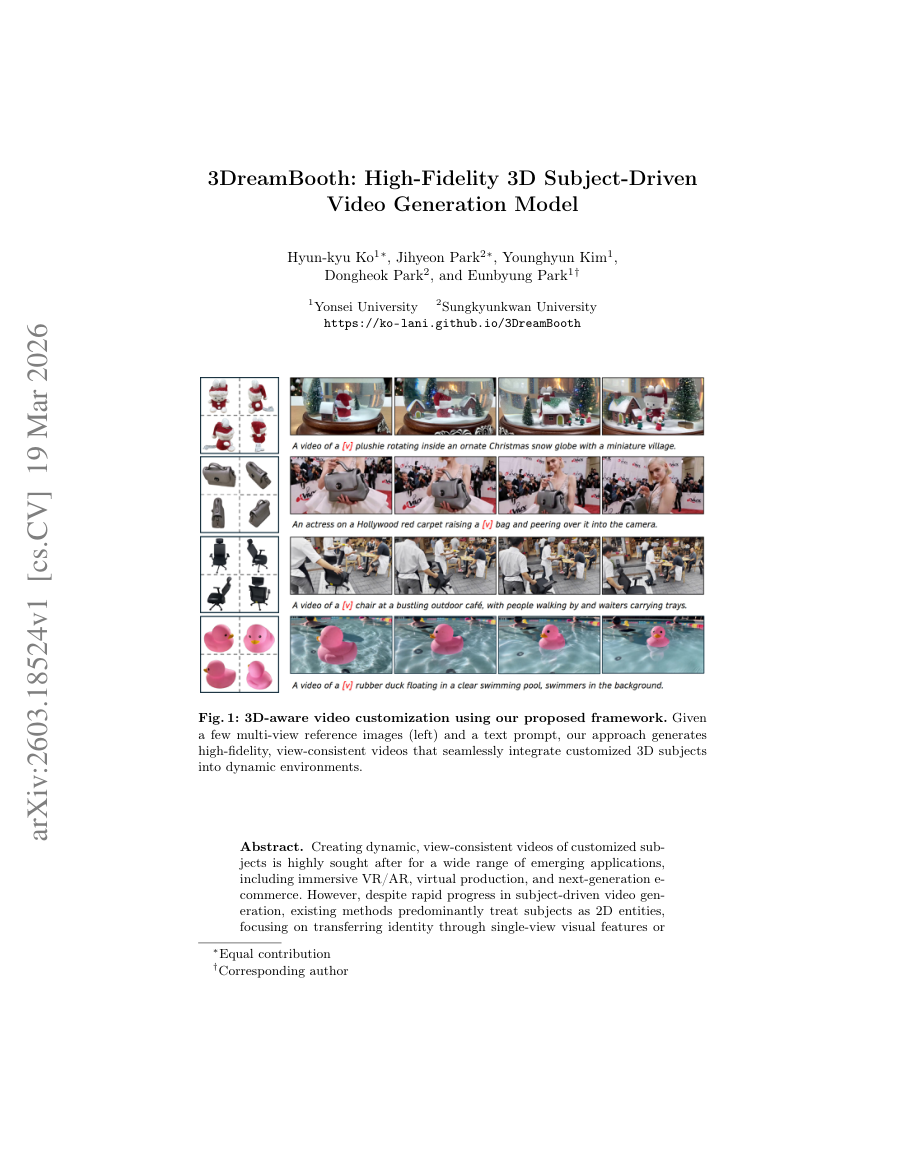
3DreamBooth: High-Fidelity 3D Subject-Driven Video Generation Model
TL;DR: A novel 3D-aware video customization framework is presented that decouples spatial geometry from temporal motion using a 1-frame optimization approach and incorporates a visual conditioning module for enhanced...
A novel 3D-aware video customization framework is presented that decouples spatial geometry from temporal motion using a 1-frame optimization approach and incorporates a visual conditioning module for enhanced texture generation. Creating dynamic, view-consistent videos of...
A novel 3D-aware video customization framework is presented that decouples spatial geometry from temporal motion using a 1-frame optimization approach and incorporates a visual conditioning module for enhanced texture generation.
To resolve these issues, we introduce a novel framework for 3D-aware video customization , comprising 3DreamBooth and 3Dapter .
Because real-world subjects are inherently 3D, applying these 2D-centric approaches to 3D object customization reveals a fundamental limitation: they lack the comprehensive spatial priors necessary to reconstruct the 3D geometry.
The reported improvement still needs a closer check on benchmark scope, ablations, and whether the method keeps working outside the authors' evaluation setup.
- Problem framing: A novel 3D-aware video customization framework is presented that decouples spatial geometry from temporal motion using a 1-frame optimization approach and incorporates a visual conditioning module for enhanced texture generation.
- Method signal: To resolve these issues, we introduce a novel framework for 3D-aware video customization , comprising 3DreamBooth and 3Dapter .
- Evidence to watch: Because real-world subjects are inherently 3D, applying these 2D-centric approaches to 3D object customization reveals a fundamental limitation: they lack the comprehensive spatial priors necessary to reconstruct the 3D geometry.
- Read-through priority: the PDF is available, so this is a good candidate for checking tables, ablations, and scaling tradeoffs beyond the abstract from Hugging Face Papers / arXiv.
- Problem: A novel 3D-aware video customization framework is presented that decouples spatial geometry from temporal motion using a 1-frame optimization approach and incorporates a visual conditioning module for...
- Approach: To resolve these issues, we introduce a novel framework for 3D-aware video customization , comprising 3DreamBooth and 3Dapter .
- Result signal: Because real-world subjects are inherently 3D, applying these 2D-centric approaches to 3D object customization reveals a fundamental limitation: they lack the comprehensive spatial priors necessary to...
- Community traction: Hugging Face Papers shows 41 votes for this paper.
- The reported improvement still needs a closer check on benchmark scope, ablations, and whether the method keeps working outside the authors' evaluation setup.
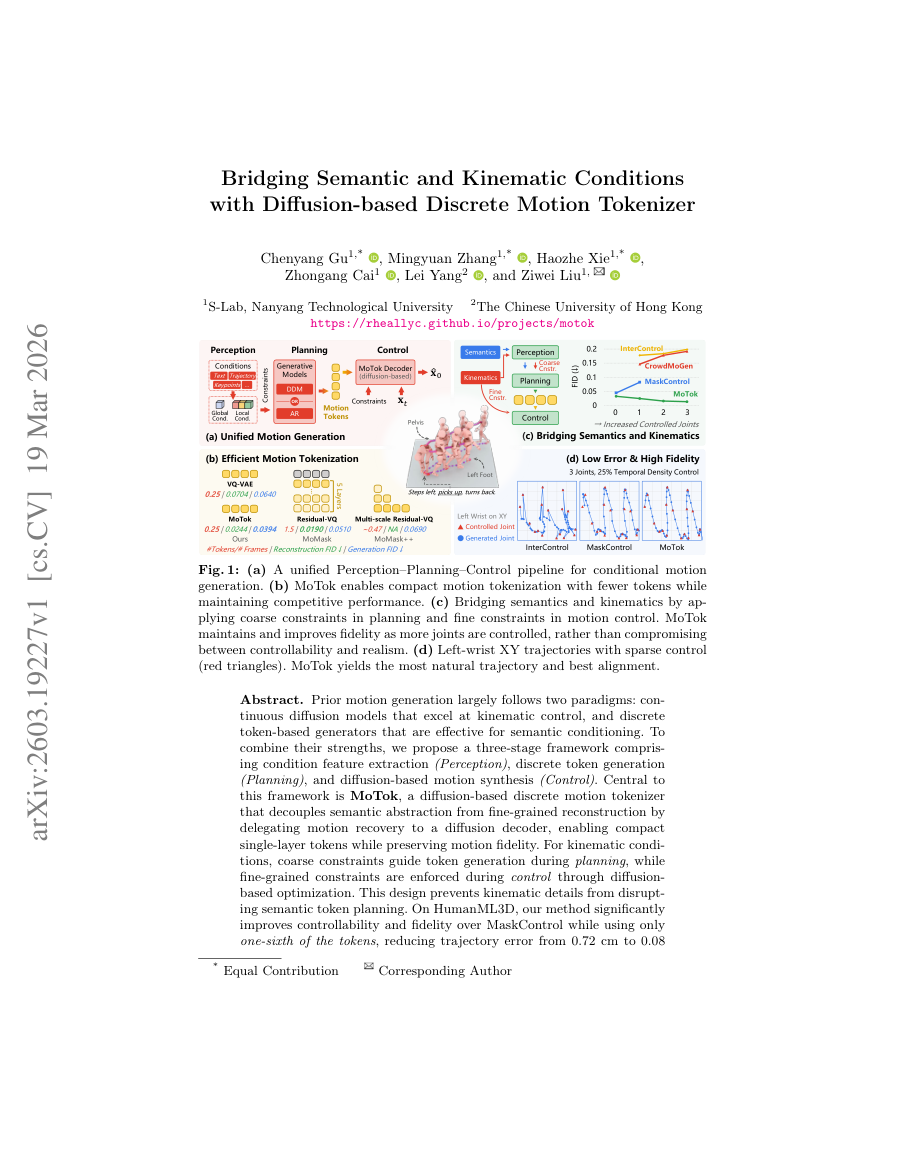
Bridging Semantic and Kinematic Conditions with Diffusion-based Discrete Motion Tokenizer
TL;DR: A three-stage motion generation framework combines discrete token-based planning with diffusion-based synthesis to improve controllability and fidelity while reducing token usage and computational requirements.
A three-stage motion generation framework combines discrete token-based planning with diffusion-based synthesis to improve controllability and fidelity while reducing token usage and computational requirements. Prior motion generation largely follows two paradigms: continuous...
A three-stage motion generation framework combines discrete token-based planning with diffusion-based synthesis to improve controllability and fidelity while reducing token usage and computational requirements.
To combine their strengths, we propose a three-stage framework comprising condition feature extraction (Perception), discrete token generation (Planning), and diffusion-based motion synthesis (Control).
A three-stage motion generation framework combines discrete token-based planning with diffusion-based synthesis to improve controllability and fidelity while reducing token usage and computational requirements.
The summary does not include concrete numbers, so the practical size of the gain and the tradeoff against latency or data cost are still unclear.
- Problem framing: A three-stage motion generation framework combines discrete token-based planning with diffusion-based synthesis to improve controllability and fidelity while reducing token usage and computational requirements.
- Method signal: To combine their strengths, we propose a three-stage framework comprising condition feature extraction (Perception), discrete token generation (Planning), and diffusion-based motion synthesis (Control).
- Evidence to watch: A three-stage motion generation framework combines discrete token-based planning with diffusion-based synthesis to improve controllability and fidelity while reducing token usage and computational requirements.
- Read-through priority: the PDF is available, so this is a good candidate for checking tables, ablations, and scaling tradeoffs beyond the abstract from Hugging Face Papers / arXiv.
- Problem: A three-stage motion generation framework combines discrete token-based planning with diffusion-based synthesis to improve controllability and fidelity while reducing token usage and computational requirements.
- Approach: To combine their strengths, we propose a three-stage framework comprising condition feature extraction (Perception), discrete token generation (Planning), and diffusion-based motion synthesis (Control).
- Result signal: A three-stage motion generation framework combines discrete token-based planning with diffusion-based synthesis to improve controllability and fidelity while reducing token usage and computational...
- Community traction: Hugging Face Papers shows 34 votes for this paper.
- The summary does not include concrete numbers, so the practical size of the gain and the tradeoff against latency or data cost are still unclear.
Everything selected into the run.
The complete analyzed stream for the issue, useful when you want to scan the entire run instead of only the curated front page.
How we monitor internal coding agents for misalignment
How we monitor internal coding agents for misalignment OpenAI
How we monitor internal coding agents for misalignment matters because it signals momentum in agent, agents, alignment and may shift how teams prioritize models, tooling, or deployment choices.
- Primary signals: agent, agents, alignment.
- Source context: OpenAI Research published or updated this item on 03/19/2026.
Google Colab Now Has an Open-Source MCP (Model Context Protocol) Server: Use Colab Runtimes with GPUs from Any Local AI Agent
Google Colab Now Has an Open-Source MCP (Model Context Protocol) Server: Use Colab Runtimes with GPUs from Any Local AI Agent MarkTechPost
Google Colab Now Has an Open-Source MCP (Model Context Protocol) Server: Use Colab Runtimes with GPUs from Any Local AI Agent matters because it signals momentum in agent, model and may shift how teams prioritize models, tooling, or deployment choices.
- Primary signals: agent, model.
- Source context: MarkTechPost published or updated this item on 03/19/2026.
Build a Domain-Specific Embedding Model in Under a Day
A Blog post by NVIDIA on Hugging Face
Build a Domain-Specific Embedding Model in Under a Day matters because it signals momentum in model and may shift how teams prioritize models, tooling, or deployment choices.
- Primary signals: model.
- Source context: Hugging Face Blog published or updated this item on 03/20/2026.
2025 Coding Agent Benchmark: Real-World Test of 15 AI Developer Tools
2025 Coding Agent Benchmark: Real-World Test of 15 AI Developer Tools Turing Post
2025 Coding Agent Benchmark: Real-World Test of 15 AI Developer Tools matters because it signals momentum in agent, benchmark and may shift how teams prioritize models, tooling, or deployment choices.
- Primary signals: agent, benchmark.
- Source context: Turing Post published or updated this item on 02/27/2026.
OpenAI is throwing everything into building a fully automated researcher
OpenAI is throwing everything into building a fully automated researcher MIT Technology Review
OpenAI is throwing everything into building a fully automated researcher matters because it signals momentum in the broader AI ecosystem and may shift how teams prioritize models, tooling, or deployment choices.
- Primary signals: AI platforms and product execution.
- Source context: MIT Tech Review AI published or updated this item on 03/20/2026.
What's New in Mellea 0.4.0 + Granite Libraries Release
A Blog post by IBM Granite on Hugging Face
What's New in Mellea 0.4.0 + Granite Libraries Release matters because it signals momentum in the broader AI ecosystem and may shift how teams prioritize models, tooling, or deployment choices.
- Primary signals: AI platforms and product execution.
- Source context: Hugging Face Blog published or updated this item on 03/20/2026.
OpenAI Model Craft: Parameter Golf
OpenAI Model Craft: Parameter Golf OpenAI
OpenAI Model Craft: Parameter Golf matters because it signals momentum in model and may shift how teams prioritize models, tooling, or deployment choices.
- Primary signals: model.
- Source context: OpenAI Research published or updated this item on 03/18/2026.
The persona selection model
The persona selection model Anthropic
The persona selection model matters because it signals momentum in model and may shift how teams prioritize models, tooling, or deployment choices.
- Primary signals: model.
- Source context: Anthropic Research published or updated this item on 02/23/2026.
AI Big Bang: NVIDIA CEO Forecasts US$1tn in Revenue by 2027
AI Big Bang: NVIDIA CEO Forecasts US$1tn in Revenue by 2027 AI Magazine
AI Big Bang: NVIDIA CEO Forecasts US$1tn in Revenue by 2027 matters because it signals momentum in the broader AI ecosystem and may shift how teams prioritize models, tooling, or deployment choices.
- Primary signals: AI platforms and product execution.
- Source context: AI Magazine published or updated this item on 03/18/2026.
For effective AI, insurance needs to get its data house in order
A report from Autorek, a provider of AI solutions to the insurance industry has produced a report that describes operational drag in companies’ internal processes that not only affect overall efficiency but cause an impediment to the effective implementation of AI in...
For effective AI, insurance needs to get its data house in order matters because it signals momentum in the broader AI ecosystem and may shift how teams prioritize models, tooling, or deployment choices.
- Primary signals: AI platforms and product execution.
- Source context: AI News published or updated this item on 03/18/2026.
How Apple's US$600bn US Investment Helps AI Infrastructure
How Apple's US$600bn US Investment Helps AI Infrastructure AI Magazine
How Apple's US$600bn US Investment Helps AI Infrastructure matters because it signals momentum in the broader AI ecosystem and may shift how teams prioritize models, tooling, or deployment choices.
- Primary signals: AI platforms and product execution.
- Source context: AI Magazine published or updated this item on 03/18/2026.
Societal Impacts Research
Societal Impacts Research Anthropic
Societal Impacts Research matters because it signals momentum in the broader AI ecosystem and may shift how teams prioritize models, tooling, or deployment choices.
- Primary signals: AI platforms and product execution.
- Source context: Anthropic Research published or updated this item on 03/18/2026.
Top 10: AI Platforms for Retail
Top 10: AI Platforms for Retail AI Magazine
Top 10: AI Platforms for Retail matters because it signals momentum in the broader AI ecosystem and may shift how teams prioritize models, tooling, or deployment choices.
- Primary signals: AI platforms and product execution.
- Source context: AI Magazine published or updated this item on 03/18/2026.
OpenAI to acquire Promptfoo
OpenAI to acquire Promptfoo OpenAI
OpenAI to acquire Promptfoo matters because it signals momentum in the broader AI ecosystem and may shift how teams prioritize models, tooling, or deployment choices.
- Primary signals: AI platforms and product execution.
- Source context: OpenAI Research published or updated this item on 03/09/2026.
Where OpenAI’s technology could show up in Iran
Where OpenAI’s technology could show up in Iran MIT Technology Review
Where OpenAI’s technology could show up in Iran matters because it signals momentum in the broader AI ecosystem and may shift how teams prioritize models, tooling, or deployment choices.
- Primary signals: AI platforms and product execution.
- Source context: MIT Tech Review AI published or updated this item on 03/16/2026.
Could Bumble’s Bee AI End 'Swiping Fatigue' on Dating Apps?
Could Bumble’s Bee AI End 'Swiping Fatigue' on Dating Apps? AI Magazine
Could Bumble’s Bee AI End 'Swiping Fatigue' on Dating Apps? matters because it signals momentum in the broader AI ecosystem and may shift how teams prioritize models, tooling, or deployment choices.
- Primary signals: AI platforms and product execution.
- Source context: AI Magazine published or updated this item on 03/17/2026.
OpenAI reportedly ditches its "side quests" strategy to focus on coding tools and business customers
OpenAI reportedly ditches its "side quests" strategy to focus on coding tools and business customers the-decoder.com
OpenAI reportedly ditches its "side quests" strategy to focus on coding tools and business customers matters because it signals momentum in the broader AI ecosystem and may shift how teams prioritize models, tooling, or deployment choices.
- Primary signals: AI platforms and product execution.
- Source context: The Decoder published or updated this item on 03/17/2026.
Mastercard keeps tabs on fraud with new foundation model
Mastercard has developed a large tabular model (an LTM as opposed to an LLM) that’s trained on transaction data rather than text or images to help it address security and authenticity issues in digital payments. The company has trained a foundation model on billions of card...
Mastercard keeps tabs on fraud with new foundation model matters because it affects the policy, supply-chain, or security constraints around AI development, especially across security, foundation, llm.
- Primary signals: security, foundation, llm.
- Source context: AI News published or updated this item on 03/18/2026.
China pushes OpenClaw "one-person companies" with millions in AI agent subsidies
China pushes OpenClaw "one-person companies" with millions in AI agent subsidies the-decoder.com
China pushes OpenClaw "one-person companies" with millions in AI agent subsidies matters because it affects the policy, supply-chain, or security constraints around AI development, especially across china, agent.
- Primary signals: china, agent.
- Source context: The Decoder published or updated this item on 03/14/2026.
The Pentagon is planning for AI companies to train on classified data, defense official says
The Pentagon is planning for AI companies to train on classified data, defense official says MIT Technology Review
The Pentagon is planning for AI companies to train on classified data, defense official says matters because it affects the policy, supply-chain, or security constraints around AI development, especially across defense.
- Primary signals: defense.
- Source context: MIT Tech Review AI published or updated this item on 03/17/2026.
3DreamBooth: High-Fidelity 3D Subject-Driven Video Generation Model
TL;DR: A novel 3D-aware video customization framework is presented that decouples spatial geometry from temporal motion using a 1-frame optimization approach and incorporates a visual conditioning module for enhanced...
A novel 3D-aware video customization framework is presented that decouples spatial geometry from temporal motion using a 1-frame optimization approach and incorporates a visual conditioning module for enhanced texture generation. Creating dynamic, view-consistent videos of...
A novel 3D-aware video customization framework is presented that decouples spatial geometry from temporal motion using a 1-frame optimization approach and incorporates a visual conditioning module for enhanced texture generation.
To resolve these issues, we introduce a novel framework for 3D-aware video customization , comprising 3DreamBooth and 3Dapter .
Because real-world subjects are inherently 3D, applying these 2D-centric approaches to 3D object customization reveals a fundamental limitation: they lack the comprehensive spatial priors necessary to reconstruct the 3D geometry.
The reported improvement still needs a closer check on benchmark scope, ablations, and whether the method keeps working outside the authors' evaluation setup.
- Problem framing: A novel 3D-aware video customization framework is presented that decouples spatial geometry from temporal motion using a 1-frame optimization approach and incorporates a visual conditioning module for enhanced texture generation.
- Method signal: To resolve these issues, we introduce a novel framework for 3D-aware video customization , comprising 3DreamBooth and 3Dapter .
- Evidence to watch: Because real-world subjects are inherently 3D, applying these 2D-centric approaches to 3D object customization reveals a fundamental limitation: they lack the comprehensive spatial priors necessary to reconstruct the 3D geometry.
- Read-through priority: the PDF is available, so this is a good candidate for checking tables, ablations, and scaling tradeoffs beyond the abstract from Hugging Face Papers / arXiv.
- Problem: A novel 3D-aware video customization framework is presented that decouples spatial geometry from temporal motion using a 1-frame optimization approach and incorporates a visual conditioning module for...
- Approach: To resolve these issues, we introduce a novel framework for 3D-aware video customization , comprising 3DreamBooth and 3Dapter .
- Result signal: Because real-world subjects are inherently 3D, applying these 2D-centric approaches to 3D object customization reveals a fundamental limitation: they lack the comprehensive spatial priors necessary to...
- Community traction: Hugging Face Papers shows 41 votes for this paper.
- The reported improvement still needs a closer check on benchmark scope, ablations, and whether the method keeps working outside the authors' evaluation setup.
Bridging Semantic and Kinematic Conditions with Diffusion-based Discrete Motion Tokenizer
TL;DR: A three-stage motion generation framework combines discrete token-based planning with diffusion-based synthesis to improve controllability and fidelity while reducing token usage and computational requirements.
A three-stage motion generation framework combines discrete token-based planning with diffusion-based synthesis to improve controllability and fidelity while reducing token usage and computational requirements. Prior motion generation largely follows two paradigms: continuous...
A three-stage motion generation framework combines discrete token-based planning with diffusion-based synthesis to improve controllability and fidelity while reducing token usage and computational requirements.
To combine their strengths, we propose a three-stage framework comprising condition feature extraction (Perception), discrete token generation (Planning), and diffusion-based motion synthesis (Control).
A three-stage motion generation framework combines discrete token-based planning with diffusion-based synthesis to improve controllability and fidelity while reducing token usage and computational requirements.
The summary does not include concrete numbers, so the practical size of the gain and the tradeoff against latency or data cost are still unclear.
- Problem framing: A three-stage motion generation framework combines discrete token-based planning with diffusion-based synthesis to improve controllability and fidelity while reducing token usage and computational requirements.
- Method signal: To combine their strengths, we propose a three-stage framework comprising condition feature extraction (Perception), discrete token generation (Planning), and diffusion-based motion synthesis (Control).
- Evidence to watch: A three-stage motion generation framework combines discrete token-based planning with diffusion-based synthesis to improve controllability and fidelity while reducing token usage and computational requirements.
- Read-through priority: the PDF is available, so this is a good candidate for checking tables, ablations, and scaling tradeoffs beyond the abstract from Hugging Face Papers / arXiv.
- Problem: A three-stage motion generation framework combines discrete token-based planning with diffusion-based synthesis to improve controllability and fidelity while reducing token usage and computational requirements.
- Approach: To combine their strengths, we propose a three-stage framework comprising condition feature extraction (Perception), discrete token generation (Planning), and diffusion-based motion synthesis (Control).
- Result signal: A three-stage motion generation framework combines discrete token-based planning with diffusion-based synthesis to improve controllability and fidelity while reducing token usage and computational...
- Community traction: Hugging Face Papers shows 34 votes for this paper.
- The summary does not include concrete numbers, so the practical size of the gain and the tradeoff against latency or data cost are still unclear.
Issue routing and exits.
The daily edition stays aligned with the rest of the site while keeping the full issue readable end to end.
Navigation
Public desks
Issue
- 03/20/2026
- 22 total analyzed
- Readable issue route