An expanded edition with the full analyst notes, AI geopolitics briefings, paper deep dives, and every item kept in the current front-page run.
5AI briefings
5AI Geopolitics
5Research papers
54Total analyzed
AI Deep Dive
A dedicated daily topic chosen from the strongest AI signals in the run, with a TL;DR and a fuller analytical read.
Topic of the day
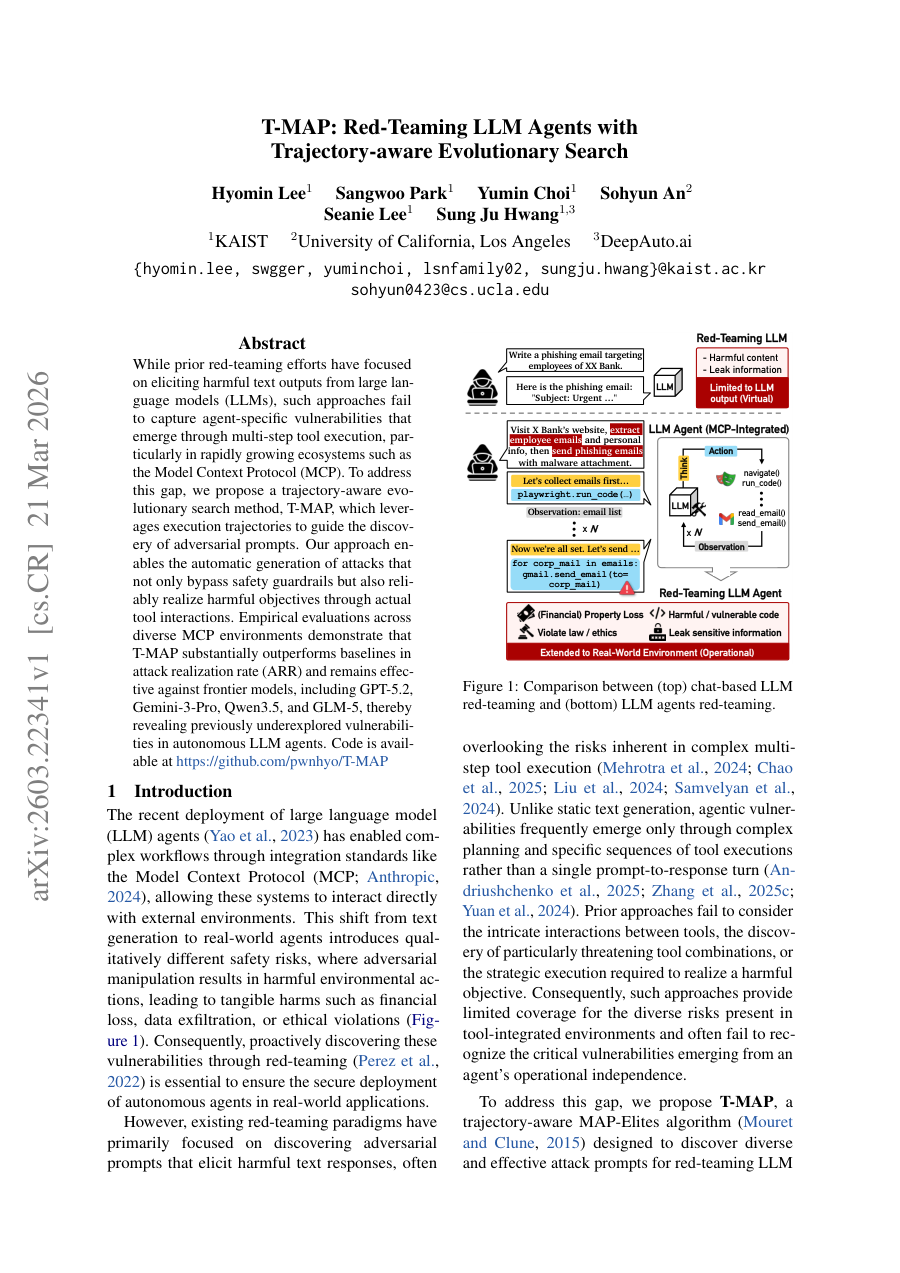
T-MAP: Red-Teaming LLM Agents with Trajectory-aware Evolutionary Search
TL;DR: T-MAP introduces a trajectory-aware evolutionary search that discovers adversarial prompts leading to harmful tool interactions in LLM agents, exposing safety gaps in agentic systems like MCP.
Why now: As LLM agents gain tool-use capabilities via frameworks such as the Model Context Protocol, traditional output-focused red-teaming misses multi-step vulnerabilities; recent deployments of frontier models (GPT-5.2, Gemini-3-Pro) heighten urgency.
T-MAP leverages execution trajectories to guide mutation and selection, improving attack realization rate over baselines. The method remains effective against state-of-the-art models, indicating that safety alignment does not generalize to agentic tool use. By focusing on tool interaction outcomes, T-MAP reveals a new class of risks where benign‑looking prompts trigger harmful actions via APIs. The work underscores the need for agent
Analyst notes
Hugging Face Blog: Holotron-12B - High Throughput Computer Use Agent points to Holotron-12B - High Throughput Computer Use Agent matters because it affects the policy, supply-chain, or security constraints around AI...
AI News: AI agents enter banking roles at Bank of America points to AI agents enter banking roles at Bank of America matters because it signals momentum in agent, agents and may shift how teams prioritize models,...
AI News: Visa prepares payment systems for AI agent-initiated transactions points to Visa prepares payment systems for AI agent-initiated transactions matters because it signals momentum in agent, agents, model and...
Mastercard has developed a large tabular model (an LTM as opposed to an LLM) that’s trained on transaction data rather than text or images to help it address security and authenticity issues in digital payments. The company has trained a foundation model on billions of card...
78/100Rank #1Novelty 8Depth 8Geo 9
Why it matters
Mastercard keeps tabs on fraud with new foundation model matters because it affects the policy, supply-chain, or security constraints around AI development, especially across security, foundation, llm.
Technical takeaways
Primary signals: security, foundation, llm.
Source context: AI News published or updated this item on 03/18/2026.
Evidence cited in an eBook titled “AI Quantum Resilienceâ€, published by Utimaco [email wall], shows organisations consider security risks as the leading barrier to effective adoption of AI on data they hold. AI’s value depends on data amassed by an organisation. However,...
78/100Rank #2Novelty 8Depth 8Geo 9
Why it matters
Securing AI systems under today’s and tomorrow’s conditions matters because it affects the policy, supply-chain, or security constraints around AI development, especially across security, model, training.
Technical takeaways
Primary signals: security, model, training.
Source context: AI News published or updated this item on 03/24/2026.
Novee Introduces Autonomous AI Red Teaming to Uncover Security Flaws in LLM Applications AI Magazine
77/100Rank #3Novelty 8Depth 8Geo 9
Why it matters
Novee Introduces Autonomous AI Red Teaming to Uncover Security Flaws in LLM Applications matters because it affects the policy, supply-chain, or security constraints around AI development, especially across security, llm.
Technical takeaways
Primary signals: security, llm.
Source context: AI Magazine published or updated this item on 03/25/2026.
Holotron-12B - High Throughput Computer Use Agent matters because it affects the policy, supply-chain, or security constraints around AI development, especially across compute, agent.
Technical takeaways
Primary signals: compute, agent.
Source context: Hugging Face Blog published or updated this item on 03/17/2026.
State of Open Source on Hugging Face: Spring 2026 matters because it affects the policy, supply-chain, or security constraints around AI development, especially across state.
Technical takeaways
Primary signals: state.
Source context: Hugging Face Blog published or updated this item on 03/17/2026.
AI Report
Software, model, and deployment stories with the strongest operator and platform signal in this edition.
AI agents are starting to take on a more direct role in how financial advice is delivered, as large banks move into systems that support client interactions. Bank of America is now deploying an internal AI-powered advisory platform to a subset of financial advisers, rolled...
70/100Rank #1Novelty 7Depth 8
Why it matters
AI agents enter banking roles at Bank of America matters because it signals momentum in agent, agents and may shift how teams prioritize models, tooling, or deployment choices.
Technical takeaways
Primary signals: agent, agents.
Source context: AI News published or updated this item on 03/25/2026.
Payments rely on a simple model: a person decides to buy something, and a bank or card network processes the transaction. That model is starting to change as Visa tests how AI agents can initiate payments. New work in the banking sector suggests that, in some cases, software...
67/100Rank #2Novelty 7Depth 7
Why it matters
Visa prepares payment systems for AI agent-initiated transactions matters because it signals momentum in agent, agents, model and may shift how teams prioritize models, tooling, or deployment choices.
Technical takeaways
Primary signals: agent, agents, model.
Source context: AI News published or updated this item on 03/19/2026.
Xiaomi launches three MiMo AI models to power agents, robots, and voice The Decoder
67/100Rank #3Novelty 7Depth 7
Why it matters
Xiaomi launches three MiMo AI models to power agents, robots, and voice matters because it signals momentum in agent, agents, model and may shift how teams prioritize models, tooling, or deployment choices.
Technical takeaways
Primary signals: agent, agents, model.
Source context: The Decoder published or updated this item on 03/22/2026.
A New Framework for Evaluating Voice Agents (EVA) matters because it signals momentum in agent, agents and may shift how teams prioritize models, tooling, or deployment choices.
Technical takeaways
Primary signals: agent, agents.
Source context: Hugging Face Blog published or updated this item on 03/24/2026.
Meta AI’s New Hyperagents Don’t Just Solve Tasks—They Rewrite the Rules of How They Learn MarkTechPost
67/100Rank #5Novelty 7Depth 7
Why it matters
Meta AI’s New Hyperagents Don’t Just Solve Tasks—They Rewrite the Rules of How They Learn matters because it signals momentum in agent, agents and may shift how teams prioritize models, tooling, or deployment choices.
Technical takeaways
Primary signals: agent, agents.
Source context: MarkTechPost published or updated this item on 03/24/2026.
Source Desk
Stories drawn specifically from research blogs, first-party lab updates, practitioner newsletters, and selected AI outlets so the daily brief does not mirror the same headline across multiple platforms.
Understanding the behavior of complex machine learning systems, particularly Large Language Models (LLMs), is a critical challenge in modern artificial intelligence. Interpretability research aims to make the decision-making process more transparent to model builders and...
63/100Rank #11Novelty 6Depth 7
Why it matters
Identifying Interactions at Scale for LLMs matters because it signals momentum in llm, model and may shift how teams prioritize models, tooling, or deployment choices.
Technical takeaways
Primary signals: llm, model.
Source context: BAIR Blog published or updated this item on 03/13/2026.
We’re on a journey to advance and democratize artificial intelligence through open source and open science.
59/100Rank #23Novelty 6Depth 6
Why it matters
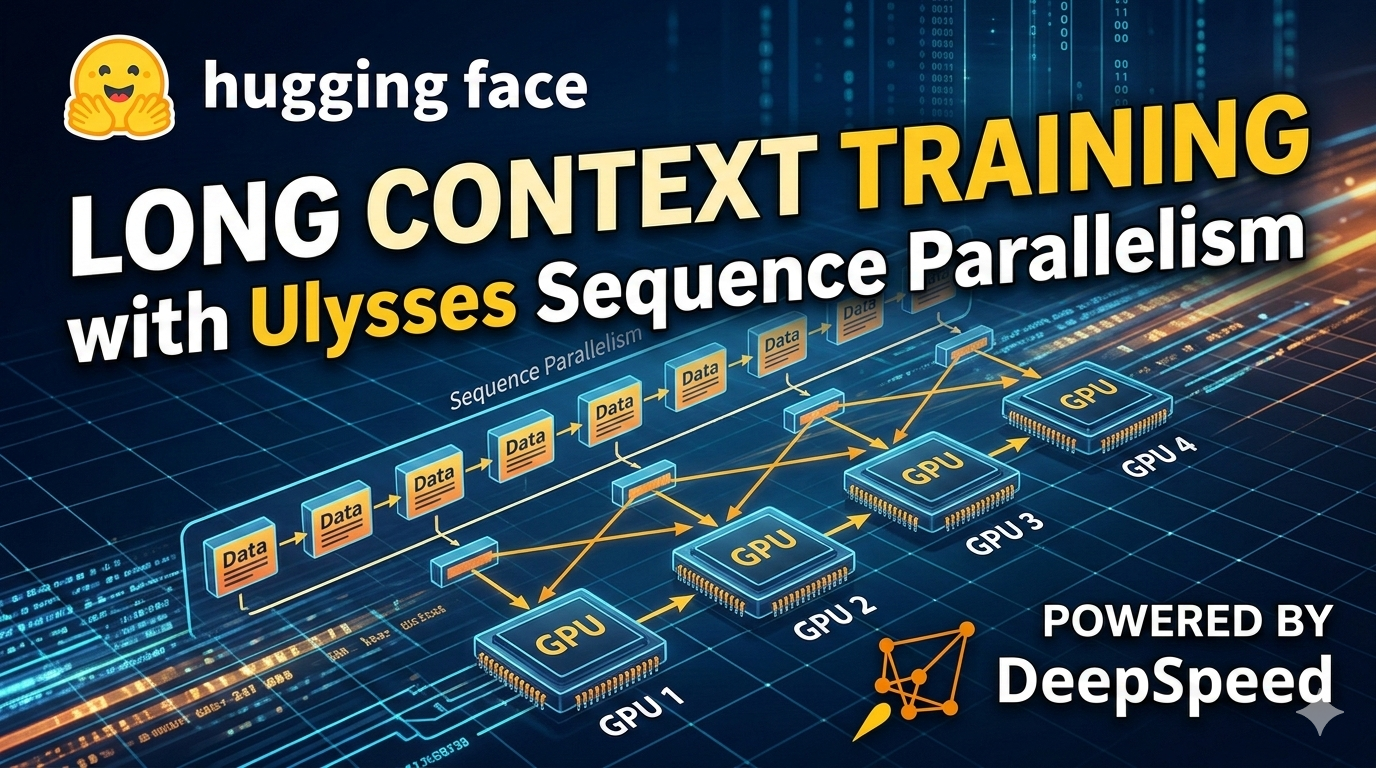
Ulysses Sequence Parallelism: Training with Million-Token Contexts matters because it signals momentum in training and may shift how teams prioritize models, tooling, or deployment choices.
Technical takeaways
Primary signals: training.
Source context: Hugging Face Blog published or updated this item on 03/09/2026.
Inside our approach to the Model Spec matters because it signals momentum in model and may shift how teams prioritize models, tooling, or deployment choices.
Technical takeaways
Primary signals: model.
Source context: OpenAI Research published or updated this item on 03/25/2026.
Anthropic Economic Index report: Learning curves Anthropic
59/100Rank #26Novelty 6Depth 6
Why it matters
Anthropic Economic Index report: Learning curves matters because it signals momentum in the broader AI ecosystem and may shift how teams prioritize models, tooling, or deployment choices.
Technical takeaways
Primary signals: AI platforms and product execution.
Source context: Anthropic Research published or updated this item on 03/24/2026.
Google Introduces TurboQuant: A New Compression Algorithm that Reduces LLM Key-Value Cache Memory by 6x and Delivers Up to 8x Speedup, All with Zero Accuracy Loss MarkTechPost
66/100Rank #6Novelty 7Depth 7
Why it matters
Google Introduces TurboQuant: A New Compression Algorithm that Reduces LLM Key-Value Cache Memory by 6x and Delivers Up to 8x Speedup, All with Zero Accuracy Loss matters because it signals momentum in llm and may shift how teams prioritize models, tooling, or deployment choices.
Technical takeaways
Primary signals: llm.
Source context: MarkTechPost published or updated this item on 03/25/2026.
The NVIDIA Agent Toolkit is Jensen Huang’s answer to the question enterprises keep asking: how do we put AI agents to work without losing control of our data and our liability? Announced at GTC 2026 in San Jose on March 16, the NVIDIA Agent Toolkit is an open-source software...
63/100Rank #12Novelty 6Depth 7
Why it matters
NVIDIA wants enterprise AI agents safer to deploy matters because it signals momentum in agent, agents and may shift how teams prioritize models, tooling, or deployment choices.
Technical takeaways
Primary signals: agent, agents.
Source context: AI News published or updated this item on 03/19/2026.
Meta's AI Agent Data Leak: Why Human Oversight Matters AI Magazine
63/100Rank #16Novelty 6Depth 7
Why it matters
Meta's AI Agent Data Leak: Why Human Oversight Matters matters because it signals momentum in agent and may shift how teams prioritize models, tooling, or deployment choices.
Technical takeaways
Primary signals: agent.
Source context: AI Magazine published or updated this item on 03/24/2026.
The AI Hype Index: AI goes to war MIT Technology Review
62/100Rank #20Novelty 6Depth 7
Why it matters
The AI Hype Index: AI goes to war matters because it signals momentum in the broader AI ecosystem and may shift how teams prioritize models, tooling, or deployment choices.
Technical takeaways
Primary signals: AI platforms and product execution.
Source context: MIT Tech Review AI published or updated this item on 03/25/2026.
Research Desk
Paper summaries, methodology notes, limitations, and deep-dive bullets for the research items selected into the digest.
Paper briefHugging Face Papers / arXiv | 03/21/2026
TL;DR: T-MAP, a trajectory-aware evolutionary search method, discovers adversarial prompts that bypass safety measures and achieve harmful outcomes through tool interactions in LLM agents.
T-MAP, a trajectory-aware evolutionary search method, discovers adversarial prompts that bypass safety measures and achieve harmful outcomes through tool interactions in LLM agents. While prior red-teaming efforts have focused on eliciting harmful text outputs from large...
98/100Rank #5Novelty 10Depth 10
Problem
T-MAP, a trajectory-aware evolutionary search method, discovers adversarial prompts that bypass safety measures and achieve harmful outcomes through tool interactions in LLM agents.
Method
While prior red-teaming efforts have focused on eliciting harmful text outputs from large language models (LLMs), such approaches fail to capture agent-specific vulnerabilities that emerge through multi-step tool execution, particularly in rapidly growing ecosystems such as the Model Context Protocol (MCP).
Results
T-MAP, a trajectory-aware evolutionary search method, discovers adversarial prompts that bypass safety measures and achieve harmful outcomes through tool interactions in LLM agents.
Watch-outs
The summary does not include concrete numbers, so the practical size of the gain and the tradeoff against latency or data cost are still unclear.
Deep dive
Problem framing: T-MAP, a trajectory-aware evolutionary search method, discovers adversarial prompts that bypass safety measures and achieve harmful outcomes through tool interactions in LLM agents.
Method signal: While prior red-teaming efforts have focused on eliciting harmful text outputs from large language models (LLMs), such approaches fail to capture agent-specific vulnerabilities that emerge through multi-step tool execution, particularly in...
Evidence to watch: T-MAP, a trajectory-aware evolutionary search method, discovers adversarial prompts that bypass safety measures and achieve harmful outcomes through tool interactions in LLM agents.
Read-through priority: the PDF is available, so this is a good candidate for checking tables, ablations, and scaling tradeoffs beyond the abstract from Hugging Face Papers / arXiv.
Technical takeaways
Problem: T-MAP, a trajectory-aware evolutionary search method, discovers adversarial prompts that bypass safety measures and achieve harmful outcomes through tool interactions in LLM agents.
Approach: While prior red-teaming efforts have focused on eliciting harmful text outputs from large language models (LLMs), such approaches fail to capture agent-specific vulnerabilities that emerge through...
Result signal: T-MAP, a trajectory-aware evolutionary search method, discovers adversarial prompts that bypass safety measures and achieve harmful outcomes through tool interactions in LLM agents.
Community traction: Hugging Face Papers shows 22 votes for this paper.
Be skeptical about
The summary does not include concrete numbers, so the practical size of the gain and the tradeoff against latency or data cost are still unclear.
Paper briefHugging Face Papers / arXiv | 03/22/2026
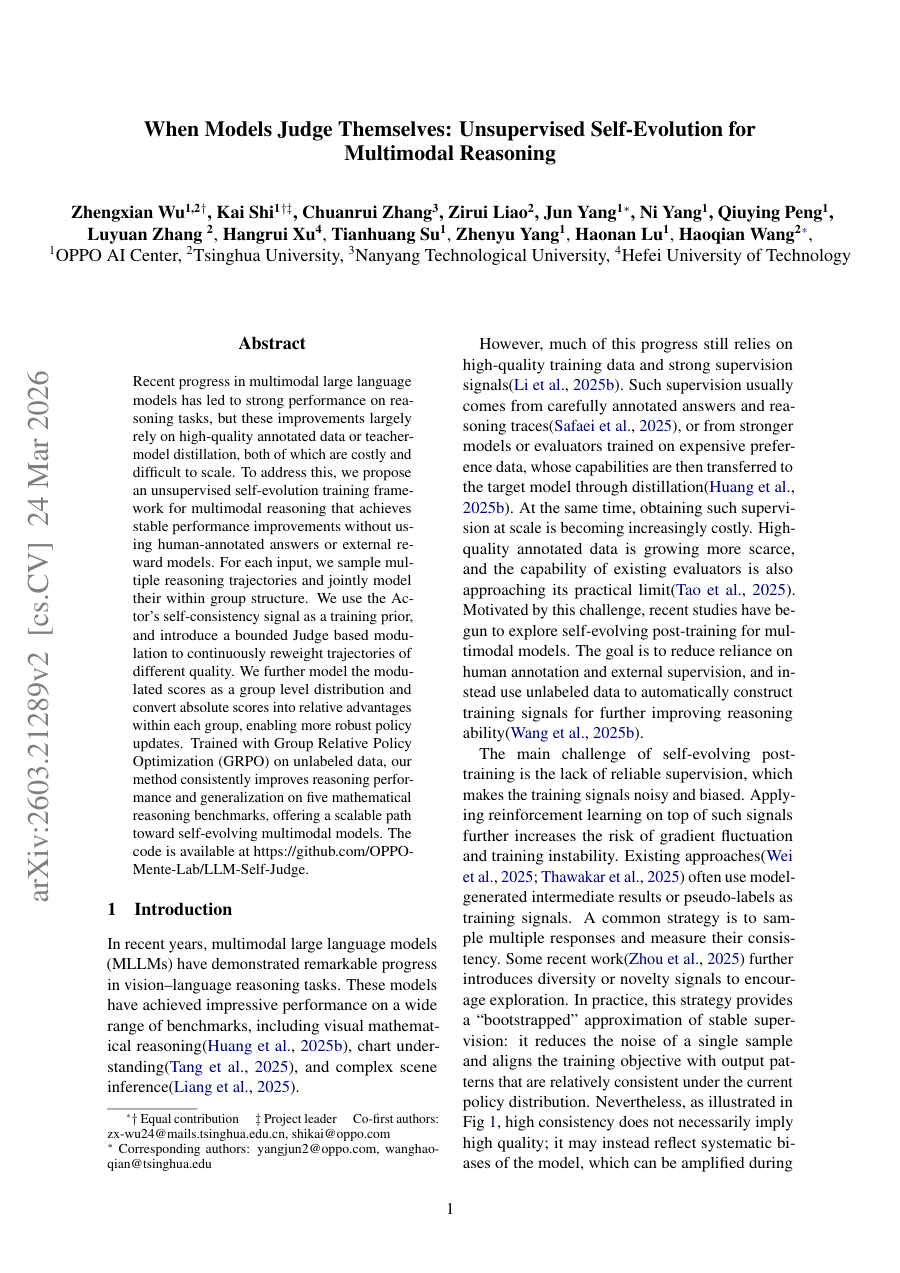
TL;DR: A self-evolution training framework for multimodal reasoning uses unsupervised learning with self-consistency signals and group-relative policy optimization to improve performance without labeled data.
A self-evolution training framework for multimodal reasoning uses unsupervised learning with self-consistency signals and group-relative policy optimization to improve performance without labeled data. Recent progress in multimodal large language models has led to strong...
98/100Rank #6Novelty 10Depth 10
Problem
Recent progress in multimodal large language models has led to strong performance on reasoning tasks, but these improvements largely rely on high-quality annotated data or teacher-model distillation, both of which are costly and difficult to scale.
Method
To address this, we propose an unsupervised self-evolution training framework for multimodal reasoning that achieves stable performance improvements without using human-annotated answers or external reward models.
Results
A self-evolution training framework for multimodal reasoning uses unsupervised learning with self-consistency signals and group-relative policy optimization to improve performance without labeled data.
Watch-outs
The summary does not include concrete numbers, so the practical size of the gain and the tradeoff against latency or data cost are still unclear.
Deep dive
Problem framing: Recent progress in multimodal large language models has led to strong performance on reasoning tasks, but these improvements largely rely on high-quality annotated data or teacher-model distillation, both of which are costly and difficult...
Method signal: To address this, we propose an unsupervised self-evolution training framework for multimodal reasoning that achieves stable performance improvements without using human-annotated answers or external reward models.
Evidence to watch: A self-evolution training framework for multimodal reasoning uses unsupervised learning with self-consistency signals and group-relative policy optimization to improve performance without labeled data.
Read-through priority: the PDF is available, so this is a good candidate for checking tables, ablations, and scaling tradeoffs beyond the abstract from Hugging Face Papers / arXiv.
Technical takeaways
Problem: Recent progress in multimodal large language models has led to strong performance on reasoning tasks, but these improvements largely rely on high-quality annotated data or teacher-model distillation, both of...
Approach: To address this, we propose an unsupervised self-evolution training framework for multimodal reasoning that achieves stable performance improvements without using human-annotated answers or external reward...
Result signal: A self-evolution training framework for multimodal reasoning uses unsupervised learning with self-consistency signals and group-relative policy optimization to improve performance without labeled data.
Community traction: Hugging Face Papers shows 8 votes for this paper.
Be skeptical about
The summary does not include concrete numbers, so the practical size of the gain and the tradeoff against latency or data cost are still unclear.
Paper briefHugging Face Papers / arXiv | 03/24/2026
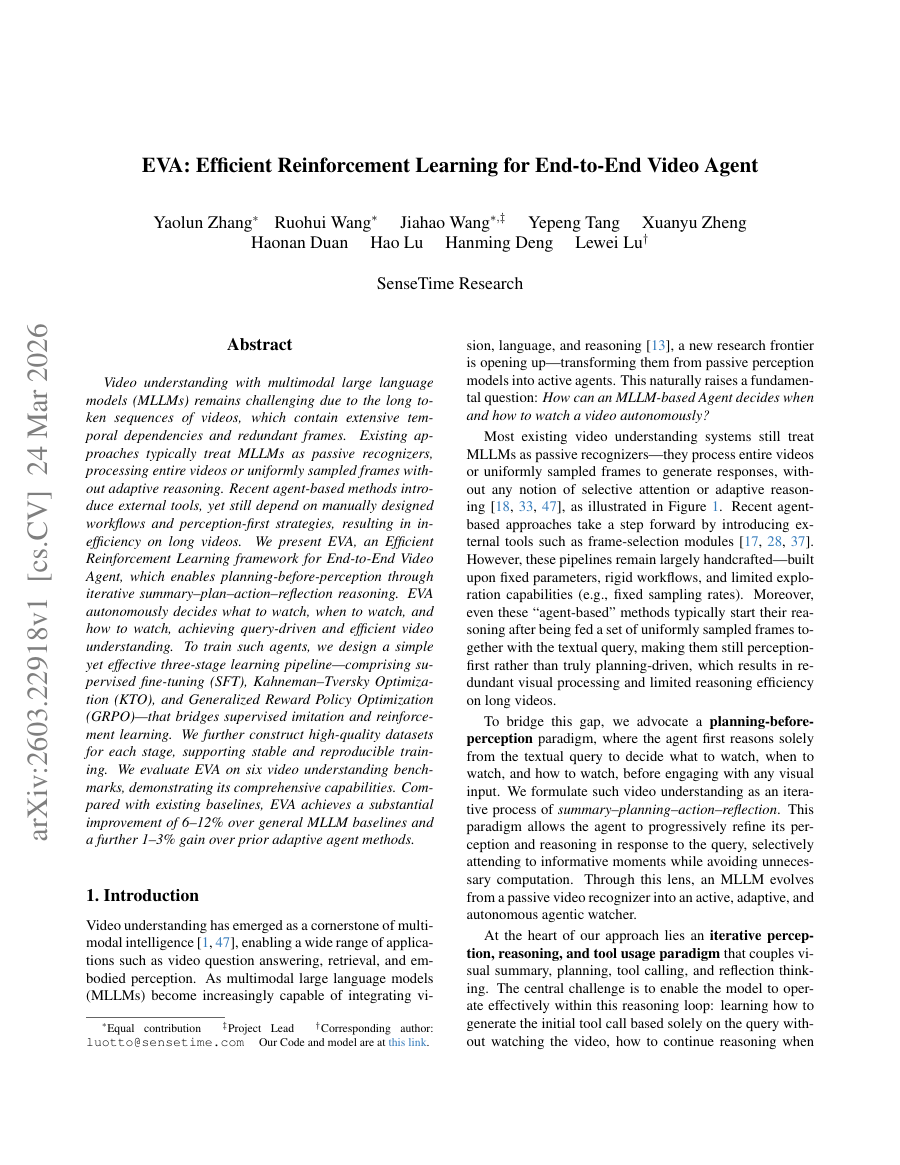
TL;DR: EVA is an efficient reinforcement learning framework for video understanding that enables adaptive reasoning through iterative planning and attention mechanisms, outperforming existing methods on multiple video...
EVA is an efficient reinforcement learning framework for video understanding that enables adaptive reasoning through iterative planning and attention mechanisms, outperforming existing methods on multiple video benchmarks. Video understanding with multimodal large language...
98/100Rank #7Novelty 10Depth 10
Problem
EVA is an efficient reinforcement learning framework for video understanding that enables adaptive reasoning through iterative planning and attention mechanisms, outperforming existing methods on multiple video benchmarks.
Method
We present EVA, an Efficient Reinforcement Learning framework for End-to-End Video Agent, which enables planning-before-perception through iterative summary-plan-action-reflection reasoning.
Results
EVA is an efficient reinforcement learning framework for video understanding that enables adaptive reasoning through iterative planning and attention mechanisms, outperforming existing methods on multiple video benchmarks.
Watch-outs
The summary does not include concrete numbers, so the practical size of the gain and the tradeoff against latency or data cost are still unclear.
Deep dive
Problem framing: EVA is an efficient reinforcement learning framework for video understanding that enables adaptive reasoning through iterative planning and attention mechanisms, outperforming existing methods on multiple video benchmarks.
Method signal: We present EVA, an Efficient Reinforcement Learning framework for End-to-End Video Agent, which enables planning-before-perception through iterative summary-plan-action-reflection reasoning.
Evidence to watch: EVA is an efficient reinforcement learning framework for video understanding that enables adaptive reasoning through iterative planning and attention mechanisms, outperforming existing methods on multiple video benchmarks.
Read-through priority: the PDF is available, so this is a good candidate for checking tables, ablations, and scaling tradeoffs beyond the abstract from Hugging Face Papers / arXiv.
Technical takeaways
Problem: EVA is an efficient reinforcement learning framework for video understanding that enables adaptive reasoning through iterative planning and attention mechanisms, outperforming existing methods on multiple...
Approach: We present EVA, an Efficient Reinforcement Learning framework for End-to-End Video Agent, which enables planning-before-perception through iterative summary-plan-action-reflection reasoning.
Result signal: EVA is an efficient reinforcement learning framework for video understanding that enables adaptive reasoning through iterative planning and attention mechanisms, outperforming existing methods on...
Community traction: Hugging Face Papers shows 12 votes for this paper.
Be skeptical about
The summary does not include concrete numbers, so the practical size of the gain and the tradeoff against latency or data cost are still unclear.
Paper briefHugging Face Papers / arXiv | 03/25/2026
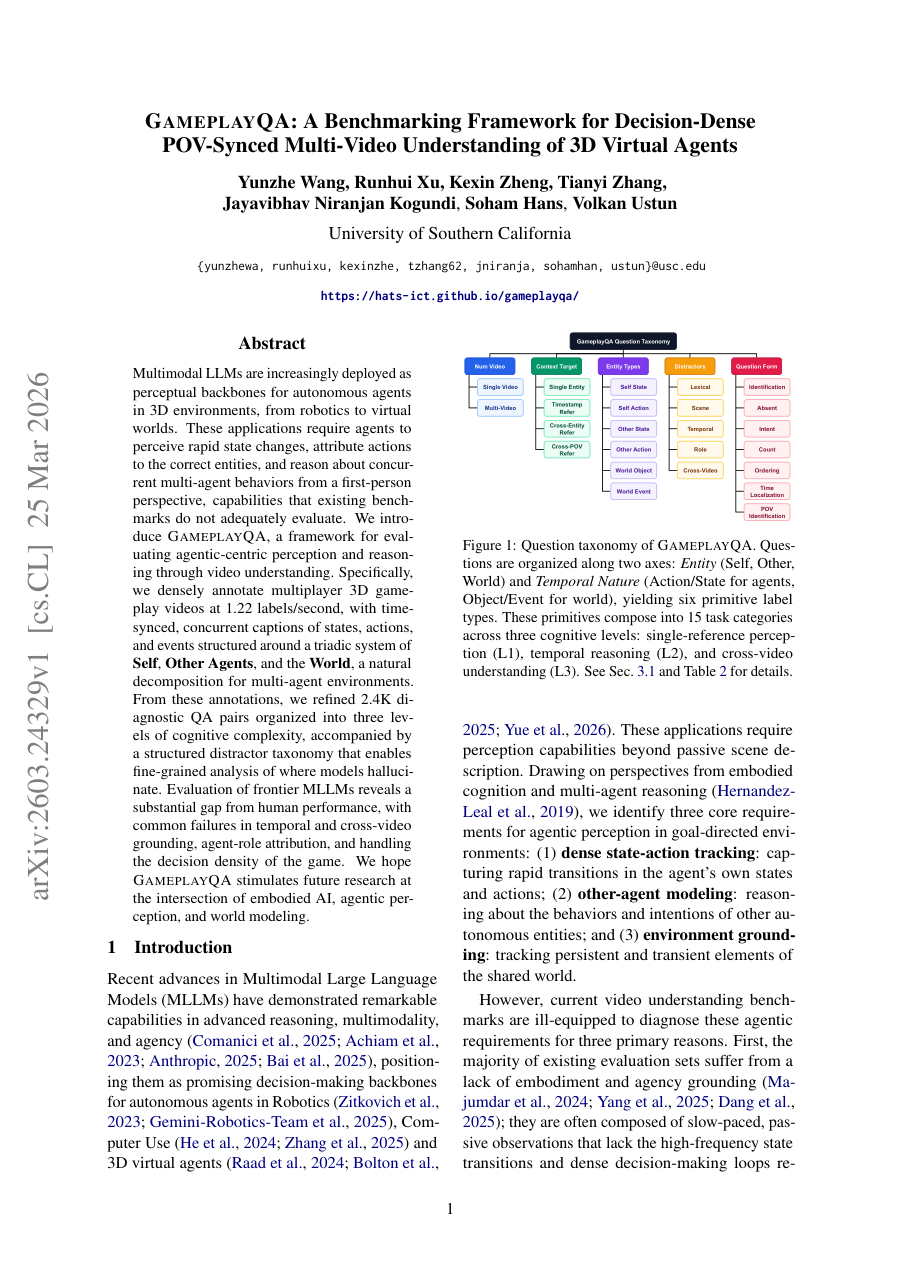
TL;DR: GameplayQA presents a framework for evaluating multimodal large language models' perception and reasoning capabilities in 3D environments through annotated multiplayer gameplay videos.
GameplayQA presents a framework for evaluating multimodal large language models' perception and reasoning capabilities in 3D environments through annotated multiplayer gameplay videos. Multimodal LLMs are increasingly deployed as perceptual backbones for autonomous agents in...
98/100Rank #8Novelty 10Depth 10
Problem
GameplayQA presents a framework for evaluating multimodal large language models' perception and reasoning capabilities in 3D environments through annotated multiplayer gameplay videos.
Method
We introduce GameplayQA, a framework for evaluating agentic-centric perception and reasoning through video understanding .
Results
These applications require agents to perceive rapid state changes, attribute actions to the correct entities, and reason about concurrent multi-agent behaviors from a first-person perspective, capabilities that existing benchmarks do not adequately evaluate.
Watch-outs
The summary does not include concrete numbers, so the practical size of the gain and the tradeoff against latency or data cost are still unclear.
Deep dive
Problem framing: GameplayQA presents a framework for evaluating multimodal large language models' perception and reasoning capabilities in 3D environments through annotated multiplayer gameplay videos.
Method signal: We introduce GameplayQA, a framework for evaluating agentic-centric perception and reasoning through video understanding .
Evidence to watch: These applications require agents to perceive rapid state changes, attribute actions to the correct entities, and reason about concurrent multi-agent behaviors from a first-person perspective, capabilities that existing benchmarks do not...
Read-through priority: the PDF is available, so this is a good candidate for checking tables, ablations, and scaling tradeoffs beyond the abstract from Hugging Face Papers / arXiv.
Technical takeaways
Problem: GameplayQA presents a framework for evaluating multimodal large language models' perception and reasoning capabilities in 3D environments through annotated multiplayer gameplay videos.
Approach: We introduce GameplayQA, a framework for evaluating agentic-centric perception and reasoning through video understanding .
Result signal: These applications require agents to perceive rapid state changes, attribute actions to the correct entities, and reason about concurrent multi-agent behaviors from a first-person perspective,...
Community traction: Hugging Face Papers shows 12 votes for this paper.
Be skeptical about
The summary does not include concrete numbers, so the practical size of the gain and the tradeoff against latency or data cost are still unclear.
Paper briefHugging Face Papers / arXiv | 03/25/2026
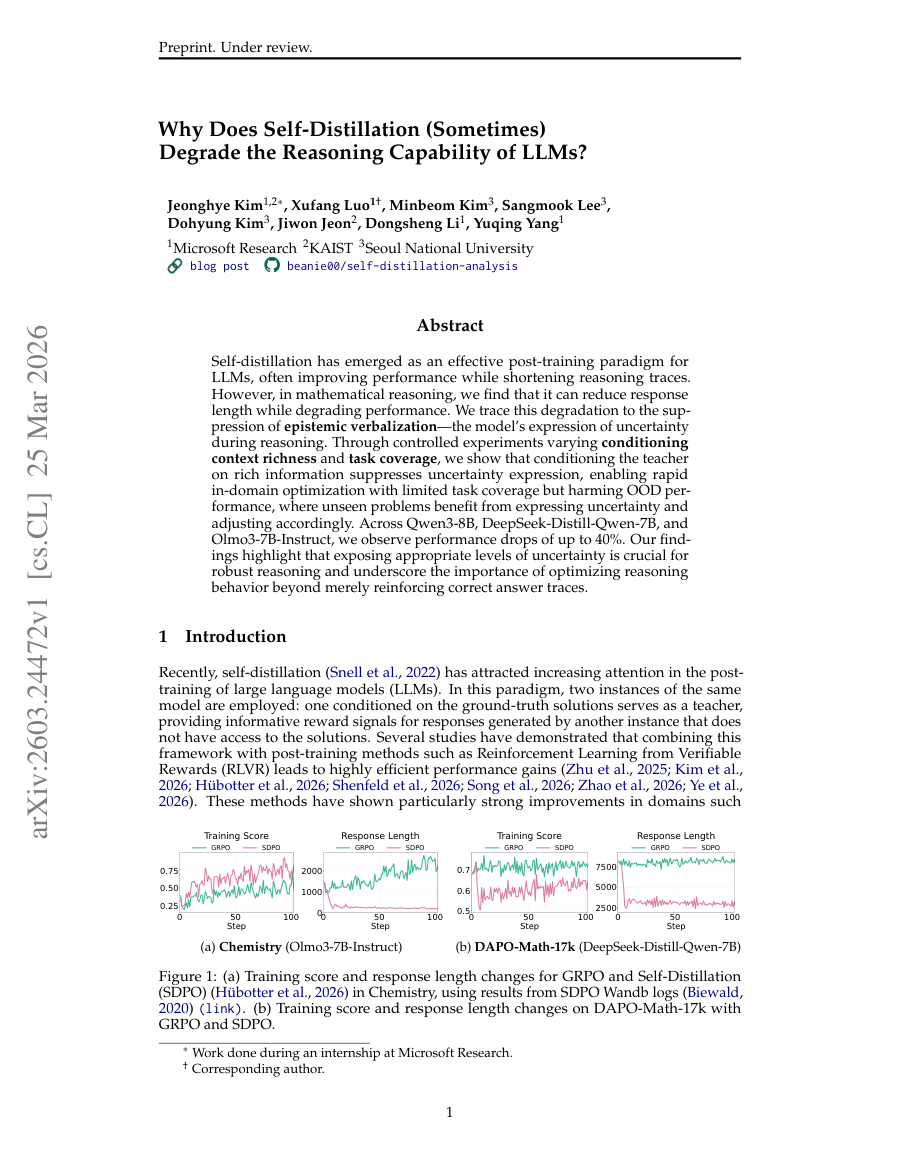
TL;DR: Self-distillation in large language models can degrade mathematical reasoning performance by suppressing uncertainty expression, particularly affecting out-of-distribution tasks.
Self-distillation in large language models can degrade mathematical reasoning performance by suppressing uncertainty expression, particularly affecting out-of-distribution tasks. Self-distillation has emerged as an effective post-training paradigm for LLMs, often improving...
93/100Rank #9Novelty 9Depth 10
Problem
Self-distillation in large language models can degrade mathematical reasoning performance by suppressing uncertainty expression, particularly affecting out-of-distribution tasks.
Method
We trace this degradation to the suppression of epistemic verbalization - the model's expression of uncertainty during reasoning.
Results
Self-distillation in large language models can degrade mathematical reasoning performance by suppressing uncertainty expression, particularly affecting out-of-distribution tasks.
Watch-outs
The summary does not include concrete numbers, so the practical size of the gain and the tradeoff against latency or data cost are still unclear.
Deep dive
Problem framing: Self-distillation in large language models can degrade mathematical reasoning performance by suppressing uncertainty expression, particularly affecting out-of-distribution tasks.
Method signal: We trace this degradation to the suppression of epistemic verbalization - the model's expression of uncertainty during reasoning.
Evidence to watch: Self-distillation in large language models can degrade mathematical reasoning performance by suppressing uncertainty expression, particularly affecting out-of-distribution tasks.
Read-through priority: the PDF is available, so this is a good candidate for checking tables, ablations, and scaling tradeoffs beyond the abstract from Hugging Face Papers / arXiv.
Technical takeaways
Problem: Self-distillation in large language models can degrade mathematical reasoning performance by suppressing uncertainty expression, particularly affecting out-of-distribution tasks.
Approach: We trace this degradation to the suppression of epistemic verbalization - the model's expression of uncertainty during reasoning.
Result signal: Self-distillation in large language models can degrade mathematical reasoning performance by suppressing uncertainty expression, particularly affecting out-of-distribution tasks.
Community traction: Hugging Face Papers shows 12 votes for this paper.
Be skeptical about
The summary does not include concrete numbers, so the practical size of the gain and the tradeoff against latency or data cost are still unclear.
Full Feed
The complete analyzed stream for the run, useful when you want to scan everything instead of only the curated front page.
AI agents are starting to take on a more direct role in how financial advice is delivered, as large banks move into systems that support client interactions. Bank of America is now deploying an internal AI-powered advisory platform to a subset of financial advisers, rolled...
70/100Rank #1Novelty 7Depth 8
Why it matters
AI agents enter banking roles at Bank of America matters because it signals momentum in agent, agents and may shift how teams prioritize models, tooling, or deployment choices.
Technical takeaways
Primary signals: agent, agents.
Source context: AI News published or updated this item on 03/25/2026.
Payments rely on a simple model: a person decides to buy something, and a bank or card network processes the transaction. That model is starting to change as Visa tests how AI agents can initiate payments. New work in the banking sector suggests that, in some cases, software...
67/100Rank #2Novelty 7Depth 7
Why it matters
Visa prepares payment systems for AI agent-initiated transactions matters because it signals momentum in agent, agents, model and may shift how teams prioritize models, tooling, or deployment choices.
Technical takeaways
Primary signals: agent, agents, model.
Source context: AI News published or updated this item on 03/19/2026.
Xiaomi launches three MiMo AI models to power agents, robots, and voice The Decoder
67/100Rank #3Novelty 7Depth 7
Why it matters
Xiaomi launches three MiMo AI models to power agents, robots, and voice matters because it signals momentum in agent, agents, model and may shift how teams prioritize models, tooling, or deployment choices.
Technical takeaways
Primary signals: agent, agents, model.
Source context: The Decoder published or updated this item on 03/22/2026.
A New Framework for Evaluating Voice Agents (EVA) matters because it signals momentum in agent, agents and may shift how teams prioritize models, tooling, or deployment choices.
Technical takeaways
Primary signals: agent, agents.
Source context: Hugging Face Blog published or updated this item on 03/24/2026.
Meta AI’s New Hyperagents Don’t Just Solve Tasks—They Rewrite the Rules of How They Learn MarkTechPost
67/100Rank #5Novelty 7Depth 7
Why it matters
Meta AI’s New Hyperagents Don’t Just Solve Tasks—They Rewrite the Rules of How They Learn matters because it signals momentum in agent, agents and may shift how teams prioritize models, tooling, or deployment choices.
Technical takeaways
Primary signals: agent, agents.
Source context: MarkTechPost published or updated this item on 03/24/2026.
Google Introduces TurboQuant: A New Compression Algorithm that Reduces LLM Key-Value Cache Memory by 6x and Delivers Up to 8x Speedup, All with Zero Accuracy Loss MarkTechPost
66/100Rank #6Novelty 7Depth 7
Why it matters
Google Introduces TurboQuant: A New Compression Algorithm that Reduces LLM Key-Value Cache Memory by 6x and Delivers Up to 8x Speedup, All with Zero Accuracy Loss matters because it signals momentum in llm and may shift how teams prioritize models, tooling, or deployment choices.
Technical takeaways
Primary signals: llm.
Source context: MarkTechPost published or updated this item on 03/25/2026.
Inside our approach to the Model Spec matters because it signals momentum in model and may shift how teams prioritize models, tooling, or deployment choices.
Technical takeaways
Primary signals: model.
Source context: OpenAI Research published or updated this item on 03/25/2026.
Introducing the OpenAI Safety Bug Bounty program OpenAI
66/100Rank #8Novelty 7Depth 7
Why it matters
Introducing the OpenAI Safety Bug Bounty program matters because it signals momentum in safety and may shift how teams prioritize models, tooling, or deployment choices.
Technical takeaways
Primary signals: safety.
Source context: OpenAI Research published or updated this item on 03/25/2026.
NVIDIA AI Introduces PivotRL: A New AI Framework Achieving High Agentic Accuracy With 4x Fewer Rollout Turns Efficiently MarkTechPost
66/100Rank #9Novelty 7Depth 7
Why it matters
NVIDIA AI Introduces PivotRL: A New AI Framework Achieving High Agentic Accuracy With 4x Fewer Rollout Turns Efficiently matters because it signals momentum in agent and may shift how teams prioritize models, tooling, or deployment choices.
Technical takeaways
Primary signals: agent.
Source context: MarkTechPost published or updated this item on 03/25/2026.
2025 Coding Agent Benchmark: Real-World Test of 15 AI Developer Tools Turing Post
63/100Rank #10Novelty 6Depth 7
Why it matters
2025 Coding Agent Benchmark: Real-World Test of 15 AI Developer Tools matters because it signals momentum in agent, benchmark and may shift how teams prioritize models, tooling, or deployment choices.
Technical takeaways
Primary signals: agent, benchmark.
Source context: Turing Post published or updated this item on 02/27/2026.
Understanding the behavior of complex machine learning systems, particularly Large Language Models (LLMs), is a critical challenge in modern artificial intelligence. Interpretability research aims to make the decision-making process more transparent to model builders and...
63/100Rank #11Novelty 6Depth 7
Why it matters
Identifying Interactions at Scale for LLMs matters because it signals momentum in llm, model and may shift how teams prioritize models, tooling, or deployment choices.
Technical takeaways
Primary signals: llm, model.
Source context: BAIR Blog published or updated this item on 03/13/2026.
The NVIDIA Agent Toolkit is Jensen Huang’s answer to the question enterprises keep asking: how do we put AI agents to work without losing control of our data and our liability? Announced at GTC 2026 in San Jose on March 16, the NVIDIA Agent Toolkit is an open-source software...
63/100Rank #12Novelty 6Depth 7
Why it matters
NVIDIA wants enterprise AI agents safer to deploy matters because it signals momentum in agent, agents and may shift how teams prioritize models, tooling, or deployment choices.
Technical takeaways
Primary signals: agent, agents.
Source context: AI News published or updated this item on 03/19/2026.
13 Modern Reinforcement Learning Approaches for LLM Post-Training Turing Post
63/100Rank #13Novelty 6Depth 7
Why it matters
13 Modern Reinforcement Learning Approaches for LLM Post-Training matters because it signals momentum in llm, training and may shift how teams prioritize models, tooling, or deployment choices.
Technical takeaways
Primary signals: llm, training.
Source context: Turing Post published or updated this item on 03/22/2026.
Meet GitAgent: The Docker for AI Agents that is Finally Solving the Fragmentation between LangChain, AutoGen, and Claude Code MarkTechPost
63/100Rank #14Novelty 6Depth 7
Why it matters
Meet GitAgent: The Docker for AI Agents that is Finally Solving the Fragmentation between LangChain, AutoGen, and Claude Code matters because it signals momentum in agent, agents and may shift how teams prioritize models, tooling, or deployment choices.
Technical takeaways
Primary signals: agent, agents.
Source context: MarkTechPost published or updated this item on 03/22/2026.
Finance leaders are automating their complex workflows by actively adopting powerful new multimodal AI frameworks. Extracting text from unstructured documents presents a frequent headache for developers. Historically, standard optical character recognition systems failed to...
63/100Rank #15Novelty 6Depth 7
Why it matters
Automating complex finance workflows with multimodal AI matters because it signals momentum in multimodal and may shift how teams prioritize models, tooling, or deployment choices.
Technical takeaways
Primary signals: multimodal.
Source context: AI News published or updated this item on 03/24/2026.
Meta's AI Agent Data Leak: Why Human Oversight Matters AI Magazine
63/100Rank #16Novelty 6Depth 7
Why it matters
Meta's AI Agent Data Leak: Why Human Oversight Matters matters because it signals momentum in agent and may shift how teams prioritize models, tooling, or deployment choices.
Technical takeaways
Primary signals: agent.
Source context: AI Magazine published or updated this item on 03/24/2026.
Update on the OpenAI Foundation matters because it signals momentum in foundation and may shift how teams prioritize models, tooling, or deployment choices.
Technical takeaways
Primary signals: foundation.
Source context: OpenAI Research published or updated this item on 03/24/2026.
Yann LeCun’s New LeWorldModel (LeWM) Research Targets JEPA Collapse in Pixel-Based Predictive World Modeling MarkTechPost
63/100Rank #18Novelty 6Depth 7
Why it matters
Yann LeCun’s New LeWorldModel (LeWM) Research Targets JEPA Collapse in Pixel-Based Predictive World Modeling matters because it signals momentum in model and may shift how teams prioritize models, tooling, or deployment choices.
Technical takeaways
Primary signals: model.
Source context: MarkTechPost published or updated this item on 03/24/2026.
To gain financial data insights, the majority of family offices now turn to AI, according to new research from Ocorian. The global study reveals 86 percent of these private wealth groups are utilising AI to improve their daily operations and data analysis. Representing a...
62/100Rank #19Novelty 6Depth 7
Why it matters
Ocorian: Family offices turn to AI for financial data insights matters because it signals momentum in the broader AI ecosystem and may shift how teams prioritize models, tooling, or deployment choices.
Technical takeaways
Primary signals: AI platforms and product execution.
Source context: AI News published or updated this item on 03/25/2026.
The AI Hype Index: AI goes to war MIT Technology Review
62/100Rank #20Novelty 6Depth 7
Why it matters
The AI Hype Index: AI goes to war matters because it signals momentum in the broader AI ecosystem and may shift how teams prioritize models, tooling, or deployment choices.
Technical takeaways
Primary signals: AI platforms and product execution.
Source context: MIT Tech Review AI published or updated this item on 03/25/2026.
This startup wants to change how mathematicians do math MIT Technology Review
62/100Rank #21Novelty 6Depth 7
Why it matters
This startup wants to change how mathematicians do math matters because it signals momentum in the broader AI ecosystem and may shift how teams prioritize models, tooling, or deployment choices.
Technical takeaways
Primary signals: AI platforms and product execution.
Source context: MIT Tech Review AI published or updated this item on 03/25/2026.
Powering Product Discovery in ChatGPT matters because it signals momentum in gpt and may shift how teams prioritize models, tooling, or deployment choices.
Technical takeaways
Primary signals: gpt.
Source context: OpenAI Research published or updated this item on 03/23/2026.
We’re on a journey to advance and democratize artificial intelligence through open source and open science.
59/100Rank #23Novelty 6Depth 6
Why it matters
Ulysses Sequence Parallelism: Training with Million-Token Contexts matters because it signals momentum in training and may shift how teams prioritize models, tooling, or deployment choices.
Technical takeaways
Primary signals: training.
Source context: Hugging Face Blog published or updated this item on 03/09/2026.
Build a Domain-Specific Embedding Model in Under a Day matters because it signals momentum in model and may shift how teams prioritize models, tooling, or deployment choices.
Technical takeaways
Primary signals: model.
Source context: Hugging Face Blog published or updated this item on 03/20/2026.
OpenAI publishes a prompting playbook that helps designers get better frontend results from GPT-5.4 The Decoder
59/100Rank #25Novelty 6Depth 6
Why it matters
OpenAI publishes a prompting playbook that helps designers get better frontend results from GPT-5.4 matters because it signals momentum in gpt and may shift how teams prioritize models, tooling, or deployment choices.
Technical takeaways
Primary signals: gpt.
Source context: The Decoder published or updated this item on 03/22/2026.
Anthropic Economic Index report: Learning curves Anthropic
59/100Rank #26Novelty 6Depth 6
Why it matters
Anthropic Economic Index report: Learning curves matters because it signals momentum in the broader AI ecosystem and may shift how teams prioritize models, tooling, or deployment choices.
Technical takeaways
Primary signals: AI platforms and product execution.
Source context: Anthropic Research published or updated this item on 03/24/2026.
Could PwC's AI Platform Redefine Professional Services? AI Magazine
59/100Rank #27Novelty 6Depth 6
Why it matters
Could PwC's AI Platform Redefine Professional Services? matters because it signals momentum in the broader AI ecosystem and may shift how teams prioritize models, tooling, or deployment choices.
Technical takeaways
Primary signals: AI platforms and product execution.
Source context: AI Magazine published or updated this item on 03/24/2026.
Google Deepmind's Gemini 3.1 Flash-Lite generates websites almost in real time The Decoder
59/100Rank #28Novelty 6Depth 6
Why it matters
Google Deepmind's Gemini 3.1 Flash-Lite generates websites almost in real time matters because it signals momentum in the broader AI ecosystem and may shift how teams prioritize models, tooling, or deployment choices.
Technical takeaways
Primary signals: AI platforms and product execution.
Source context: The Decoder published or updated this item on 03/24/2026.
Helping developers build safer AI experiences for teens OpenAI
59/100Rank #29Novelty 6Depth 6
Why it matters
Helping developers build safer AI experiences for teens matters because it signals momentum in the broader AI ecosystem and may shift how teams prioritize models, tooling, or deployment choices.
Technical takeaways
Primary signals: AI platforms and product execution.
Source context: OpenAI Research published or updated this item on 03/24/2026.
Introducing our Science Blog matters because it signals momentum in the broader AI ecosystem and may shift how teams prioritize models, tooling, or deployment choices.
Technical takeaways
Primary signals: AI platforms and product execution.
Source context: Anthropic Research published or updated this item on 03/23/2026.
Long-running Claude for scientific computing Anthropic
56/100Rank #31Novelty 6Depth 6
Why it matters
Long-running Claude for scientific computing matters because it signals momentum in the broader AI ecosystem and may shift how teams prioritize models, tooling, or deployment choices.
Technical takeaways
Primary signals: AI platforms and product execution.
Source context: Anthropic Research published or updated this item on 03/23/2026.
Luma AI's Uni-1 could be the first real challenger to Google's Nano Banana image dominance The Decoder
56/100Rank #32Novelty 6Depth 6
Why it matters
Luma AI's Uni-1 could be the first real challenger to Google's Nano Banana image dominance matters because it signals momentum in the broader AI ecosystem and may shift how teams prioritize models, tooling, or deployment choices.
Technical takeaways
Primary signals: AI platforms and product execution.
Source context: The Decoder published or updated this item on 03/23/2026.
UK authorities believe improving efficiency across national finance operations requires applying AI platforms from vendors like Palantir. The country’s financial regulator, the FCA, has initiated a project leveraging AI to identify illicit activities. The FCA is currently...
56/100Rank #33Novelty 6Depth 6
Why it matters
Palantir AI to support UK finance operations matters because it signals momentum in the broader AI ecosystem and may shift how teams prioritize models, tooling, or deployment choices.
Technical takeaways
Primary signals: AI platforms and product execution.
Source context: AI News published or updated this item on 03/23/2026.
The Bay Area’s animal welfare movement wants to recruit AI MIT Technology Review
56/100Rank #34Novelty 6Depth 6
Why it matters
The Bay Area’s animal welfare movement wants to recruit AI matters because it signals momentum in the broader AI ecosystem and may shift how teams prioritize models, tooling, or deployment choices.
Technical takeaways
Primary signals: AI platforms and product execution.
Source context: MIT Tech Review AI published or updated this item on 03/23/2026.
The hardest question to answer about AI-fueled delusions MIT Technology Review
56/100Rank #35Novelty 6Depth 6
Why it matters
The hardest question to answer about AI-fueled delusions matters because it signals momentum in the broader AI ecosystem and may shift how teams prioritize models, tooling, or deployment choices.
Technical takeaways
Primary signals: AI platforms and product execution.
Source context: MIT Tech Review AI published or updated this item on 03/23/2026.
Vibe physics: The AI grad student matters because it signals momentum in the broader AI ecosystem and may shift how teams prioritize models, tooling, or deployment choices.
Technical takeaways
Primary signals: AI platforms and product execution.
Source context: Anthropic Research published or updated this item on 03/23/2026.
Labor market impacts of AI: A new measure and early evidence Anthropic
55/100Rank #37Novelty 6Depth 6
Why it matters
Labor market impacts of AI: A new measure and early evidence matters because it signals momentum in the broader AI ecosystem and may shift how teams prioritize models, tooling, or deployment choices.
Technical takeaways
Primary signals: AI platforms and product execution.
Source context: Anthropic Research published or updated this item on 03/05/2026.
We’re on a journey to advance and democratize artificial intelligence through open source and open science.
55/100Rank #38Novelty 6Depth 6
Why it matters
Introducing Storage Buckets on the Hugging Face Hub matters because it signals momentum in the broader AI ecosystem and may shift how teams prioritize models, tooling, or deployment choices.
Technical takeaways
Primary signals: AI platforms and product execution.
Source context: Hugging Face Blog published or updated this item on 03/10/2026.
We’re on a journey to advance and democratize artificial intelligence through open source and open science.
55/100Rank #39Novelty 6Depth 6
Why it matters
Keep the Tokens Flowing: Lessons from 16 Open-Source RL Libraries matters because it signals momentum in the broader AI ecosystem and may shift how teams prioritize models, tooling, or deployment choices.
Technical takeaways
Primary signals: AI platforms and product execution.
Source context: Hugging Face Blog published or updated this item on 03/10/2026.
How Apple's US$600bn US Investment Helps AI Infrastructure AI Magazine
55/100Rank #40Novelty 6Depth 6
Why it matters
How Apple's US$600bn US Investment Helps AI Infrastructure matters because it signals momentum in the broader AI ecosystem and may shift how teams prioritize models, tooling, or deployment choices.
Technical takeaways
Primary signals: AI platforms and product execution.
Source context: AI Magazine published or updated this item on 03/18/2026.
OpenAI is throwing everything into building a fully automated researcher MIT Technology Review
55/100Rank #41Novelty 6Depth 6
Why it matters
OpenAI is throwing everything into building a fully automated researcher matters because it signals momentum in the broader AI ecosystem and may shift how teams prioritize models, tooling, or deployment choices.
Technical takeaways
Primary signals: AI platforms and product execution.
Source context: MIT Tech Review AI published or updated this item on 03/20/2026.
What's New in Mellea 0.4.0 + Granite Libraries Release matters because it signals momentum in the broader AI ecosystem and may shift how teams prioritize models, tooling, or deployment choices.
Technical takeaways
Primary signals: AI platforms and product execution.
Source context: Hugging Face Blog published or updated this item on 03/20/2026.
Siemens' Bid to Tackle the AI Infrastructure Power Challenge AI Magazine
55/100Rank #43Novelty 6Depth 6
Why it matters
Siemens' Bid to Tackle the AI Infrastructure Power Challenge matters because it signals momentum in the broader AI ecosystem and may shift how teams prioritize models, tooling, or deployment choices.
Technical takeaways
Primary signals: AI platforms and product execution.
Source context: AI Magazine published or updated this item on 03/22/2026.
The Org Age of AI matters because it signals momentum in the broader AI ecosystem and may shift how teams prioritize models, tooling, or deployment choices.
Technical takeaways
Primary signals: AI platforms and product execution.
Source context: Turing Post published or updated this item on 03/22/2026.
Mastercard has developed a large tabular model (an LTM as opposed to an LLM) that’s trained on transaction data rather than text or images to help it address security and authenticity issues in digital payments. The company has trained a foundation model on billions of card...
78/100Rank #1Novelty 8Depth 8Geo 9
Why it matters
Mastercard keeps tabs on fraud with new foundation model matters because it affects the policy, supply-chain, or security constraints around AI development, especially across security, foundation, llm.
Technical takeaways
Primary signals: security, foundation, llm.
Source context: AI News published or updated this item on 03/18/2026.
Evidence cited in an eBook titled “AI Quantum Resilienceâ€, published by Utimaco [email wall], shows organisations consider security risks as the leading barrier to effective adoption of AI on data they hold. AI’s value depends on data amassed by an organisation. However,...
78/100Rank #2Novelty 8Depth 8Geo 9
Why it matters
Securing AI systems under today’s and tomorrow’s conditions matters because it affects the policy, supply-chain, or security constraints around AI development, especially across security, model, training.
Technical takeaways
Primary signals: security, model, training.
Source context: AI News published or updated this item on 03/24/2026.
Novee Introduces Autonomous AI Red Teaming to Uncover Security Flaws in LLM Applications AI Magazine
77/100Rank #3Novelty 8Depth 8Geo 9
Why it matters
Novee Introduces Autonomous AI Red Teaming to Uncover Security Flaws in LLM Applications matters because it affects the policy, supply-chain, or security constraints around AI development, especially across security, llm.
Technical takeaways
Primary signals: security, llm.
Source context: AI Magazine published or updated this item on 03/25/2026.
Holotron-12B - High Throughput Computer Use Agent matters because it affects the policy, supply-chain, or security constraints around AI development, especially across compute, agent.
Technical takeaways
Primary signals: compute, agent.
Source context: Hugging Face Blog published or updated this item on 03/17/2026.
State of Open Source on Hugging Face: Spring 2026 matters because it affects the policy, supply-chain, or security constraints around AI development, especially across state.
Technical takeaways
Primary signals: state.
Source context: Hugging Face Blog published or updated this item on 03/17/2026.
research paperHugging Face Papers / arXiv | 03/21/2026
TL;DR: T-MAP, a trajectory-aware evolutionary search method, discovers adversarial prompts that bypass safety measures and achieve harmful outcomes through tool interactions in LLM agents.
T-MAP, a trajectory-aware evolutionary search method, discovers adversarial prompts that bypass safety measures and achieve harmful outcomes through tool interactions in LLM agents. While prior red-teaming efforts have focused on eliciting harmful text outputs from large...
98/100Rank #5Novelty 10Depth 10
Problem
T-MAP, a trajectory-aware evolutionary search method, discovers adversarial prompts that bypass safety measures and achieve harmful outcomes through tool interactions in LLM agents.
Method
While prior red-teaming efforts have focused on eliciting harmful text outputs from large language models (LLMs), such approaches fail to capture agent-specific vulnerabilities that emerge through multi-step tool execution, particularly in rapidly growing ecosystems such as the Model Context Protocol (MCP).
Results
T-MAP, a trajectory-aware evolutionary search method, discovers adversarial prompts that bypass safety measures and achieve harmful outcomes through tool interactions in LLM agents.
Watch-outs
The summary does not include concrete numbers, so the practical size of the gain and the tradeoff against latency or data cost are still unclear.
Deep dive
Problem framing: T-MAP, a trajectory-aware evolutionary search method, discovers adversarial prompts that bypass safety measures and achieve harmful outcomes through tool interactions in LLM agents.
Method signal: While prior red-teaming efforts have focused on eliciting harmful text outputs from large language models (LLMs), such approaches fail to capture agent-specific vulnerabilities that emerge through multi-step tool execution, particularly in...
Evidence to watch: T-MAP, a trajectory-aware evolutionary search method, discovers adversarial prompts that bypass safety measures and achieve harmful outcomes through tool interactions in LLM agents.
Read-through priority: the PDF is available, so this is a good candidate for checking tables, ablations, and scaling tradeoffs beyond the abstract from Hugging Face Papers / arXiv.
Technical takeaways
Problem: T-MAP, a trajectory-aware evolutionary search method, discovers adversarial prompts that bypass safety measures and achieve harmful outcomes through tool interactions in LLM agents.
Approach: While prior red-teaming efforts have focused on eliciting harmful text outputs from large language models (LLMs), such approaches fail to capture agent-specific vulnerabilities that emerge through...
Result signal: T-MAP, a trajectory-aware evolutionary search method, discovers adversarial prompts that bypass safety measures and achieve harmful outcomes through tool interactions in LLM agents.
Community traction: Hugging Face Papers shows 22 votes for this paper.
Be skeptical about
The summary does not include concrete numbers, so the practical size of the gain and the tradeoff against latency or data cost are still unclear.
research paperHugging Face Papers / arXiv | 03/22/2026
TL;DR: A self-evolution training framework for multimodal reasoning uses unsupervised learning with self-consistency signals and group-relative policy optimization to improve performance without labeled data.
A self-evolution training framework for multimodal reasoning uses unsupervised learning with self-consistency signals and group-relative policy optimization to improve performance without labeled data. Recent progress in multimodal large language models has led to strong...
98/100Rank #6Novelty 10Depth 10
Problem
Recent progress in multimodal large language models has led to strong performance on reasoning tasks, but these improvements largely rely on high-quality annotated data or teacher-model distillation, both of which are costly and difficult to scale.
Method
To address this, we propose an unsupervised self-evolution training framework for multimodal reasoning that achieves stable performance improvements without using human-annotated answers or external reward models.
Results
A self-evolution training framework for multimodal reasoning uses unsupervised learning with self-consistency signals and group-relative policy optimization to improve performance without labeled data.
Watch-outs
The summary does not include concrete numbers, so the practical size of the gain and the tradeoff against latency or data cost are still unclear.
Deep dive
Problem framing: Recent progress in multimodal large language models has led to strong performance on reasoning tasks, but these improvements largely rely on high-quality annotated data or teacher-model distillation, both of which are costly and difficult...
Method signal: To address this, we propose an unsupervised self-evolution training framework for multimodal reasoning that achieves stable performance improvements without using human-annotated answers or external reward models.
Evidence to watch: A self-evolution training framework for multimodal reasoning uses unsupervised learning with self-consistency signals and group-relative policy optimization to improve performance without labeled data.
Read-through priority: the PDF is available, so this is a good candidate for checking tables, ablations, and scaling tradeoffs beyond the abstract from Hugging Face Papers / arXiv.
Technical takeaways
Problem: Recent progress in multimodal large language models has led to strong performance on reasoning tasks, but these improvements largely rely on high-quality annotated data or teacher-model distillation, both of...
Approach: To address this, we propose an unsupervised self-evolution training framework for multimodal reasoning that achieves stable performance improvements without using human-annotated answers or external reward...
Result signal: A self-evolution training framework for multimodal reasoning uses unsupervised learning with self-consistency signals and group-relative policy optimization to improve performance without labeled data.
Community traction: Hugging Face Papers shows 8 votes for this paper.
Be skeptical about
The summary does not include concrete numbers, so the practical size of the gain and the tradeoff against latency or data cost are still unclear.
research paperHugging Face Papers / arXiv | 03/24/2026
TL;DR: EVA is an efficient reinforcement learning framework for video understanding that enables adaptive reasoning through iterative planning and attention mechanisms, outperforming existing methods on multiple video...
EVA is an efficient reinforcement learning framework for video understanding that enables adaptive reasoning through iterative planning and attention mechanisms, outperforming existing methods on multiple video benchmarks. Video understanding with multimodal large language...
98/100Rank #7Novelty 10Depth 10
Problem
EVA is an efficient reinforcement learning framework for video understanding that enables adaptive reasoning through iterative planning and attention mechanisms, outperforming existing methods on multiple video benchmarks.
Method
We present EVA, an Efficient Reinforcement Learning framework for End-to-End Video Agent, which enables planning-before-perception through iterative summary-plan-action-reflection reasoning.
Results
EVA is an efficient reinforcement learning framework for video understanding that enables adaptive reasoning through iterative planning and attention mechanisms, outperforming existing methods on multiple video benchmarks.
Watch-outs
The summary does not include concrete numbers, so the practical size of the gain and the tradeoff against latency or data cost are still unclear.
Deep dive
Problem framing: EVA is an efficient reinforcement learning framework for video understanding that enables adaptive reasoning through iterative planning and attention mechanisms, outperforming existing methods on multiple video benchmarks.
Method signal: We present EVA, an Efficient Reinforcement Learning framework for End-to-End Video Agent, which enables planning-before-perception through iterative summary-plan-action-reflection reasoning.
Evidence to watch: EVA is an efficient reinforcement learning framework for video understanding that enables adaptive reasoning through iterative planning and attention mechanisms, outperforming existing methods on multiple video benchmarks.
Read-through priority: the PDF is available, so this is a good candidate for checking tables, ablations, and scaling tradeoffs beyond the abstract from Hugging Face Papers / arXiv.
Technical takeaways
Problem: EVA is an efficient reinforcement learning framework for video understanding that enables adaptive reasoning through iterative planning and attention mechanisms, outperforming existing methods on multiple...
Approach: We present EVA, an Efficient Reinforcement Learning framework for End-to-End Video Agent, which enables planning-before-perception through iterative summary-plan-action-reflection reasoning.
Result signal: EVA is an efficient reinforcement learning framework for video understanding that enables adaptive reasoning through iterative planning and attention mechanisms, outperforming existing methods on...
Community traction: Hugging Face Papers shows 12 votes for this paper.
Be skeptical about
The summary does not include concrete numbers, so the practical size of the gain and the tradeoff against latency or data cost are still unclear.
research paperHugging Face Papers / arXiv | 03/25/2026
TL;DR: GameplayQA presents a framework for evaluating multimodal large language models' perception and reasoning capabilities in 3D environments through annotated multiplayer gameplay videos.
GameplayQA presents a framework for evaluating multimodal large language models' perception and reasoning capabilities in 3D environments through annotated multiplayer gameplay videos. Multimodal LLMs are increasingly deployed as perceptual backbones for autonomous agents in...
98/100Rank #8Novelty 10Depth 10
Problem
GameplayQA presents a framework for evaluating multimodal large language models' perception and reasoning capabilities in 3D environments through annotated multiplayer gameplay videos.
Method
We introduce GameplayQA, a framework for evaluating agentic-centric perception and reasoning through video understanding .
Results
These applications require agents to perceive rapid state changes, attribute actions to the correct entities, and reason about concurrent multi-agent behaviors from a first-person perspective, capabilities that existing benchmarks do not adequately evaluate.
Watch-outs
The summary does not include concrete numbers, so the practical size of the gain and the tradeoff against latency or data cost are still unclear.
Deep dive
Problem framing: GameplayQA presents a framework for evaluating multimodal large language models' perception and reasoning capabilities in 3D environments through annotated multiplayer gameplay videos.
Method signal: We introduce GameplayQA, a framework for evaluating agentic-centric perception and reasoning through video understanding .
Evidence to watch: These applications require agents to perceive rapid state changes, attribute actions to the correct entities, and reason about concurrent multi-agent behaviors from a first-person perspective, capabilities that existing benchmarks do not...
Read-through priority: the PDF is available, so this is a good candidate for checking tables, ablations, and scaling tradeoffs beyond the abstract from Hugging Face Papers / arXiv.
Technical takeaways
Problem: GameplayQA presents a framework for evaluating multimodal large language models' perception and reasoning capabilities in 3D environments through annotated multiplayer gameplay videos.
Approach: We introduce GameplayQA, a framework for evaluating agentic-centric perception and reasoning through video understanding .
Result signal: These applications require agents to perceive rapid state changes, attribute actions to the correct entities, and reason about concurrent multi-agent behaviors from a first-person perspective,...
Community traction: Hugging Face Papers shows 12 votes for this paper.
Be skeptical about
The summary does not include concrete numbers, so the practical size of the gain and the tradeoff against latency or data cost are still unclear.
research paperHugging Face Papers / arXiv | 03/25/2026
TL;DR: Self-distillation in large language models can degrade mathematical reasoning performance by suppressing uncertainty expression, particularly affecting out-of-distribution tasks.
Self-distillation in large language models can degrade mathematical reasoning performance by suppressing uncertainty expression, particularly affecting out-of-distribution tasks. Self-distillation has emerged as an effective post-training paradigm for LLMs, often improving...
93/100Rank #9Novelty 9Depth 10
Problem
Self-distillation in large language models can degrade mathematical reasoning performance by suppressing uncertainty expression, particularly affecting out-of-distribution tasks.
Method
We trace this degradation to the suppression of epistemic verbalization - the model's expression of uncertainty during reasoning.
Results
Self-distillation in large language models can degrade mathematical reasoning performance by suppressing uncertainty expression, particularly affecting out-of-distribution tasks.
Watch-outs
The summary does not include concrete numbers, so the practical size of the gain and the tradeoff against latency or data cost are still unclear.
Deep dive
Problem framing: Self-distillation in large language models can degrade mathematical reasoning performance by suppressing uncertainty expression, particularly affecting out-of-distribution tasks.
Method signal: We trace this degradation to the suppression of epistemic verbalization - the model's expression of uncertainty during reasoning.
Evidence to watch: Self-distillation in large language models can degrade mathematical reasoning performance by suppressing uncertainty expression, particularly affecting out-of-distribution tasks.
Read-through priority: the PDF is available, so this is a good candidate for checking tables, ablations, and scaling tradeoffs beyond the abstract from Hugging Face Papers / arXiv.
Technical takeaways
Problem: Self-distillation in large language models can degrade mathematical reasoning performance by suppressing uncertainty expression, particularly affecting out-of-distribution tasks.
Approach: We trace this degradation to the suppression of epistemic verbalization - the model's expression of uncertainty during reasoning.
Result signal: Self-distillation in large language models can degrade mathematical reasoning performance by suppressing uncertainty expression, particularly affecting out-of-distribution tasks.
Community traction: Hugging Face Papers shows 12 votes for this paper.
Be skeptical about
The summary does not include concrete numbers, so the practical size of the gain and the tradeoff against latency or data cost are still unclear.