Daily Edition
The expanded edition keeps the full analyst notes, paper breakdowns, geopolitical framing, and the complete feed selected into this run.
Topic of the day.
A dedicated daily topic chosen from the strongest signals in the run, with TL;DR, why-now framing, and a fuller analyst read.
Hybrid Memory for Dynamic Video World Models
TL;DR: Hybrid Memory combines archival storage for static backgrounds with active tracking for moving objects, enabling video world models to maintain consistent subject tracking during occlusions.
Why now: As video generation models grow longer and more interactive, handling occlusions without breaking coherence becomes critical for applications like storytelling and simulation.
Hybrid Memory splits memory into a static archive and an active tracker, reducing drift during occlusion; tokenized memory and spatiotemporal retrieval allow efficient look‑ups; the approach works with existing diffusion‑based video models and adds minimal overhead.
- Archival storage preserves background frames at full resolution.
- Active tracking maintains moving‑object states with tokenized memory.
- Spatiotemporal retrieval mechanisms fetch relevant tokens for consistent rendering.
- Experiments show improved tracking accuracy under long occlusions.
- Out of Sight but Not Out of Mind: Hybrid Memory for Dynamic Video World Models (Hugging Face Papers / arXiv | 03/26/2026)
- ShotStream: Streaming Multi-Shot Video Generation for Interactive Storytelling (Hugging Face Papers / arXiv | 03/26/2026)
- PackForcing: Short Video Training Suffices for Long Video Sampling and Long Context Inference (Hugging Face Papers / arXiv | 03/26/2026)
Policy, chips, capital, and power.
Industrial strategy, compute supply, export controls, and big-company positioning shaping the AI balance of power.
Meta signs $27 billion cloud deal with Nebius in one of the largest AI infrastructure bets yet
Meta commits to a $27 billion cloud infrastructure agreement with Nebius to support its AI workloads.
Illustrates the massive scale of capital being poured into AI‑ready cloud resources by major tech firms.
- Long‑term cloud capacity commitment.
- Focus on AI‑optimized hardware.
China AI Startup Moonshot Snags Funds at $18 Billion Valuation
A Chinese AI startup achieves an $18 billion valuation after a new funding round.
Signals massive investor confidence in China’s AI sector and its global competitiveness.
- Large‑scale venture investment.
- Valuation reflects expectations of rapid growth.
Meet A-Evolve: The PyTorch Moment For Agentic AI Systems Replacing Manual Tuning With Automated State Mutation And Self-Correction
Meet A-Evolve: The PyTorch Moment For Agentic AI Systems Replacing Manual Tuning With Automated State Mutation And Self-Correction MarkTechPost
Meet A-Evolve: The PyTorch Moment For Agentic AI Systems Replacing Manual Tuning With Automated State Mutation And Self-Correction matters because it affects the policy, supply-chain, or security constraints around AI development, especially across state, agent.
- Primary signals: state, agent.
- Source context: MarkTechPost published or updated this item on 03/29/2026.
US Withdraws Draft Rule That Called for Global AI Chip Permits
The U.S. government withdraws a proposed rule that would have required global licensing for AI chip exports.
Reflects shifting policy attitudes toward AI hardware proliferation and national security concerns.
- Rule removal reduces export licensing burden.
- May accelerate global AI chip distribution.
From model to agent: Equipping the Responses API with a computer environment
From model to agent: Equipping the Responses API with a computer environment OpenAI
From model to agent: Equipping the Responses API with a computer environment matters because it affects the policy, supply-chain, or security constraints around AI development, especially across compute, agent, model.
- Primary signals: compute, agent, model.
- Source context: OpenAI Research published or updated this item on 03/11/2026.
Product, model, and platform movement.
Software, model, deployment, and competitive stories with the strongest operator and market signal in this edition.
Introducing GPT-5.4
OpenAI announces the release of GPT-5.4, a new large language model with improved reasoning and efficiency.
Marks a step forward in the GPT series, offering better performance for downstream AI applications.
- Enhanced reasoning capabilities.
- Improved token efficiency.
Introducing the OpenAI Safety Bug Bounty program
OpenAI launches a bug bounty program focused on safety vulnerabilities in its models and infrastructure.
Encourages external researchers to identify and report safety flaws, improving model robustness and public trust.
- Bounty rewards for safety‑critical findings.
- Clear scope covering model outputs, API behavior, and infrastructure.
OpenAI halts "Adult Mode" as advisors, investors, and employees raise red flags
OpenAI pauses its Adult Mode feature after internal concerns about safety and misuse.
Highlights the tension between product innovation and responsible AI deployment.
- Feature suspension pending safety review.
- Internal governance mechanisms activated.
A Coding Guide to Exploring nanobot’s Full Agent Pipeline, from Wiring Up Tools and Memory to Skills, Subagents, and Cron Scheduling
A Coding Guide to Exploring nanobot’s Full Agent Pipeline, from Wiring Up Tools and Memory to Skills, Subagents, and Cron Scheduling MarkTechPost
A Coding Guide to Exploring nanobot’s Full Agent Pipeline, from Wiring Up Tools and Memory to Skills, Subagents, and Cron Scheduling matters because it signals momentum in agent, agents and may shift how teams prioritize models, tooling, or deployment choices.
- Primary signals: agent, agents.
- Source context: MarkTechPost published or updated this item on 03/29/2026.
Chroma Releases Context-1: A 20B Agentic Search Model for Multi-Hop Retrieval, Context Management, and Scalable Synthetic Task Generation
Chroma Releases Context-1: A 20B Agentic Search Model for Multi-Hop Retrieval, Context Management, and Scalable Synthetic Task Generation MarkTechPost
Chroma Releases Context-1: A 20B Agentic Search Model for Multi-Hop Retrieval, Context Management, and Scalable Synthetic Task Generation matters because it signals momentum in agent, model and may shift how teams prioritize models, tooling, or deployment choices.
- Primary signals: agent, model.
- Source context: MarkTechPost published or updated this item on 03/29/2026.
Differentiated source coverage.
Stories drawn from research blogs, first-party lab posts, practitioner newsletters, and selected technical outlets so the edition does not mirror the same headline across every source.
Identifying Interactions at Scale for LLMs
Understanding the behavior of complex machine learning systems, particularly Large Language Models (LLMs), is a critical challenge in modern artificial intelligence. Interpretability research aims to make the decision-making process more transparent to model builders and...
Identifying Interactions at Scale for LLMs matters because it signals momentum in llm, model and may shift how teams prioritize models, tooling, or deployment choices.
- Primary signals: llm, model.
- Source context: BAIR Blog published or updated this item on 03/13/2026.

Holotron-12B - High Throughput Computer Use Agent
A Blog post by H company on Hugging Face
Holotron-12B - High Throughput Computer Use Agent matters because it affects the policy, supply-chain, or security constraints around AI development, especially across compute, agent.
- Primary signals: compute, agent.
- Source context: Hugging Face Blog published or updated this item on 03/17/2026.
OpenAI Model Craft: Parameter Golf
OpenAI Model Craft: Parameter Golf OpenAI
OpenAI Model Craft: Parameter Golf matters because it signals momentum in model and may shift how teams prioritize models, tooling, or deployment choices.
- Primary signals: model.
- Source context: OpenAI Research published or updated this item on 03/18/2026.
Labor market impacts of AI: A new measure and early evidence
Labor market impacts of AI: A new measure and early evidence Anthropic
Labor market impacts of AI: A new measure and early evidence matters because it signals momentum in the broader AI ecosystem and may shift how teams prioritize models, tooling, or deployment choices.
- Primary signals: AI platforms and product execution.
- Source context: Anthropic Research published or updated this item on 03/05/2026.
Google-Agent vs Googlebot: Google Defines the Technical Boundary Between User Triggered AI Access and Search Crawling Systems Today
Google-Agent vs Googlebot: Google Defines the Technical Boundary Between User Triggered AI Access and Search Crawling Systems Today MarkTechPost
Google-Agent vs Googlebot: Google Defines the Technical Boundary Between User Triggered AI Access and Search Crawling Systems Today matters because it signals momentum in agent and may shift how teams prioritize models, tooling, or deployment choices.
- Primary signals: agent.
- Source context: MarkTechPost published or updated this item on 03/29/2026.

Securing AI systems under today’s and tomorrow’s conditions
Evidence cited in an eBook titled “AI Quantum Resilience”, published by Utimaco [email wall], shows organisations consider security risks as the leading barrier to effective adoption of AI on data they hold. AI’s value depends on data amassed by an organisation. However,...
Securing AI systems under today’s and tomorrow’s conditions matters because it affects the policy, supply-chain, or security constraints around AI development, especially across security, model, training.
- Primary signals: security, model, training.
- Source context: AI News published or updated this item on 03/24/2026.
Balancing Ethics and Innovation in AI Decision-Making
Balancing Ethics and Innovation in AI Decision-Making aimagazine.com
Balancing Ethics and Innovation in AI Decision-Making matters because it signals momentum in the broader AI ecosystem and may shift how teams prioritize models, tooling, or deployment choices.
- Primary signals: AI platforms and product execution.
- Source context: AI Magazine published or updated this item on 03/29/2026.
Agentic commerce runs on truth and context
Agentic commerce runs on truth and context MIT Technology Review
Agentic commerce runs on truth and context matters because it signals momentum in agent and may shift how teams prioritize models, tooling, or deployment choices.
- Primary signals: agent.
- Source context: MIT Tech Review AI published or updated this item on 03/25/2026.
Method, limitations, and results.
Paper summaries, methodology notes, limitations, and deep-dive bullets for the research items selected into the digest.
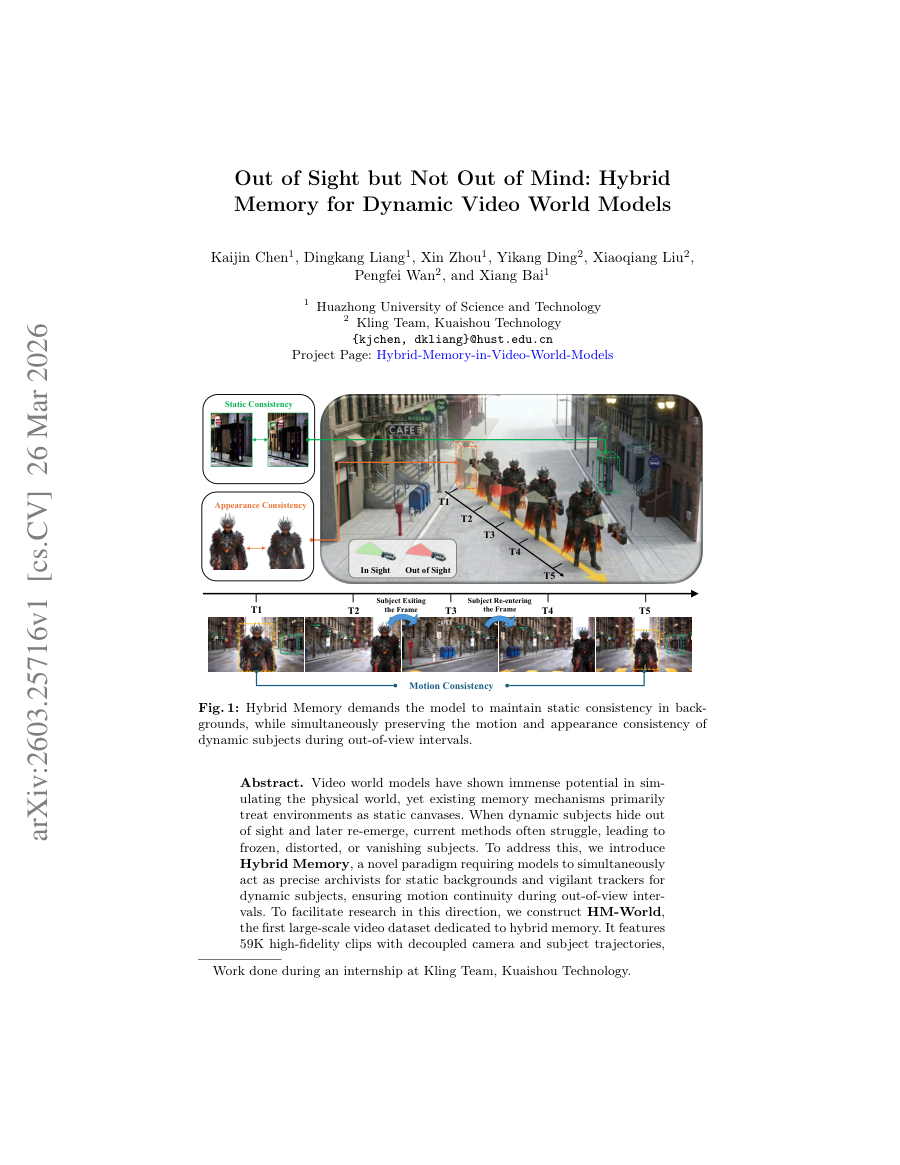
Out of Sight but Not Out of Mind: Hybrid Memory for Dynamic Video World Models
TL;DR: Hybrid Memory enables video world models to maintain consistent tracking of dynamic subjects during occlusion by combining archival storage for static backgrounds with active tracking for moving objects, using a...
Hybrid Memory enables video world models to maintain consistent tracking of dynamic subjects during occlusion by combining archival storage for static backgrounds with active tracking for moving objects, using a specialized architecture with tokenized memory and spatiotemporal retrieval mechanisms.
Hybrid Memory enables video world models to maintain consistent tracking of dynamic subjects during occlusion by combining archival storage for static backgrounds with active tracking for moving objects, using a specialized architecture with tokenized...
Hybrid Memory enables video world models to maintain consistent tracking of dynamic subjects during occlusion by combining archival storage for static backgrounds with active tracking for moving objects, using a specialized architecture with tokenized memory and spatiotemporal retrieval mechanisms.
Hybrid Memory enables video world models to maintain consistent tracking of dynamic subjects during occlusion by combining archival storage for static backgrounds with active tracking for moving objects, using a specialized architecture with tokenized memory and spatiotemporal retrieval mechanisms.
The summary does not include concrete numbers, so the practical size of the gain and the tradeoff against latency or data cost are still unclear.
- Problem framing: Hybrid Memory enables video world models to maintain consistent tracking of dynamic subjects during occlusion by combining archival storage for static backgrounds with active tracking for moving objects, using a specialized architecture...
- Method signal: Hybrid Memory enables video world models to maintain consistent tracking of dynamic subjects during occlusion by combining archival storage for static backgrounds with active tracking for moving objects, using a specialized architecture with...
- Evidence to watch: Hybrid Memory enables video world models to maintain consistent tracking of dynamic subjects during occlusion by combining archival storage for static backgrounds with active tracking for moving objects, using a specialized architecture...
- Read-through priority: the PDF is available, so this is a good candidate for checking tables, ablations, and scaling tradeoffs beyond the abstract from Hugging Face Papers / arXiv.
- Archival + active memory split.
- Tokenized memory with spatiotemporal retrieval.
- Occlusion‑robust tracking demonstrated.
- The summary does not include concrete numbers, so the practical size of the gain and the tradeoff against latency or data cost are still unclear.
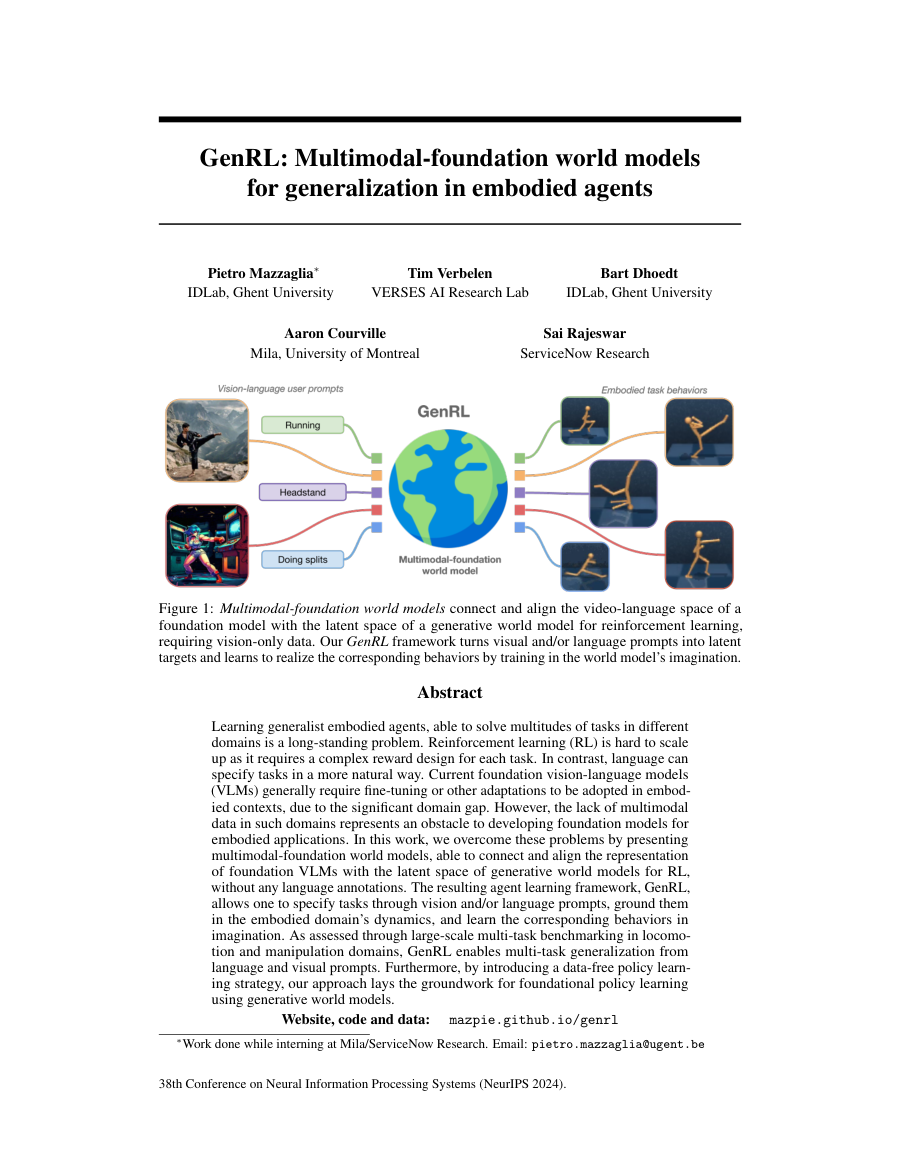
GenRL: Multimodal-foundation world models for generalization in embodied agents
TL;DR: Learning generalist embodied agents, able to solve multitudes of tasks in different domains is a long-standing problem.
Learning generalist embodied agents, able to solve multitudes of tasks in different domains is a long-standing problem. Reinforcement learning (RL) is hard to scale up as it requires a complex reward design for each task. In contrast, language can specify tasks in a more...
Learning generalist embodied agents, able to solve multitudes of tasks in different domains is a long-standing problem.
Furthermore, by introducing a data-free policy learning strategy, our approach lays the groundwork for foundational policy learning using generative world models.
Website, code and data: https://mazpie.github.io/genrl/
The abstract is promising, but we still need to inspect the full paper for compute cost, implementation complexity, and how broadly the gains transfer beyond the reported benchmarks.
- Problem framing: Learning generalist embodied agents, able to solve multitudes of tasks in different domains is a long-standing problem.
- Method signal: Furthermore, by introducing a data-free policy learning strategy, our approach lays the groundwork for foundational policy learning using generative world models.
- Evidence to watch: Website, code and data: https://mazpie.github.io/genrl/
- Read-through priority: the PDF is available, so this is a good candidate for checking tables, ablations, and scaling tradeoffs beyond the abstract from NeurIPS 2024.
- Problem: Learning generalist embodied agents, able to solve multitudes of tasks in different domains is a long-standing problem.
- Approach: Furthermore, by introducing a data-free policy learning strategy, our approach lays the groundwork for foundational policy learning using generative world models.
- Result signal: Website, code and data: https://mazpie.github.io/genrl/
- Conference context: NeurIPS 2024 Main Conference Track
- The abstract is promising, but we still need to inspect the full paper for compute cost, implementation complexity, and how broadly the gains transfer beyond the reported benchmarks.
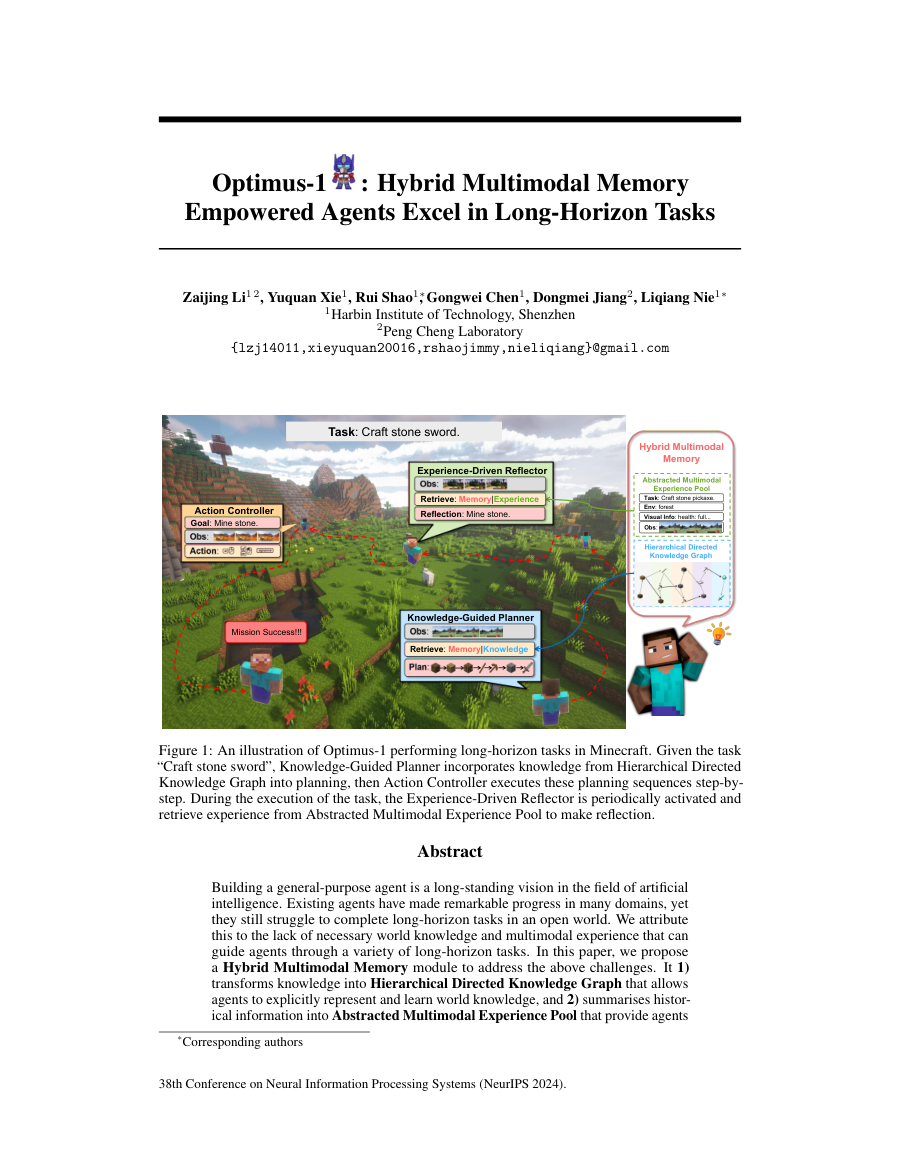
Optimus-1: Hybrid Multimodal Memory Empowered Agents Excel in Long-Horizon Tasks
TL;DR: Building a general-purpose agent is a long-standing vision in the field of artificial intelligence.
Building a general-purpose agent is a long-standing vision in the field of artificial intelligence. Existing agents have made remarkable progress in many domains, yet they still struggle to complete long-horizon tasks in an open world. We attribute this to the lack of...
Existing agents have made remarkable progress in many domains, yet they still struggle to complete long-horizon tasks in an open world.
In this paper, we propose a Hybrid Multimodal Memory module to address the above challenges.
Extensive experimental results show that Optimus-1 significantly outperforms all existing agents on challenging long-horizon task benchmarks, and exhibits near human-level performance on many tasks.
The abstract is promising, but we still need to inspect the full paper for compute cost, implementation complexity, and how broadly the gains transfer beyond the reported benchmarks.
- Problem framing: Existing agents have made remarkable progress in many domains, yet they still struggle to complete long-horizon tasks in an open world.
- Method signal: In this paper, we propose a Hybrid Multimodal Memory module to address the above challenges.
- Evidence to watch: Extensive experimental results show that Optimus-1 significantly outperforms all existing agents on challenging long-horizon task benchmarks, and exhibits near human-level performance on many tasks.
- Read-through priority: the PDF is available, so this is a good candidate for checking tables, ablations, and scaling tradeoffs beyond the abstract from NeurIPS 2024.
- Problem: Existing agents have made remarkable progress in many domains, yet they still struggle to complete long-horizon tasks in an open world.
- Approach: In this paper, we propose a Hybrid Multimodal Memory module to address the above challenges.
- Result signal: Extensive experimental results show that Optimus-1 significantly outperforms all existing agents on challenging long-horizon task benchmarks, and exhibits near human-level performance on many tasks.
- Conference context: NeurIPS 2024 Main Conference Track
- The abstract is promising, but we still need to inspect the full paper for compute cost, implementation complexity, and how broadly the gains transfer beyond the reported benchmarks.
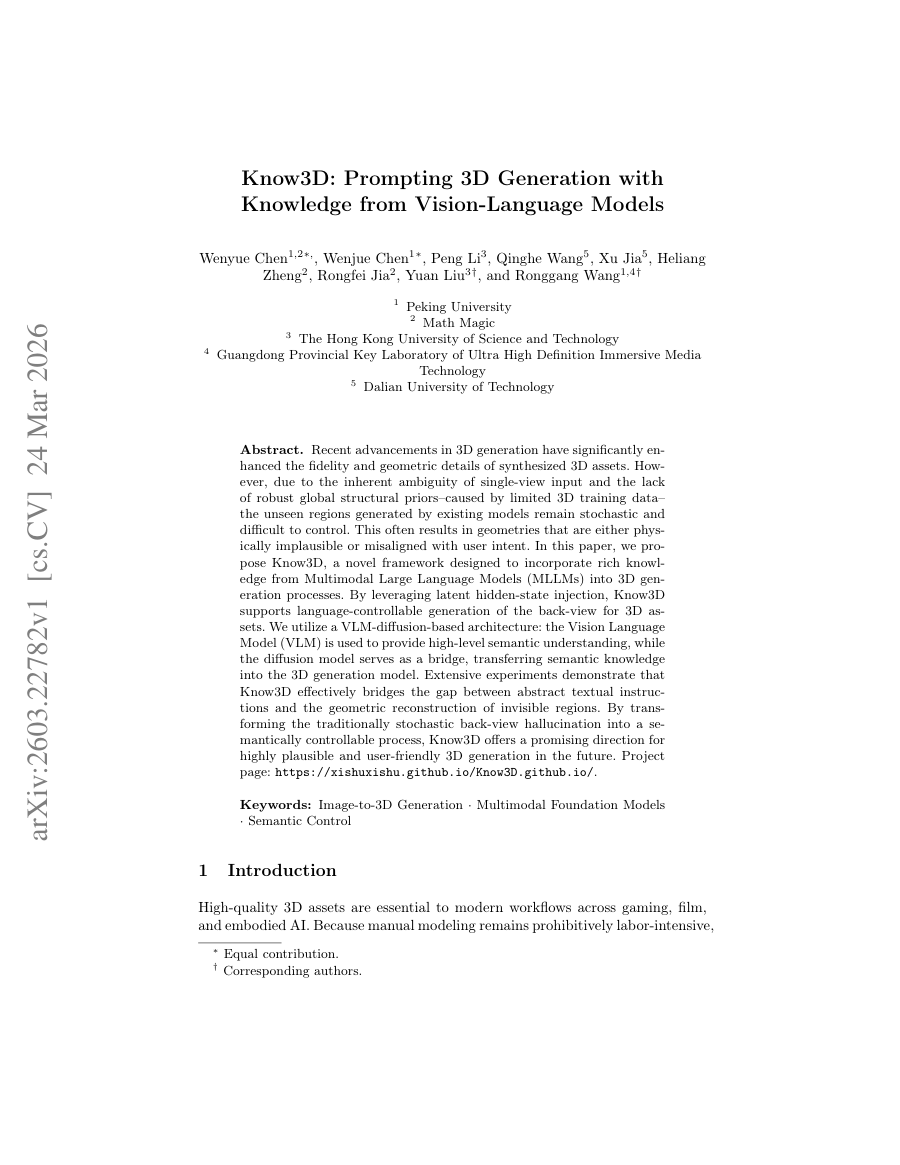
Know3D: Prompting 3D Generation with Knowledge from Vision-Language Models
TL;DR: Know3D integrates multimodal large language models with 3D generation through latent hidden-state injection, enabling language-controlled back-view synthesis by bridging semantic understanding and geometric...
Know3D integrates multimodal large language models with 3D generation through latent hidden-state injection, enabling language-controlled back-view synthesis by bridging semantic understanding and geometric reconstruction. Recent advances in 3D generation have improved the...
Know3D integrates multimodal large language models with 3D generation through latent hidden-state injection, enabling language-controlled back-view synthesis by bridging semantic understanding and geometric reconstruction.
In this paper, we propose Know3D, a novel framework that incorporates rich knowledge from multimodal large language models into 3D generative processes via latent hidden-state injection , enabling language-controllable generation of the back-view for 3D assets.
Recent advances in 3D generation have improved the fidelity and geometric details of synthesized 3D assets.
The reported improvement still needs a closer check on benchmark scope, ablations, and whether the method keeps working outside the authors' evaluation setup.
- Problem framing: Know3D integrates multimodal large language models with 3D generation through latent hidden-state injection, enabling language-controlled back-view synthesis by bridging semantic understanding and geometric reconstruction.
- Method signal: In this paper, we propose Know3D, a novel framework that incorporates rich knowledge from multimodal large language models into 3D generative processes via latent hidden-state injection , enabling language-controllable generation of the...
- Evidence to watch: Recent advances in 3D generation have improved the fidelity and geometric details of synthesized 3D assets.
- Read-through priority: the PDF is available, so this is a good candidate for checking tables, ablations, and scaling tradeoffs beyond the abstract from Hugging Face Papers / arXiv.
- Problem: Know3D integrates multimodal large language models with 3D generation through latent hidden-state injection, enabling language-controlled back-view synthesis by bridging semantic understanding and geometric...
- Approach: In this paper, we propose Know3D, a novel framework that incorporates rich knowledge from multimodal large language models into 3D generative processes via latent hidden-state injection , enabling...
- Result signal: Recent advances in 3D generation have improved the fidelity and geometric details of synthesized 3D assets.
- Community traction: Hugging Face Papers shows 4 votes for this paper.
- The reported improvement still needs a closer check on benchmark scope, ablations, and whether the method keeps working outside the authors' evaluation setup.
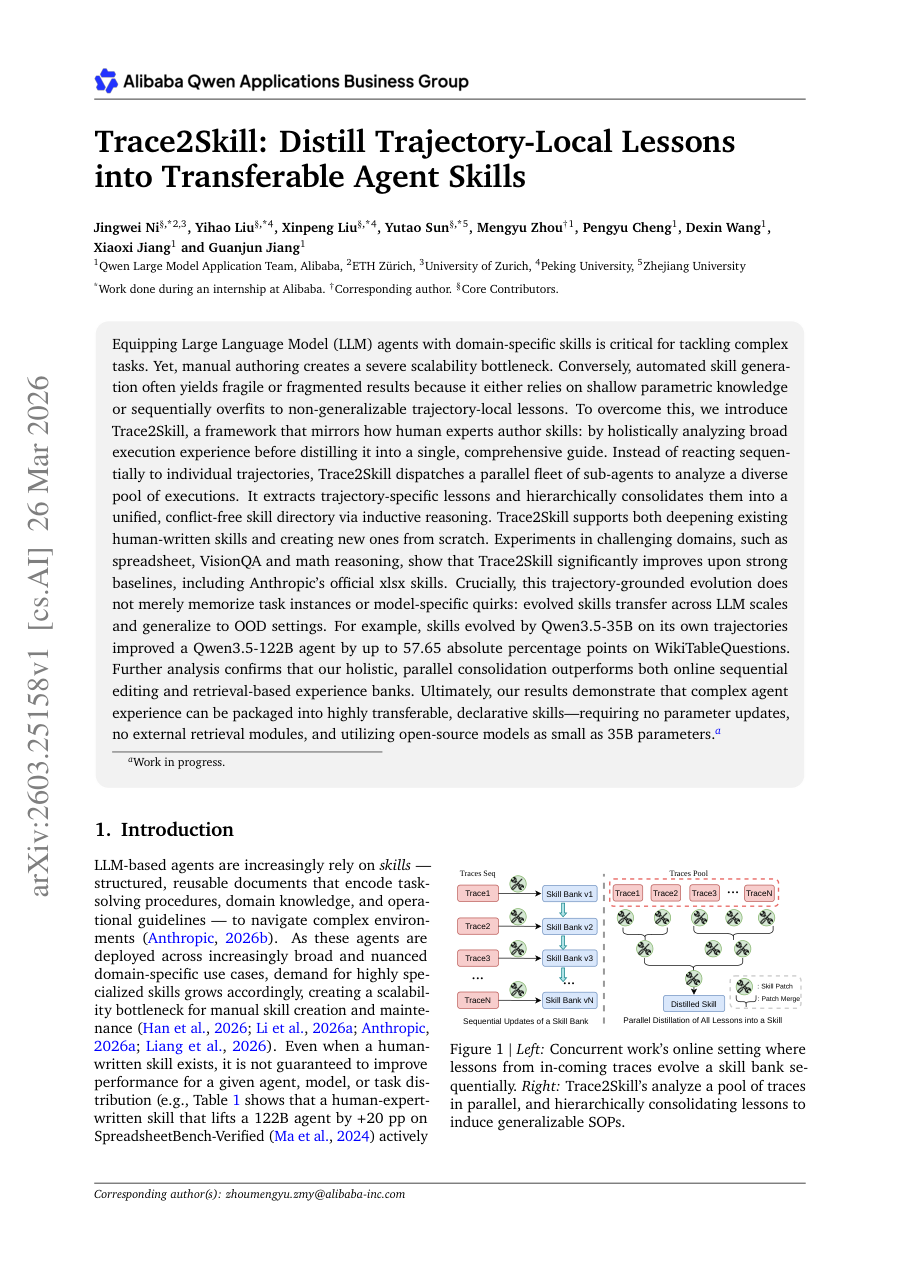
Trace2Skill: Distill Trajectory-Local Lessons into Transferable Agent Skills
TL;DR: Trace2Skill enables scalable skill generation for LLM agents by analyzing diverse execution traces in parallel and consolidating them into transferable, declarative skills without parameter updates or external modules.
Trace2Skill enables scalable skill generation for LLM agents by analyzing diverse execution traces in parallel and consolidating them into transferable, declarative skills without parameter updates or external modules. Equipping Large Language Model (LLM) agents with...
Equipping Large Language Model (LLM) agents with domain-specific skills is critical for tackling complex tasks.
To overcome this, we introduce Trace2Skill, a framework that mirrors how human experts author skills: by holistically analyzing broad execution experience before distilling it into a single, comprehensive guide.
Experiments in challenging domains, such as spreadsheet, VisionQA and math reasoning, show that Trace2Skill significantly improves upon strong baselines, including Anthropic's official xlsx skills.
The reported improvement still needs a closer check on benchmark scope, ablations, and whether the method keeps working outside the authors' evaluation setup.
- Problem framing: Equipping Large Language Model (LLM) agents with domain-specific skills is critical for tackling complex tasks.
- Method signal: To overcome this, we introduce Trace2Skill, a framework that mirrors how human experts author skills: by holistically analyzing broad execution experience before distilling it into a single, comprehensive guide.
- Evidence to watch: Experiments in challenging domains, such as spreadsheet, VisionQA and math reasoning, show that Trace2Skill significantly improves upon strong baselines, including Anthropic's official xlsx skills.
- Read-through priority: the PDF is available, so this is a good candidate for checking tables, ablations, and scaling tradeoffs beyond the abstract from Hugging Face Papers / arXiv.
- Problem: Equipping Large Language Model (LLM) agents with domain-specific skills is critical for tackling complex tasks.
- Approach: To overcome this, we introduce Trace2Skill, a framework that mirrors how human experts author skills: by holistically analyzing broad execution experience before distilling it into a single, comprehensive...
- Result signal: Experiments in challenging domains, such as spreadsheet, VisionQA and math reasoning, show that Trace2Skill significantly improves upon strong baselines, including Anthropic's official xlsx skills.
- Community traction: Hugging Face Papers shows 13 votes for this paper.
- The reported improvement still needs a closer check on benchmark scope, ablations, and whether the method keeps working outside the authors' evaluation setup.
Everything selected into the run.
The complete analyzed stream for the issue, useful when you want to scan the entire run instead of only the curated front page.
Introducing GPT-5.4
OpenAI announces the release of GPT-5.4, a new large language model with improved reasoning and efficiency.
Marks a step forward in the GPT series, offering better performance for downstream AI applications.
- Enhanced reasoning capabilities.
- Improved token efficiency.
Introducing the OpenAI Safety Bug Bounty program
OpenAI launches a bug bounty program focused on safety vulnerabilities in its models and infrastructure.
Encourages external researchers to identify and report safety flaws, improving model robustness and public trust.
- Bounty rewards for safety‑critical findings.
- Clear scope covering model outputs, API behavior, and infrastructure.
OpenAI halts "Adult Mode" as advisors, investors, and employees raise red flags
OpenAI pauses its Adult Mode feature after internal concerns about safety and misuse.
Highlights the tension between product innovation and responsible AI deployment.
- Feature suspension pending safety review.
- Internal governance mechanisms activated.
A Coding Guide to Exploring nanobot’s Full Agent Pipeline, from Wiring Up Tools and Memory to Skills, Subagents, and Cron Scheduling
A Coding Guide to Exploring nanobot’s Full Agent Pipeline, from Wiring Up Tools and Memory to Skills, Subagents, and Cron Scheduling MarkTechPost
A Coding Guide to Exploring nanobot’s Full Agent Pipeline, from Wiring Up Tools and Memory to Skills, Subagents, and Cron Scheduling matters because it signals momentum in agent, agents and may shift how teams prioritize models, tooling, or deployment choices.
- Primary signals: agent, agents.
- Source context: MarkTechPost published or updated this item on 03/29/2026.
Chroma Releases Context-1: A 20B Agentic Search Model for Multi-Hop Retrieval, Context Management, and Scalable Synthetic Task Generation
Chroma Releases Context-1: A 20B Agentic Search Model for Multi-Hop Retrieval, Context Management, and Scalable Synthetic Task Generation MarkTechPost
Chroma Releases Context-1: A 20B Agentic Search Model for Multi-Hop Retrieval, Context Management, and Scalable Synthetic Task Generation matters because it signals momentum in agent, model and may shift how teams prioritize models, tooling, or deployment choices.
- Primary signals: agent, model.
- Source context: MarkTechPost published or updated this item on 03/29/2026.

Visa prepares payment systems for AI agent-initiated transactions
Payments rely on a simple model: a person decides to buy something, and a bank or card network processes the transaction. That model is starting to change as Visa tests how AI agents can initiate payments. New work in the banking sector suggests that, in some cases, software...
Visa prepares payment systems for AI agent-initiated transactions matters because it signals momentum in agent, agents, model and may shift how teams prioritize models, tooling, or deployment choices.
- Primary signals: agent, agents, model.
- Source context: AI News published or updated this item on 03/19/2026.
Google-Agent vs Googlebot: Google Defines the Technical Boundary Between User Triggered AI Access and Search Crawling Systems Today
Google-Agent vs Googlebot: Google Defines the Technical Boundary Between User Triggered AI Access and Search Crawling Systems Today MarkTechPost
Google-Agent vs Googlebot: Google Defines the Technical Boundary Between User Triggered AI Access and Search Crawling Systems Today matters because it signals momentum in agent and may shift how teams prioritize models, tooling, or deployment choices.
- Primary signals: agent.
- Source context: MarkTechPost published or updated this item on 03/29/2026.
Identifying Interactions at Scale for LLMs
Understanding the behavior of complex machine learning systems, particularly Large Language Models (LLMs), is a critical challenge in modern artificial intelligence. Interpretability research aims to make the decision-making process more transparent to model builders and...
Identifying Interactions at Scale for LLMs matters because it signals momentum in llm, model and may shift how teams prioritize models, tooling, or deployment choices.
- Primary signals: llm, model.
- Source context: BAIR Blog published or updated this item on 03/13/2026.

NVIDIA wants enterprise AI agents safer to deploy
The NVIDIA Agent Toolkit is Jensen Huang’s answer to the question enterprises keep asking: how do we put AI agents to work without losing control of our data and our liability? Announced at GTC 2026 in San Jose on March 16, the NVIDIA Agent Toolkit is an open-source software...
NVIDIA wants enterprise AI agents safer to deploy matters because it signals momentum in agent, agents and may shift how teams prioritize models, tooling, or deployment choices.
- Primary signals: agent, agents.
- Source context: AI News published or updated this item on 03/19/2026.
13 Modern Reinforcement Learning Approaches for LLM Post-Training
13 Modern Reinforcement Learning Approaches for LLM Post-Training turingpost.com
13 Modern Reinforcement Learning Approaches for LLM Post-Training matters because it signals momentum in llm, training and may shift how teams prioritize models, tooling, or deployment choices.
- Primary signals: llm, training.
- Source context: Turing Post published or updated this item on 03/22/2026.

A New Framework for Evaluating Voice Agents (EVA)
A Blog post by ServiceNow-AI on Hugging Face
A New Framework for Evaluating Voice Agents (EVA) matters because it signals momentum in agent, agents and may shift how teams prioritize models, tooling, or deployment choices.
- Primary signals: agent, agents.
- Source context: Hugging Face Blog published or updated this item on 03/24/2026.

AI agents enter banking roles at Bank of America
AI agents are starting to take on a more direct role in how financial advice is delivered, as large banks move into systems that support client interactions. Bank of America is now deploying an internal AI-powered advisory platform to a subset of financial advisers, rolled...
AI agents enter banking roles at Bank of America matters because it signals momentum in agent, agents and may shift how teams prioritize models, tooling, or deployment choices.
- Primary signals: agent, agents.
- Source context: AI News published or updated this item on 03/25/2026.
Anthropic leak reveals new model "Claude Mythos" with "dramatically higher scores on tests" than any previous model
Anthropic leak reveals new model "Claude Mythos" with "dramatically higher scores on tests" than any previous model the-decoder.com
Anthropic leak reveals new model "Claude Mythos" with "dramatically higher scores on tests" than any previous model matters because it signals momentum in model and may shift how teams prioritize models, tooling, or deployment choices.
- Primary signals: model.
- Source context: The Decoder published or updated this item on 03/28/2026.
Mistral AI Releases Voxtral TTS: A 4B Open-Weight Streaming Speech Model for Low-Latency Multilingual Voice Generation
Mistral AI Releases Voxtral TTS: A 4B Open-Weight Streaming Speech Model for Low-Latency Multilingual Voice Generation MarkTechPost
Mistral AI Releases Voxtral TTS: A 4B Open-Weight Streaming Speech Model for Low-Latency Multilingual Voice Generation matters because it signals momentum in model and may shift how teams prioritize models, tooling, or deployment choices.
- Primary signals: model.
- Source context: MarkTechPost published or updated this item on 03/28/2026.
14 JEPA Milestones as a Map of AI Progress
14 JEPA Milestones as a Map of AI Progress turingpost.com
14 JEPA Milestones as a Map of AI Progress matters because it signals momentum in the broader AI ecosystem and may shift how teams prioritize models, tooling, or deployment choices.
- Primary signals: AI platforms and product execution.
- Source context: Turing Post published or updated this item on 03/29/2026.
Balancing Ethics and Innovation in AI Decision-Making
Balancing Ethics and Innovation in AI Decision-Making aimagazine.com
Balancing Ethics and Innovation in AI Decision-Making matters because it signals momentum in the broader AI ecosystem and may shift how teams prioritize models, tooling, or deployment choices.
- Primary signals: AI platforms and product execution.
- Source context: AI Magazine published or updated this item on 03/29/2026.
QuantumBlack: A Global Force in Agentic AI Transformation
QuantumBlack: A Global Force in Agentic AI Transformation aimagazine.com
QuantumBlack: A Global Force in Agentic AI Transformation matters because it signals momentum in agent and may shift how teams prioritize models, tooling, or deployment choices.
- Primary signals: agent.
- Source context: AI Magazine published or updated this item on 03/16/2026.
OpenAI Model Craft: Parameter Golf
OpenAI Model Craft: Parameter Golf OpenAI
OpenAI Model Craft: Parameter Golf matters because it signals momentum in model and may shift how teams prioritize models, tooling, or deployment choices.
- Primary signals: model.
- Source context: OpenAI Research published or updated this item on 03/18/2026.
Build a Domain-Specific Embedding Model in Under a Day
A Blog post by NVIDIA on Hugging Face
Build a Domain-Specific Embedding Model in Under a Day matters because it signals momentum in model and may shift how teams prioritize models, tooling, or deployment choices.
- Primary signals: model.
- Source context: Hugging Face Blog published or updated this item on 03/20/2026.

Automating complex finance workflows with multimodal AI
Finance leaders are automating their complex workflows by actively adopting powerful new multimodal AI frameworks. Extracting text from unstructured documents presents a frequent headache for developers. Historically, standard optical character recognition systems failed to...
Automating complex finance workflows with multimodal AI matters because it signals momentum in multimodal and may shift how teams prioritize models, tooling, or deployment choices.
- Primary signals: multimodal.
- Source context: AI News published or updated this item on 03/24/2026.
Agentic commerce runs on truth and context
Agentic commerce runs on truth and context MIT Technology Review
Agentic commerce runs on truth and context matters because it signals momentum in agent and may shift how teams prioritize models, tooling, or deployment choices.
- Primary signals: agent.
- Source context: MIT Tech Review AI published or updated this item on 03/25/2026.
Inside our approach to the Model Spec
Inside our approach to the Model Spec OpenAI
Inside our approach to the Model Spec matters because it signals momentum in model and may shift how teams prioritize models, tooling, or deployment choices.
- Primary signals: model.
- Source context: OpenAI Research published or updated this item on 03/25/2026.
OpenAI CEO Sam Altman reportedly teases a "very strong" model internally that can "really accelerate the economy"
OpenAI CEO Sam Altman reportedly teases a "very strong" model internally that can "really accelerate the economy" the-decoder.com
OpenAI CEO Sam Altman reportedly teases a "very strong" model internally that can "really accelerate the economy" matters because it signals momentum in model and may shift how teams prioritize models, tooling, or deployment choices.
- Primary signals: model.
- Source context: The Decoder published or updated this item on 03/25/2026.
Anthropic reportedly views itself as the antidote to OpenAI's "tobacco industry" approach to AI
Anthropic reportedly views itself as the antidote to OpenAI's "tobacco industry" approach to AI the-decoder.com
Anthropic reportedly views itself as the antidote to OpenAI's "tobacco industry" approach to AI matters because it signals momentum in the broader AI ecosystem and may shift how teams prioritize models, tooling, or deployment choices.
- Primary signals: AI platforms and product execution.
- Source context: The Decoder published or updated this item on 03/28/2026.
Autonomous AI Is Here. Control Is Falling Behind 🛡️
Autonomous AI Is Here. Control Is Falling Behind 🛡️ turingpost.com
Autonomous AI Is Here. Control Is Falling Behind 🛡️ matters because it signals momentum in the broader AI ecosystem and may shift how teams prioritize models, tooling, or deployment choices.
- Primary signals: AI platforms and product execution.
- Source context: Turing Post published or updated this item on 03/27/2026.

Liberate your OpenClaw
We’re on a journey to advance and democratize artificial intelligence through open source and open science.
Liberate your OpenClaw matters because it signals momentum in the broader AI ecosystem and may shift how teams prioritize models, tooling, or deployment choices.
- Primary signals: AI platforms and product execution.
- Source context: Hugging Face Blog published or updated this item on 03/27/2026.
The Download: the internet’s best weather app, and why people freeze their brains
The Download: the internet’s best weather app, and why people freeze their brains MIT Technology Review
The Download: the internet’s best weather app, and why people freeze their brains matters because it signals momentum in the broader AI ecosystem and may shift how teams prioritize models, tooling, or deployment choices.
- Primary signals: AI platforms and product execution.
- Source context: MIT Tech Review AI published or updated this item on 03/27/2026.
Labor market impacts of AI: A new measure and early evidence
Labor market impacts of AI: A new measure and early evidence Anthropic
Labor market impacts of AI: A new measure and early evidence matters because it signals momentum in the broader AI ecosystem and may shift how teams prioritize models, tooling, or deployment choices.
- Primary signals: AI platforms and product execution.
- Source context: Anthropic Research published or updated this item on 03/05/2026.

Introducing Storage Buckets on the Hugging Face Hub
We’re on a journey to advance and democratize artificial intelligence through open source and open science.
Introducing Storage Buckets on the Hugging Face Hub matters because it signals momentum in the broader AI ecosystem and may shift how teams prioritize models, tooling, or deployment choices.
- Primary signals: AI platforms and product execution.
- Source context: Hugging Face Blog published or updated this item on 03/10/2026.
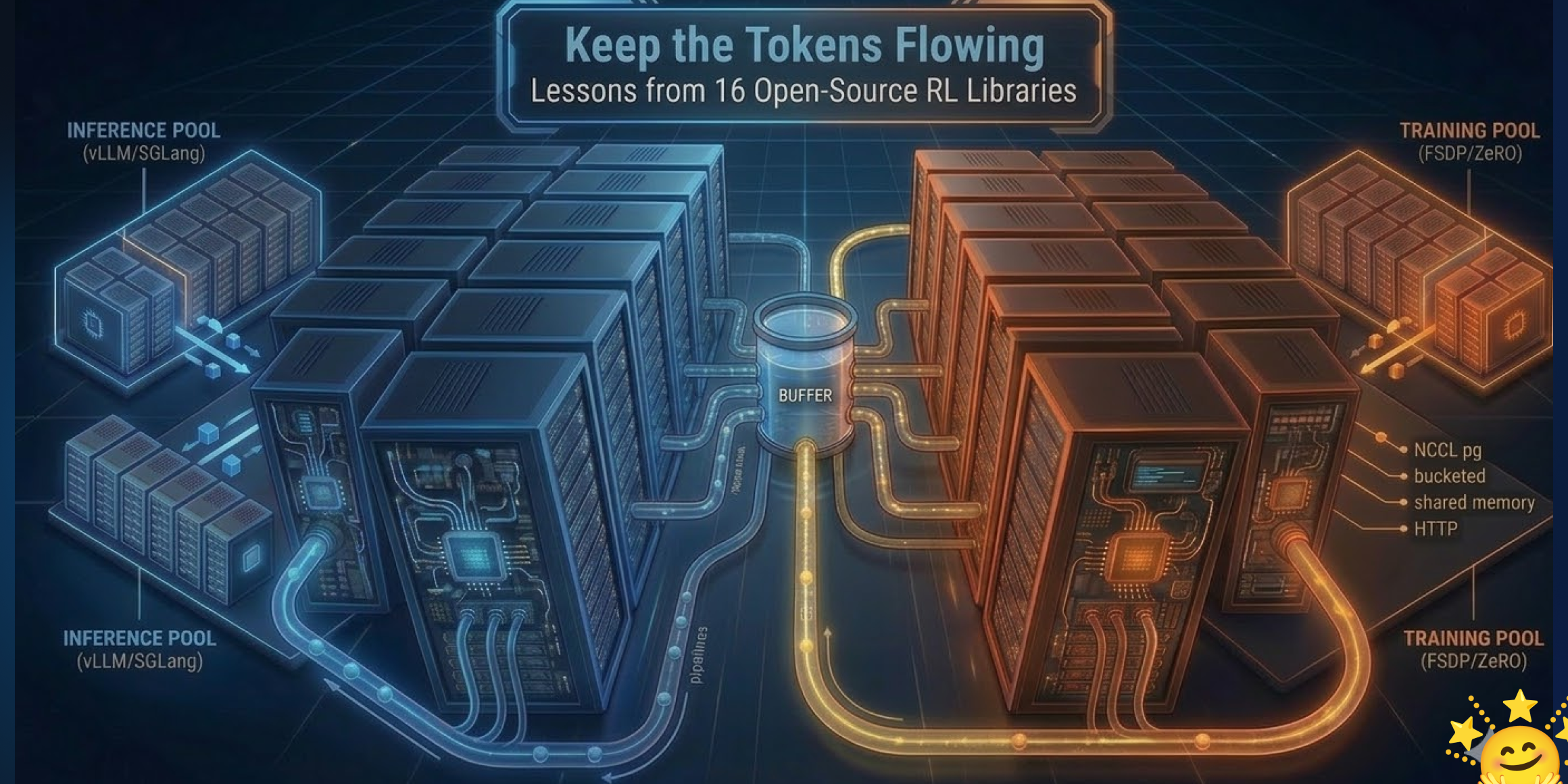
Keep the Tokens Flowing: Lessons from 16 Open-Source RL Libraries
We’re on a journey to advance and democratize artificial intelligence through open source and open science.
Keep the Tokens Flowing: Lessons from 16 Open-Source RL Libraries matters because it signals momentum in the broader AI ecosystem and may shift how teams prioritize models, tooling, or deployment choices.
- Primary signals: AI platforms and product execution.
- Source context: Hugging Face Blog published or updated this item on 03/10/2026.
How Apple's US$600bn US Investment Helps AI Infrastructure
How Apple's US$600bn US Investment Helps AI Infrastructure aimagazine.com
How Apple's US$600bn US Investment Helps AI Infrastructure matters because it signals momentum in the broader AI ecosystem and may shift how teams prioritize models, tooling, or deployment choices.
- Primary signals: AI platforms and product execution.
- Source context: AI Magazine published or updated this item on 03/18/2026.
Top 10: AI Platforms for Retail
Top 10: AI Platforms for Retail aimagazine.com
Top 10: AI Platforms for Retail matters because it signals momentum in the broader AI ecosystem and may shift how teams prioritize models, tooling, or deployment choices.
- Primary signals: AI platforms and product execution.
- Source context: AI Magazine published or updated this item on 03/18/2026.

What's New in Mellea 0.4.0 + Granite Libraries Release
A Blog post by IBM Granite on Hugging Face
What's New in Mellea 0.4.0 + Granite Libraries Release matters because it signals momentum in the broader AI ecosystem and may shift how teams prioritize models, tooling, or deployment choices.
- Primary signals: AI platforms and product execution.
- Source context: Hugging Face Blog published or updated this item on 03/20/2026.
The Org Age of AI
The Org Age of AI turingpost.com
The Org Age of AI matters because it signals momentum in the broader AI ecosystem and may shift how teams prioritize models, tooling, or deployment choices.
- Primary signals: AI platforms and product execution.
- Source context: Turing Post published or updated this item on 03/22/2026.
Introducing our Science Blog
Introducing our Science Blog Anthropic
Introducing our Science Blog matters because it signals momentum in the broader AI ecosystem and may shift how teams prioritize models, tooling, or deployment choices.
- Primary signals: AI platforms and product execution.
- Source context: Anthropic Research published or updated this item on 03/23/2026.
Long-running Claude for scientific computing
Long-running Claude for scientific computing Anthropic
Long-running Claude for scientific computing matters because it signals momentum in the broader AI ecosystem and may shift how teams prioritize models, tooling, or deployment choices.
- Primary signals: AI platforms and product execution.
- Source context: Anthropic Research published or updated this item on 03/23/2026.

Palantir AI to support UK finance operations
UK authorities believe improving efficiency across national finance operations requires applying AI platforms from vendors like Palantir. The country’s financial regulator, the FCA, has initiated a project leveraging AI to identify illicit activities. The FCA is currently...
Palantir AI to support UK finance operations matters because it signals momentum in the broader AI ecosystem and may shift how teams prioritize models, tooling, or deployment choices.
- Primary signals: AI platforms and product execution.
- Source context: AI News published or updated this item on 03/23/2026.
The hardest question to answer about AI-fueled delusions
The hardest question to answer about AI-fueled delusions MIT Technology Review
The hardest question to answer about AI-fueled delusions matters because it signals momentum in the broader AI ecosystem and may shift how teams prioritize models, tooling, or deployment choices.
- Primary signals: AI platforms and product execution.
- Source context: MIT Tech Review AI published or updated this item on 03/23/2026.
Vibe physics: The AI grad student
Vibe physics: The AI grad student Anthropic
Vibe physics: The AI grad student matters because it signals momentum in the broader AI ecosystem and may shift how teams prioritize models, tooling, or deployment choices.
- Primary signals: AI platforms and product execution.
- Source context: Anthropic Research published or updated this item on 03/23/2026.
Anthropic Economic Index report: Learning curves
Anthropic Economic Index report: Learning curves Anthropic
Anthropic Economic Index report: Learning curves matters because it signals momentum in the broader AI ecosystem and may shift how teams prioritize models, tooling, or deployment choices.
- Primary signals: AI platforms and product execution.
- Source context: Anthropic Research published or updated this item on 03/24/2026.

Ocorian: Family offices turn to AI for financial data insights
To gain financial data insights, the majority of family offices now turn to AI, according to new research from Ocorian. The global study reveals 86 percent of these private wealth groups are utilising AI to improve their daily operations and data analysis. Representing a...
Ocorian: Family offices turn to AI for financial data insights matters because it signals momentum in the broader AI ecosystem and may shift how teams prioritize models, tooling, or deployment choices.
- Primary signals: AI platforms and product execution.
- Source context: AI News published or updated this item on 03/25/2026.
The AI Hype Index: AI goes to war
The AI Hype Index: AI goes to war MIT Technology Review
The AI Hype Index: AI goes to war matters because it signals momentum in the broader AI ecosystem and may shift how teams prioritize models, tooling, or deployment choices.
- Primary signals: AI platforms and product execution.
- Source context: MIT Tech Review AI published or updated this item on 03/25/2026.
This startup wants to change how mathematicians do math
This startup wants to change how mathematicians do math MIT Technology Review
This startup wants to change how mathematicians do math matters because it signals momentum in the broader AI ecosystem and may shift how teams prioritize models, tooling, or deployment choices.
- Primary signals: AI platforms and product execution.
- Source context: MIT Tech Review AI published or updated this item on 03/25/2026.
Indosat: How AI Investments are Fulfilling Digital Ambitions
Indosat: How AI Investments are Fulfilling Digital Ambitions aimagazine.com
Indosat: How AI Investments are Fulfilling Digital Ambitions matters because it signals momentum in the broader AI ecosystem and may shift how teams prioritize models, tooling, or deployment choices.
- Primary signals: AI platforms and product execution.
- Source context: AI Magazine published or updated this item on 03/26/2026.
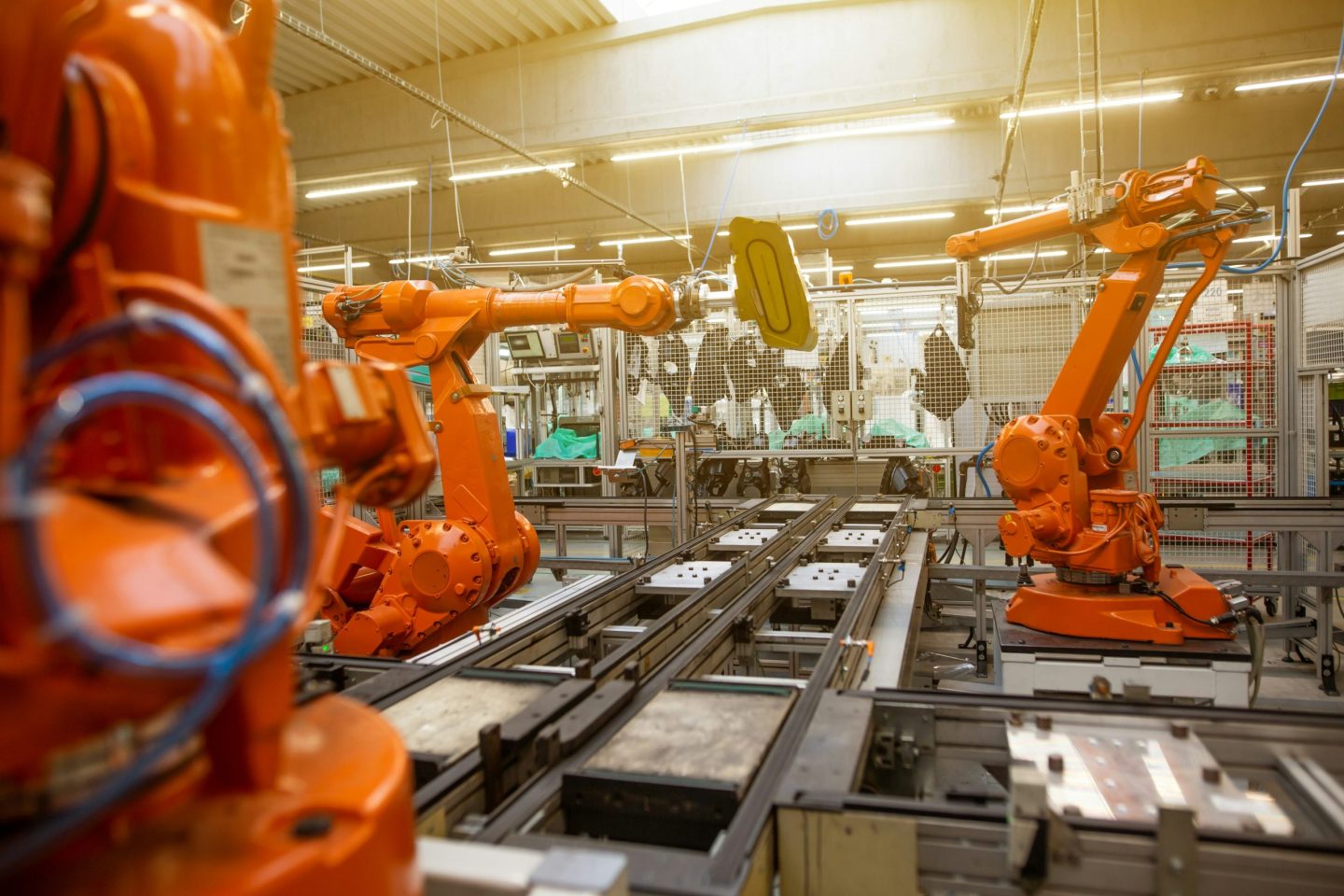
RPA matters, but AI changes how automation works
RPA (robotic process automation) is a practical and proven way to reduce manual work in business processes without AI systems. By using software bots to follow fixed rules, companies can automate repetitive tasks like data entry and invoice processing, and to a certain...
RPA matters, but AI changes how automation works matters because it signals momentum in the broader AI ecosystem and may shift how teams prioritize models, tooling, or deployment choices.
- Primary signals: AI platforms and product execution.
- Source context: AI News published or updated this item on 03/26/2026.
Meta signs $27 billion cloud deal with Nebius in one of the largest AI infrastructure bets yet
Meta commits to a $27 billion cloud infrastructure agreement with Nebius to support its AI workloads.
Illustrates the massive scale of capital being poured into AI‑ready cloud resources by major tech firms.
- Long‑term cloud capacity commitment.
- Focus on AI‑optimized hardware.
China AI Startup Moonshot Snags Funds at $18 Billion Valuation
A Chinese AI startup achieves an $18 billion valuation after a new funding round.
Signals massive investor confidence in China’s AI sector and its global competitiveness.
- Large‑scale venture investment.
- Valuation reflects expectations of rapid growth.
Meet A-Evolve: The PyTorch Moment For Agentic AI Systems Replacing Manual Tuning With Automated State Mutation And Self-Correction
Meet A-Evolve: The PyTorch Moment For Agentic AI Systems Replacing Manual Tuning With Automated State Mutation And Self-Correction MarkTechPost
Meet A-Evolve: The PyTorch Moment For Agentic AI Systems Replacing Manual Tuning With Automated State Mutation And Self-Correction matters because it affects the policy, supply-chain, or security constraints around AI development, especially across state, agent.
- Primary signals: state, agent.
- Source context: MarkTechPost published or updated this item on 03/29/2026.
US Withdraws Draft Rule That Called for Global AI Chip Permits
The U.S. government withdraws a proposed rule that would have required global licensing for AI chip exports.
Reflects shifting policy attitudes toward AI hardware proliferation and national security concerns.
- Rule removal reduces export licensing burden.
- May accelerate global AI chip distribution.
From model to agent: Equipping the Responses API with a computer environment
From model to agent: Equipping the Responses API with a computer environment OpenAI
From model to agent: Equipping the Responses API with a computer environment matters because it affects the policy, supply-chain, or security constraints around AI development, especially across compute, agent, model.
- Primary signals: compute, agent, model.
- Source context: OpenAI Research published or updated this item on 03/11/2026.
Securing AI systems under today’s and tomorrow’s conditions
Evidence cited in an eBook titled “AI Quantum Resilience”, published by Utimaco [email wall], shows organisations consider security risks as the leading barrier to effective adoption of AI on data they hold. AI’s value depends on data amassed by an organisation. However,...
Securing AI systems under today’s and tomorrow’s conditions matters because it affects the policy, supply-chain, or security constraints around AI development, especially across security, model, training.
- Primary signals: security, model, training.
- Source context: AI News published or updated this item on 03/24/2026.
Holotron-12B - High Throughput Computer Use Agent
A Blog post by H company on Hugging Face
Holotron-12B - High Throughput Computer Use Agent matters because it affects the policy, supply-chain, or security constraints around AI development, especially across compute, agent.
- Primary signals: compute, agent.
- Source context: Hugging Face Blog published or updated this item on 03/17/2026.
China AI Startup Moonshot Snags Funds at $18 Billion Valuation
China AI Startup Moonshot Snags Funds at $18 Billion Valuation is one of the notable items tracked in today's digest.
China AI Startup Moonshot Snags Funds at $18 Billion Valuation matters because it affects the policy, supply-chain, or security constraints around AI development, especially across china.
- Primary signals: china.
- Source context: Unknown source published or updated this item on 03/30/2026.

State of Open Source on Hugging Face: Spring 2026
A Blog post by Hugging Face on Hugging Face
State of Open Source on Hugging Face: Spring 2026 matters because it affects the policy, supply-chain, or security constraints around AI development, especially across state.
- Primary signals: state.
- Source context: Hugging Face Blog published or updated this item on 03/17/2026.
GenRL: Multimodal-foundation world models for generalization in embodied agents
TL;DR: Learning generalist embodied agents, able to solve multitudes of tasks in different domains is a long-standing problem.
Learning generalist embodied agents, able to solve multitudes of tasks in different domains is a long-standing problem. Reinforcement learning (RL) is hard to scale up as it requires a complex reward design for each task. In contrast, language can specify tasks in a more...
Learning generalist embodied agents, able to solve multitudes of tasks in different domains is a long-standing problem.
Furthermore, by introducing a data-free policy learning strategy, our approach lays the groundwork for foundational policy learning using generative world models.
Website, code and data: https://mazpie.github.io/genrl/
The abstract is promising, but we still need to inspect the full paper for compute cost, implementation complexity, and how broadly the gains transfer beyond the reported benchmarks.
- Problem framing: Learning generalist embodied agents, able to solve multitudes of tasks in different domains is a long-standing problem.
- Method signal: Furthermore, by introducing a data-free policy learning strategy, our approach lays the groundwork for foundational policy learning using generative world models.
- Evidence to watch: Website, code and data: https://mazpie.github.io/genrl/
- Read-through priority: the PDF is available, so this is a good candidate for checking tables, ablations, and scaling tradeoffs beyond the abstract from NeurIPS 2024.
- Problem: Learning generalist embodied agents, able to solve multitudes of tasks in different domains is a long-standing problem.
- Approach: Furthermore, by introducing a data-free policy learning strategy, our approach lays the groundwork for foundational policy learning using generative world models.
- Result signal: Website, code and data: https://mazpie.github.io/genrl/
- Conference context: NeurIPS 2024 Main Conference Track
- The abstract is promising, but we still need to inspect the full paper for compute cost, implementation complexity, and how broadly the gains transfer beyond the reported benchmarks.
Optimus-1: Hybrid Multimodal Memory Empowered Agents Excel in Long-Horizon Tasks
TL;DR: Building a general-purpose agent is a long-standing vision in the field of artificial intelligence.
Building a general-purpose agent is a long-standing vision in the field of artificial intelligence. Existing agents have made remarkable progress in many domains, yet they still struggle to complete long-horizon tasks in an open world. We attribute this to the lack of...
Existing agents have made remarkable progress in many domains, yet they still struggle to complete long-horizon tasks in an open world.
In this paper, we propose a Hybrid Multimodal Memory module to address the above challenges.
Extensive experimental results show that Optimus-1 significantly outperforms all existing agents on challenging long-horizon task benchmarks, and exhibits near human-level performance on many tasks.
The abstract is promising, but we still need to inspect the full paper for compute cost, implementation complexity, and how broadly the gains transfer beyond the reported benchmarks.
- Problem framing: Existing agents have made remarkable progress in many domains, yet they still struggle to complete long-horizon tasks in an open world.
- Method signal: In this paper, we propose a Hybrid Multimodal Memory module to address the above challenges.
- Evidence to watch: Extensive experimental results show that Optimus-1 significantly outperforms all existing agents on challenging long-horizon task benchmarks, and exhibits near human-level performance on many tasks.
- Read-through priority: the PDF is available, so this is a good candidate for checking tables, ablations, and scaling tradeoffs beyond the abstract from NeurIPS 2024.
- Problem: Existing agents have made remarkable progress in many domains, yet they still struggle to complete long-horizon tasks in an open world.
- Approach: In this paper, we propose a Hybrid Multimodal Memory module to address the above challenges.
- Result signal: Extensive experimental results show that Optimus-1 significantly outperforms all existing agents on challenging long-horizon task benchmarks, and exhibits near human-level performance on many tasks.
- Conference context: NeurIPS 2024 Main Conference Track
- The abstract is promising, but we still need to inspect the full paper for compute cost, implementation complexity, and how broadly the gains transfer beyond the reported benchmarks.
Out of Sight but Not Out of Mind: Hybrid Memory for Dynamic Video World Models
TL;DR: Hybrid Memory enables video world models to maintain consistent tracking of dynamic subjects during occlusion by combining archival storage for static backgrounds with active tracking for moving objects, using a...
Hybrid Memory enables video world models to maintain consistent tracking of dynamic subjects during occlusion by combining archival storage for static backgrounds with active tracking for moving objects, using a specialized architecture with tokenized memory and spatiotemporal retrieval mechanisms.
Hybrid Memory enables video world models to maintain consistent tracking of dynamic subjects during occlusion by combining archival storage for static backgrounds with active tracking for moving objects, using a specialized architecture with tokenized...
Hybrid Memory enables video world models to maintain consistent tracking of dynamic subjects during occlusion by combining archival storage for static backgrounds with active tracking for moving objects, using a specialized architecture with tokenized memory and spatiotemporal retrieval mechanisms.
Hybrid Memory enables video world models to maintain consistent tracking of dynamic subjects during occlusion by combining archival storage for static backgrounds with active tracking for moving objects, using a specialized architecture with tokenized memory and spatiotemporal retrieval mechanisms.
The summary does not include concrete numbers, so the practical size of the gain and the tradeoff against latency or data cost are still unclear.
- Problem framing: Hybrid Memory enables video world models to maintain consistent tracking of dynamic subjects during occlusion by combining archival storage for static backgrounds with active tracking for moving objects, using a specialized architecture...
- Method signal: Hybrid Memory enables video world models to maintain consistent tracking of dynamic subjects during occlusion by combining archival storage for static backgrounds with active tracking for moving objects, using a specialized architecture with...
- Evidence to watch: Hybrid Memory enables video world models to maintain consistent tracking of dynamic subjects during occlusion by combining archival storage for static backgrounds with active tracking for moving objects, using a specialized architecture...
- Read-through priority: the PDF is available, so this is a good candidate for checking tables, ablations, and scaling tradeoffs beyond the abstract from Hugging Face Papers / arXiv.
- Archival + active memory split.
- Tokenized memory with spatiotemporal retrieval.
- Occlusion‑robust tracking demonstrated.
- The summary does not include concrete numbers, so the practical size of the gain and the tradeoff against latency or data cost are still unclear.
Know3D: Prompting 3D Generation with Knowledge from Vision-Language Models
TL;DR: Know3D integrates multimodal large language models with 3D generation through latent hidden-state injection, enabling language-controlled back-view synthesis by bridging semantic understanding and geometric...
Know3D integrates multimodal large language models with 3D generation through latent hidden-state injection, enabling language-controlled back-view synthesis by bridging semantic understanding and geometric reconstruction. Recent advances in 3D generation have improved the...
Know3D integrates multimodal large language models with 3D generation through latent hidden-state injection, enabling language-controlled back-view synthesis by bridging semantic understanding and geometric reconstruction.
In this paper, we propose Know3D, a novel framework that incorporates rich knowledge from multimodal large language models into 3D generative processes via latent hidden-state injection , enabling language-controllable generation of the back-view for 3D assets.
Recent advances in 3D generation have improved the fidelity and geometric details of synthesized 3D assets.
The reported improvement still needs a closer check on benchmark scope, ablations, and whether the method keeps working outside the authors' evaluation setup.
- Problem framing: Know3D integrates multimodal large language models with 3D generation through latent hidden-state injection, enabling language-controlled back-view synthesis by bridging semantic understanding and geometric reconstruction.
- Method signal: In this paper, we propose Know3D, a novel framework that incorporates rich knowledge from multimodal large language models into 3D generative processes via latent hidden-state injection , enabling language-controllable generation of the...
- Evidence to watch: Recent advances in 3D generation have improved the fidelity and geometric details of synthesized 3D assets.
- Read-through priority: the PDF is available, so this is a good candidate for checking tables, ablations, and scaling tradeoffs beyond the abstract from Hugging Face Papers / arXiv.
- Problem: Know3D integrates multimodal large language models with 3D generation through latent hidden-state injection, enabling language-controlled back-view synthesis by bridging semantic understanding and geometric...
- Approach: In this paper, we propose Know3D, a novel framework that incorporates rich knowledge from multimodal large language models into 3D generative processes via latent hidden-state injection , enabling...
- Result signal: Recent advances in 3D generation have improved the fidelity and geometric details of synthesized 3D assets.
- Community traction: Hugging Face Papers shows 4 votes for this paper.
- The reported improvement still needs a closer check on benchmark scope, ablations, and whether the method keeps working outside the authors' evaluation setup.
Trace2Skill: Distill Trajectory-Local Lessons into Transferable Agent Skills
TL;DR: Trace2Skill enables scalable skill generation for LLM agents by analyzing diverse execution traces in parallel and consolidating them into transferable, declarative skills without parameter updates or external modules.
Trace2Skill enables scalable skill generation for LLM agents by analyzing diverse execution traces in parallel and consolidating them into transferable, declarative skills without parameter updates or external modules. Equipping Large Language Model (LLM) agents with...
Equipping Large Language Model (LLM) agents with domain-specific skills is critical for tackling complex tasks.
To overcome this, we introduce Trace2Skill, a framework that mirrors how human experts author skills: by holistically analyzing broad execution experience before distilling it into a single, comprehensive guide.
Experiments in challenging domains, such as spreadsheet, VisionQA and math reasoning, show that Trace2Skill significantly improves upon strong baselines, including Anthropic's official xlsx skills.
The reported improvement still needs a closer check on benchmark scope, ablations, and whether the method keeps working outside the authors' evaluation setup.
- Problem framing: Equipping Large Language Model (LLM) agents with domain-specific skills is critical for tackling complex tasks.
- Method signal: To overcome this, we introduce Trace2Skill, a framework that mirrors how human experts author skills: by holistically analyzing broad execution experience before distilling it into a single, comprehensive guide.
- Evidence to watch: Experiments in challenging domains, such as spreadsheet, VisionQA and math reasoning, show that Trace2Skill significantly improves upon strong baselines, including Anthropic's official xlsx skills.
- Read-through priority: the PDF is available, so this is a good candidate for checking tables, ablations, and scaling tradeoffs beyond the abstract from Hugging Face Papers / arXiv.
- Problem: Equipping Large Language Model (LLM) agents with domain-specific skills is critical for tackling complex tasks.
- Approach: To overcome this, we introduce Trace2Skill, a framework that mirrors how human experts author skills: by holistically analyzing broad execution experience before distilling it into a single, comprehensive...
- Result signal: Experiments in challenging domains, such as spreadsheet, VisionQA and math reasoning, show that Trace2Skill significantly improves upon strong baselines, including Anthropic's official xlsx skills.
- Community traction: Hugging Face Papers shows 13 votes for this paper.
- The reported improvement still needs a closer check on benchmark scope, ablations, and whether the method keeps working outside the authors' evaluation setup.
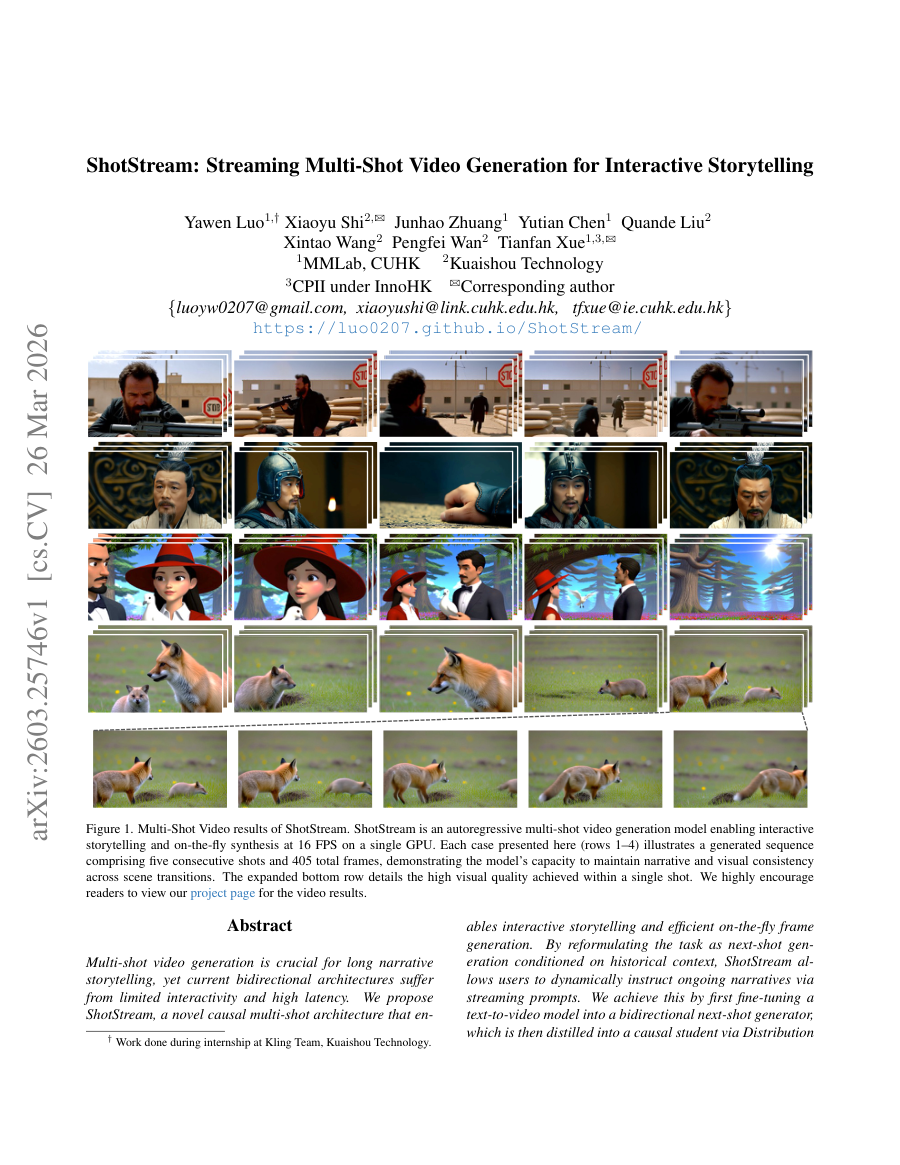
ShotStream: Streaming Multi-Shot Video Generation for Interactive Storytelling
TL;DR: ShotStream enables real-time interactive multi-shot video generation through causal architecture design, dual-cache memory mechanisms, and two-stage distillation to maintain visual consistency and reduce latency.
ShotStream enables real-time interactive multi-shot video generation through causal architecture design, dual-cache memory mechanisms, and two-stage distillation to maintain visual consistency and reduce latency.
By reformulating the task as next-shot generation conditioned on historical context, ShotStream allows users to dynamically instruct ongoing narratives via streaming prompts.
We propose ShotStream, a novel causal multi-shot architecture that enables interactive storytelling and efficient on-the-fly frame generation.
We achieve this by first fine-tuning a text-to-video model into a bidirectional next-shot generator, which is then distilled into a causal student via Distribution Matching Distillation .
The summary does not include concrete numbers, so the practical size of the gain and the tradeoff against latency or data cost are still unclear.
- Problem framing: By reformulating the task as next-shot generation conditioned on historical context, ShotStream allows users to dynamically instruct ongoing narratives via streaming prompts.
- Method signal: We propose ShotStream, a novel causal multi-shot architecture that enables interactive storytelling and efficient on-the-fly frame generation.
- Evidence to watch: We achieve this by first fine-tuning a text-to-video model into a bidirectional next-shot generator, which is then distilled into a causal student via Distribution Matching Distillation .
- Read-through priority: the PDF is available, so this is a good candidate for checking tables, ablations, and scaling tradeoffs beyond the abstract from Hugging Face Papers / arXiv.
- Causal next‑shot formulation.
- Dual‑cache memory for inter‑ and intra‑shot consistency.
- Two‑stage distillation to close train‑test gap.
- The summary does not include concrete numbers, so the practical size of the gain and the tradeoff against latency or data cost are still unclear.
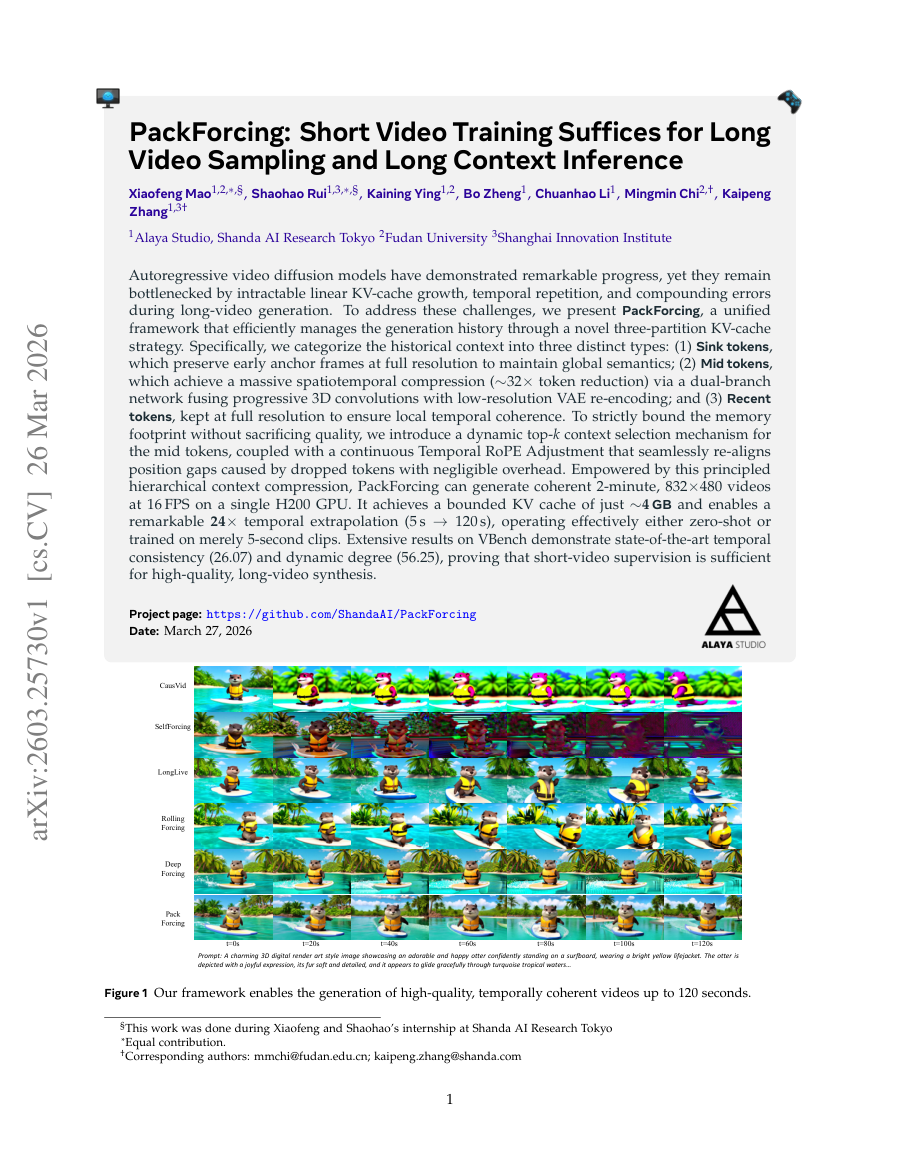
PackForcing: Short Video Training Suffices for Long Video Sampling and Long Context Inference
TL;DR: PackForcing enables efficient long-video generation through hierarchical KV-cache management and spatiotemporal compression while maintaining temporal consistency and reducing memory usage.
PackForcing enables efficient long-video generation through hierarchical KV-cache management and spatiotemporal compression while maintaining temporal consistency and reducing memory usage.
Autoregressive video diffusion models have demonstrated remarkable progress, yet they remain bottlenecked by intractable linear KV-cache growth, temporal repetition , and compounding errors during long-video generation.
To address these challenges, we present PackForcing, a unified framework that efficiently manages the generation history through a novel three-partition KV-cache strategy.
Autoregressive video diffusion models have demonstrated remarkable progress, yet they remain bottlenecked by intractable linear KV-cache growth, temporal repetition , and compounding errors during long-video generation.
The summary does not include concrete numbers, so the practical size of the gain and the tradeoff against latency or data cost are still unclear.
- Problem framing: Autoregressive video diffusion models have demonstrated remarkable progress, yet they remain bottlenecked by intractable linear KV-cache growth, temporal repetition , and compounding errors during long-video generation.
- Method signal: To address these challenges, we present PackForcing, a unified framework that efficiently manages the generation history through a novel three-partition KV-cache strategy.
- Evidence to watch: Autoregressive video diffusion models have demonstrated remarkable progress, yet they remain bottlenecked by intractable linear KV-cache growth, temporal repetition , and compounding errors during long-video generation.
- Read-through priority: the PDF is available, so this is a good candidate for checking tables, ablations, and scaling tradeoffs beyond the abstract from Hugging Face Papers / arXiv.
- Three‑partition KV‑cache (sink, mid, recent tokens).
- Dynamic top‑k selection and temporal RoPE adjustment.
- 24× temporal extrapolation on a single H200 GPU.
- The summary does not include concrete numbers, so the practical size of the gain and the tradeoff against latency or data cost are still unclear.
Issue routing and exits.
The daily edition stays aligned with the rest of the site while keeping the full issue readable end to end.
Navigation
Public desks
Issue
- 03/30/2026
- 61 total analyzed
- Readable issue route