Daily Edition
The expanded edition keeps the full analyst notes, paper breakdowns, geopolitical framing, and the complete feed selected into this run.
Topic of the day.
A dedicated daily topic chosen from the strongest signals in the run, with TL;DR, why-now framing, and a fuller analyst read.
AI developer agents and coding workflows
TL;DR: AI developer agents and coding workflows is today's clearest AI theme: Microsoft open-source toolkit secures AI agents at runtime leads the signal, and related coverage suggests the shift is moving from isolated headline to broader...
Why now: The topic shows up across AI News and AI News, AI News, which means the same operating pressure is appearing through multiple lenses instead of only one announcement.
AI developer agents and coding workflows deserves the slower read today because the supporting items cluster around policy, security, agent. Microsoft open-source toolkit secures AI agents at runtime matters because it affects the policy, supply-chain, or security constraints around AI development, especially across policy, security, agent. The combined signal suggests teams should treat this as a real operating change rather than background noise.
- AI News: Microsoft open-source toolkit secures AI agents at runtime points to Microsoft open-source toolkit secures AI agents at runtime matters because it affects the policy, supply-chain, or security constraints...
- AI News: Asylon and Thrive Logic bring physical AI to enterprise perimeter security points to Asylon and Thrive Logic bring physical AI to enterprise perimeter security matters because it affects the policy,...
- AI News: Boomi calls it “data activation” and says it’s the missing step in every AI deployment points to Boomi calls it “data activation” and says it’s the missing step in every AI deployment matters because it...
- Microsoft open-source toolkit secures AI agents at runtime (AI News | 2026-04-08)
- Asylon and Thrive Logic bring physical AI to enterprise perimeter security (AI News | 2026-04-07)
- Boomi calls it “data activation” and says it’s the missing step in every AI deployment (AI News | 2026-04-07)
Policy, chips, capital, and power.
Industrial strategy, compute supply, export controls, and big-company positioning shaping the AI balance of power.

Microsoft open-source toolkit secures AI agents at runtime
A new open-source toolkit from Microsoft focuses on runtime security to force strict governance onto enterprise AI agents. The release tackles a growing anxiety: autonomous language models are now executing code and hitting corporate networks way faster than traditional...
Microsoft open-source toolkit secures AI agents at runtime matters because it affects the policy, supply-chain, or security constraints around AI development, especially across policy, security, agent.
- Primary signals: policy, security, agent.
- Source context: AI News published or updated this item on 2026-04-08.

Asylon and Thrive Logic bring physical AI to enterprise perimeter security
Exciting times are ahead in the world of enterprise perimeter security with a new partnership between Thrive Logic, an AI agent-driven security and operational intelligence platform, and Asylon, a security robotics company. Together, the companies are to introduce physical AI...
Asylon and Thrive Logic bring physical AI to enterprise perimeter security matters because it affects the policy, supply-chain, or security constraints around AI development, especially across security, agent, robotics.
- Primary signals: security, agent, robotics.
- Source context: AI News published or updated this item on 2026-04-07.

Anthropic’s refusal to arm AI is exactly why the UK wants it
The Anthropic UK expansion story is less about diplomatic courtship and more about what happens when a government punishes a company for having principles. In late February, US Defence Secretary Pete Hegseth gave Anthropic CEO Dario Amodei a stark ultimatum: remove guardrails...
Anthropic’s refusal to arm AI is exactly why the UK wants it matters because it affects the policy, supply-chain, or security constraints around AI development, especially across defence, government.
- Primary signals: defence, government.
- Source context: AI News published or updated this item on 2026-04-07.

AI’s software development success and central management needs
A survey carried out by OutSystems, The State of AI Development 2026 [email wall], argues that AI has moved into early production phase for many enterprises, primarily inside the IT function. The survey was based on the responses of 1,879 IT leaders, and warns that adoption...
AI’s software development success and central management needs matters because it affects the policy, supply-chain, or security constraints around AI development, especially across state.
- Primary signals: state.
- Source context: AI News published or updated this item on 2026-04-08.

5 best practices to secure AI systems
A decade ago, it would have been hard to believe that artificial intelligence could do what it can do now. However, it is this same power that introduces a new attack surface that traditional security frameworks were not built to address. As this technology becomes embedded...
5 best practices to secure AI systems matters because it affects the policy, supply-chain, or security constraints around AI development, especially across defense, security.
- Primary signals: defense, security.
- Source context: AI News published or updated this item on 2026-04-02.
Product, model, and platform movement.
Software, model, deployment, and competitive stories with the strongest operator and market signal in this edition.

Boomi calls it “data activation” and says it’s the missing step in every AI deployment
The failure mode for enterprise AI in 2026 is not what most people expected. It is not that the models are wrong, or that agents cannot reason, or that the technology is overhyped. The failure mode is that the data feeding those systems is fragmented, inconsistently labelled,...
Boomi calls it “data activation” and says it’s the missing step in every AI deployment matters because it signals momentum in agent, agents, model and may shift how teams prioritize models, tooling, or deployment choices.
- Primary signals: agent, agents, model.
- Source context: AI News published or updated this item on 2026-04-07.
ALTK‑Evolve: On‑the‑Job Learning for AI Agents
A Blog post by IBM Research on Hugging Face
ALTK‑Evolve: On‑the‑Job Learning for AI Agents matters because it signals momentum in agent, agents and may shift how teams prioritize models, tooling, or deployment choices.
- Primary signals: agent, agents.
- Source context: Hugging Face Blog published or updated this item on 2026-04-08.
Z.AI Introduces GLM-5.1: An Open-Weight 754B Agentic Model That Achieves SOTA on SWE-Bench Pro and Sustains 8-Hour Autonomous Execution
Z.AI Introduces GLM-5.1: An Open-Weight 754B Agentic Model That Achieves SOTA on SWE-Bench Pro and Sustains 8-Hour Autonomous Execution MarkTechPost
Z.AI Introduces GLM-5.1: An Open-Weight 754B Agentic Model That Achieves SOTA on SWE-Bench Pro and Sustains 8-Hour Autonomous Execution matters because it signals momentum in agent, model and may shift how teams prioritize models, tooling, or deployment choices.
- Primary signals: agent, model.
- Source context: MarkTechPost published or updated this item on 2026-04-08.
AI 101: Hermes Agent – OpenClaw’s Rival? Differences and Best Use Cases
AI 101: Hermes Agent – OpenClaw’s Rival? Differences and Best Use Cases Turing Post
AI 101: Hermes Agent – OpenClaw’s Rival? Differences and Best Use Cases matters because it signals momentum in agent and may shift how teams prioritize models, tooling, or deployment choices.
- Primary signals: agent.
- Source context: Turing Post published or updated this item on 2026-04-09.

As AI agents take on more tasks, governance becomes a priority
AI systems are starting to move beyond simple responses. In many organisations, AI agents are now being tested to plan tasks, make decisions, and carry out actions with limited human input. It is no longer just about whether a model gives the right answer. It is about what...
As AI agents take on more tasks, governance becomes a priority matters because it signals momentum in agent, agents, model and may shift how teams prioritize models, tooling, or deployment choices.
- Primary signals: agent, agents, model.
- Source context: AI News published or updated this item on 2026-04-06.
Differentiated source coverage.
Stories drawn from research blogs, first-party lab posts, practitioner newsletters, and selected technical outlets so the edition does not mirror the same headline across every source.

Holo3: Breaking the Computer Use Frontier
A Blog post by H company on Hugging Face
Holo3: Breaking the Computer Use Frontier matters because it affects the policy, supply-chain, or security constraints around AI development, especially across compute, frontier.
- Primary signals: compute, frontier.
- Source context: Hugging Face Blog published or updated this item on 2026-04-01.
Industrial policy for the Intelligence Age
Industrial policy for the Intelligence Age OpenAI
Industrial policy for the Intelligence Age matters because it affects the policy, supply-chain, or security constraints around AI development, especially across policy.
- Primary signals: policy.
- Source context: OpenAI Research published or updated this item on 2026-04-06.
A “diff” tool for AI: Finding behavioral differences in new models
A “diff” tool for AI: Finding behavioral differences in new models Anthropic
A “diff” tool for AI: Finding behavioral differences in new models matters because it signals momentum in model and may shift how teams prioritize models, tooling, or deployment choices.
- Primary signals: model.
- Source context: Anthropic Research published or updated this item on 2026-03-13.

Gemma 4: Byte for byte, the most capable open models
Gemma 4: Our most intelligent open models to date, purpose-built for advanced reasoning and agentic workflows.
Gemma 4: Byte for byte, the most capable open models matters because it signals momentum in agent, model, reasoning and may shift how teams prioritize models, tooling, or deployment choices.
- Primary signals: agent, model, reasoning.
- Source context: DeepMind Blog published or updated this item on 2026-04-02.
RightNow AI Releases AutoKernel: An Open-Source Framework that Applies an Autonomous Agent Loop to GPU Kernel Optimization for Arbitrary PyTorch Models
RightNow AI Releases AutoKernel: An Open-Source Framework that Applies an Autonomous Agent Loop to GPU Kernel Optimization for Arbitrary PyTorch Models MarkTechPost
RightNow AI Releases AutoKernel: An Open-Source Framework that Applies an Autonomous Agent Loop to GPU Kernel Optimization for Arbitrary PyTorch Models matters because it signals momentum in agent, model and may shift how teams prioritize models, tooling, or deployment choices.
- Primary signals: agent, model.
- Source context: MarkTechPost published or updated this item on 2026-04-06.

KiloClaw targets shadow AI with autonomous agent governance
With the launch of KiloClaw, enterprises now have a tool to enforce governance over autonomous agents and manage shadow AI. While businesses spent the last year securing large language models and formalising vendor agreements, developers and knowledge workers started moving...
KiloClaw targets shadow AI with autonomous agent governance matters because it signals momentum in agent, agents, model and may shift how teams prioritize models, tooling, or deployment choices.
- Primary signals: agent, agents, model.
- Source context: AI News published or updated this item on 2026-04-02.
Why is Anthropic Not Releasing Claude Mythos to the Public?
Why is Anthropic Not Releasing Claude Mythos to the Public? AI Magazine
Why is Anthropic Not Releasing Claude Mythos to the Public? matters because it signals momentum in the broader AI ecosystem and may shift how teams prioritize models, tooling, or deployment choices.
- Primary signals: AI platforms and product execution.
- Source context: AI Magazine published or updated this item on 2026-04-08.
Enabling agent-first process redesign
Enabling agent-first process redesign MIT Technology Review
Enabling agent-first process redesign matters because it signals momentum in agent and may shift how teams prioritize models, tooling, or deployment choices.
- Primary signals: agent.
- Source context: MIT Tech Review AI published or updated this item on 2026-04-07.
Method, limitations, and results.
Paper summaries, methodology notes, limitations, and deep-dive bullets for the research items selected into the digest.
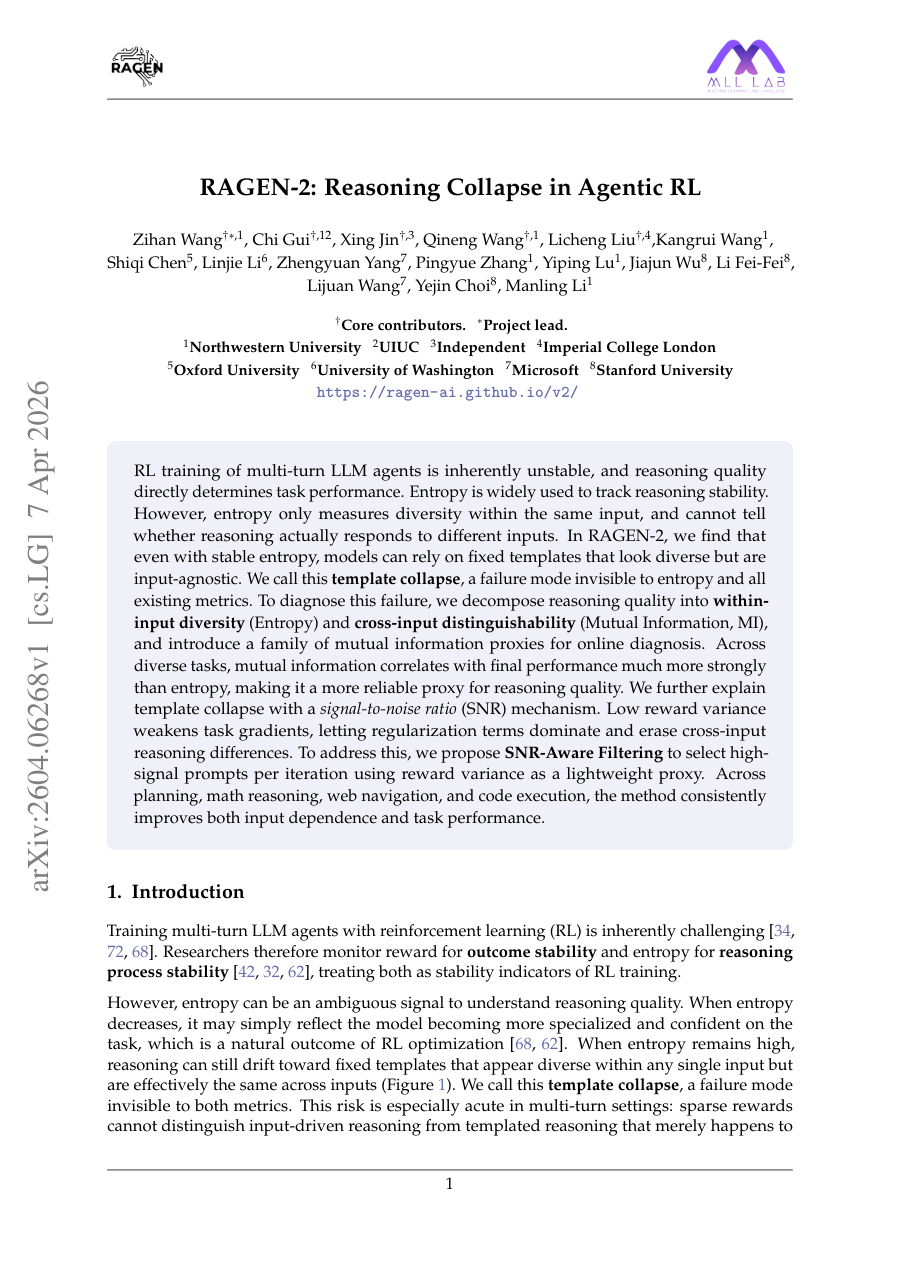
RAGEN-2: Reasoning Collapse in Agentic RL
TL;DR: Research identifies template collapse in multi-turn LLM agents as a hidden failure mode undetectable by entropy, proposing mutual information proxies and SNR-aware filtering to improve reasoning quality and task...
Research identifies template collapse in multi-turn LLM agents as a hidden failure mode undetectable by entropy, proposing mutual information proxies and SNR-aware filtering to improve reasoning quality and task performance. RL training of multi-turn LLM agents is inherently...
Research identifies template collapse in multi-turn LLM agents as a hidden failure mode undetectable by entropy, proposing mutual information proxies and SNR-aware filtering to improve reasoning quality and task performance.
To address this, we propose SNR-Aware Filtering to select high-signal prompts per iteration using reward variance as a lightweight proxy.
Research identifies template collapse in multi-turn LLM agents as a hidden failure mode undetectable by entropy, proposing mutual information proxies and SNR-aware filtering to improve reasoning quality and task performance.
The summary does not include concrete numbers, so the practical size of the gain and the tradeoff against latency or data cost are still unclear.
- Problem framing: Research identifies template collapse in multi-turn LLM agents as a hidden failure mode undetectable by entropy, proposing mutual information proxies and SNR-aware filtering to improve reasoning quality and task performance.
- Method signal: To address this, we propose SNR-Aware Filtering to select high-signal prompts per iteration using reward variance as a lightweight proxy.
- Evidence to watch: Research identifies template collapse in multi-turn LLM agents as a hidden failure mode undetectable by entropy, proposing mutual information proxies and SNR-aware filtering to improve reasoning quality and task performance.
- Read-through priority: the PDF is available, so this is a good candidate for checking tables, ablations, and scaling tradeoffs beyond the abstract from Hugging Face Papers / arXiv.
- Problem: Research identifies template collapse in multi-turn LLM agents as a hidden failure mode undetectable by entropy, proposing mutual information proxies and SNR-aware filtering to improve reasoning quality and...
- Approach: To address this, we propose SNR-Aware Filtering to select high-signal prompts per iteration using reward variance as a lightweight proxy.
- Result signal: Research identifies template collapse in multi-turn LLM agents as a hidden failure mode undetectable by entropy, proposing mutual information proxies and SNR-aware filtering to improve reasoning...
- Community traction: Hugging Face Papers shows 30 votes for this paper.
- The summary does not include concrete numbers, so the practical size of the gain and the tradeoff against latency or data cost are still unclear.
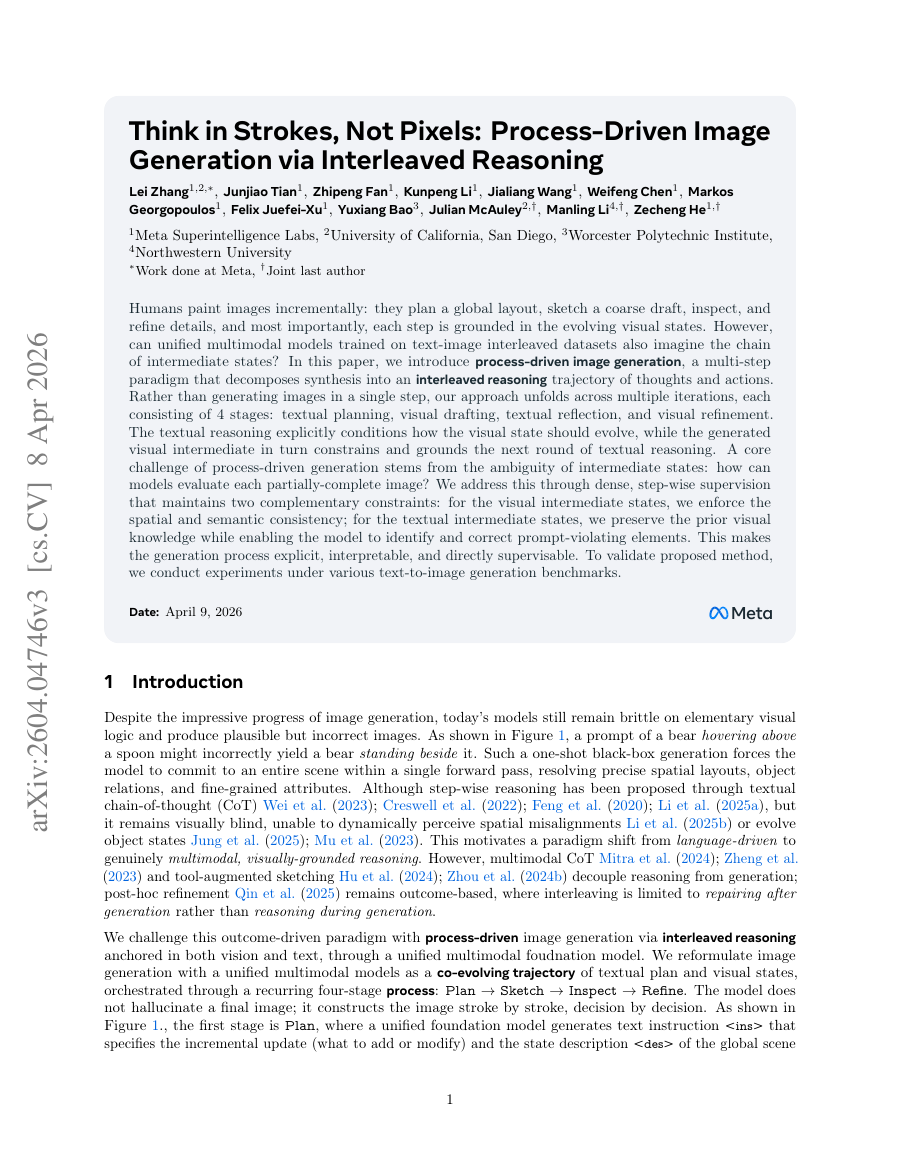
Think in Strokes, Not Pixels: Process-Driven Image Generation via Interleaved Reasoning
TL;DR: Process-driven image generation decomposes synthesis into iterative steps involving textual planning, visual drafting, textual reflection, and visual refinement, with step-wise supervision ensuring consistency and...
Process-driven image generation decomposes synthesis into iterative steps involving textual planning, visual drafting, textual reflection, and visual refinement, with step-wise supervision ensuring consistency and interpretability. Humans paint images incrementally: they plan...
A core challenge of process-driven generation stems from the ambiguity of intermediate states: how can models evaluate each partially-complete image?
In this paper, we introduce process-driven image generation, a multi-step paradigm that decomposes synthesis into an interleaved reasoning trajectory of thoughts and actions.
To validate proposed method, we conduct experiments under various text-to-image generation benchmarks.
The summary does not include concrete numbers, so the practical size of the gain and the tradeoff against latency or data cost are still unclear.
- Problem framing: A core challenge of process-driven generation stems from the ambiguity of intermediate states: how can models evaluate each partially-complete image?
- Method signal: In this paper, we introduce process-driven image generation, a multi-step paradigm that decomposes synthesis into an interleaved reasoning trajectory of thoughts and actions.
- Evidence to watch: To validate proposed method, we conduct experiments under various text-to-image generation benchmarks.
- Read-through priority: the PDF is available, so this is a good candidate for checking tables, ablations, and scaling tradeoffs beyond the abstract from Hugging Face Papers / arXiv.
- Problem: A core challenge of process-driven generation stems from the ambiguity of intermediate states: how can models evaluate each partially-complete image?
- Approach: In this paper, we introduce process-driven image generation, a multi-step paradigm that decomposes synthesis into an interleaved reasoning trajectory of thoughts and actions.
- Result signal: To validate proposed method, we conduct experiments under various text-to-image generation benchmarks.
- Community traction: Hugging Face Papers shows 27 votes for this paper.
- The summary does not include concrete numbers, so the practical size of the gain and the tradeoff against latency or data cost are still unclear.
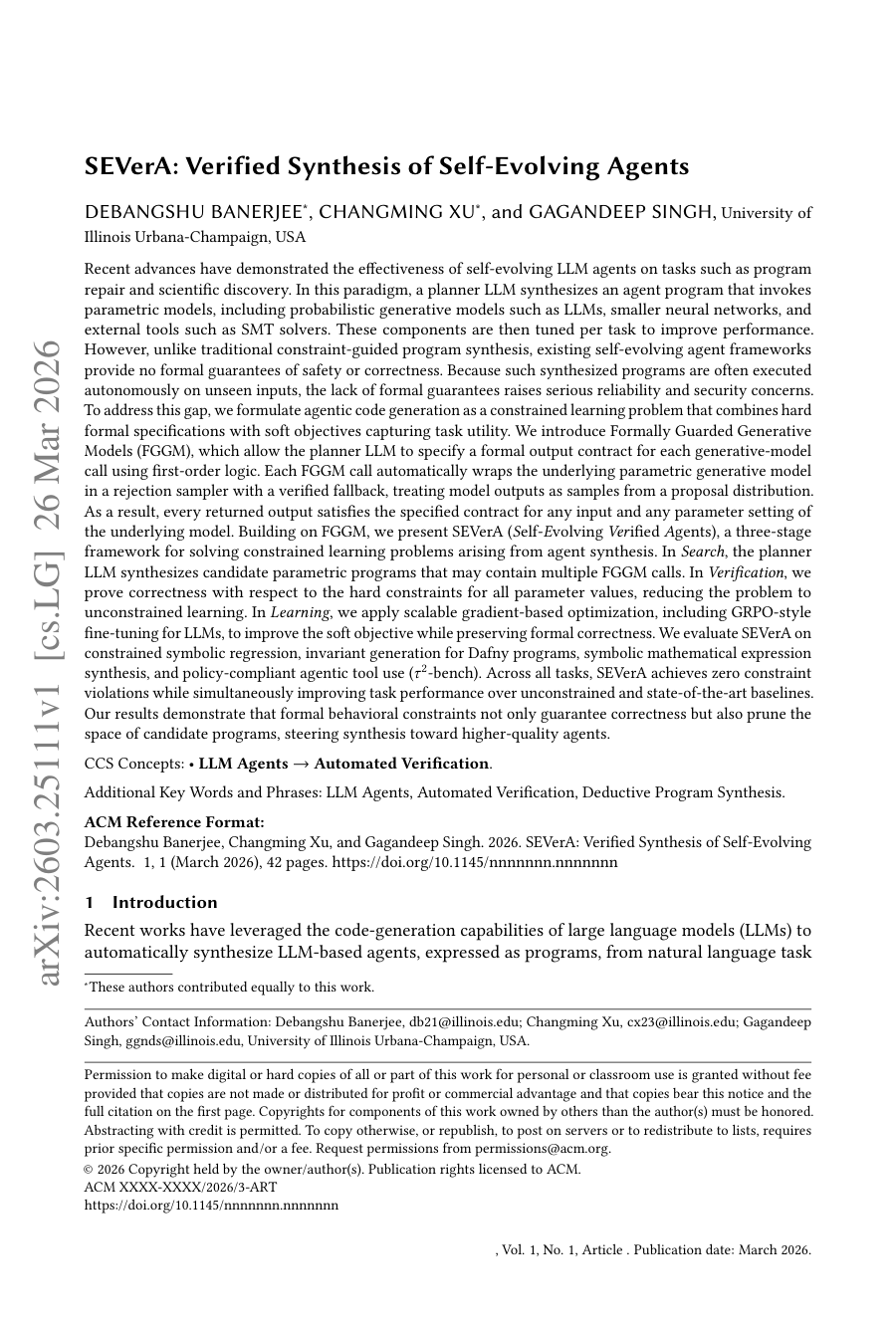
SEVerA: Verified Synthesis of Self-Evolving Agents
TL;DR: Formally Guarded Generative Models enable safe and correct agentic code generation by combining formal specifications with soft objectives, ensuring reliability in autonomous agent systems.
Formally Guarded Generative Models enable safe and correct agentic code generation by combining formal specifications with soft objectives, ensuring reliability in autonomous agent systems. Recent advances have shown the effectiveness of self-evolving LLM agents on tasks such...
Recent advances have shown the effectiveness of self-evolving LLM agents on tasks such as program repair and scientific discovery.
We introduce Formally Guarded Generative Models (FGGM), which allow the planner LLM to specify a formal output contract for each generative model call using first-order logic .
In this paradigm, a planner LLM synthesizes an agent program that invokes parametric models , including LLMs, which are then tuned per task to improve performance.
The summary does not include concrete numbers, so the practical size of the gain and the tradeoff against latency or data cost are still unclear.
- Problem framing: Recent advances have shown the effectiveness of self-evolving LLM agents on tasks such as program repair and scientific discovery.
- Method signal: We introduce Formally Guarded Generative Models (FGGM), which allow the planner LLM to specify a formal output contract for each generative model call using first-order logic .
- Evidence to watch: In this paradigm, a planner LLM synthesizes an agent program that invokes parametric models , including LLMs, which are then tuned per task to improve performance.
- Read-through priority: the PDF is available, so this is a good candidate for checking tables, ablations, and scaling tradeoffs beyond the abstract from Hugging Face Papers / arXiv.
- Problem: Recent advances have shown the effectiveness of self-evolving LLM agents on tasks such as program repair and scientific discovery.
- Approach: We introduce Formally Guarded Generative Models (FGGM), which allow the planner LLM to specify a formal output contract for each generative model call using first-order logic .
- Result signal: In this paradigm, a planner LLM synthesizes an agent program that invokes parametric models , including LLMs, which are then tuned per task to improve performance.
- Community traction: Hugging Face Papers shows 8 votes for this paper.
- The summary does not include concrete numbers, so the practical size of the gain and the tradeoff against latency or data cost are still unclear.

INSPATIO-WORLD: A Real-Time 4D World Simulator via Spatiotemporal Autoregressive Modeling
TL;DR: INSPATIO-WORLD presents a real-time framework for generating high-fidelity dynamic scenes from single videos using spatiotemporal autoregressive architecture and joint distribution matching distillation.
INSPATIO-WORLD presents a real-time framework for generating high-fidelity dynamic scenes from single videos using spatiotemporal autoregressive architecture and joint distribution matching distillation. Building world models with spatial consistency and real-time...
Building world models with spatial consistency and real-time interactivity remains a fundamental challenge in computer vision.
To address these challenges, we propose INSPATIO-WORLD, a novel real-time framework capable of recovering and generating high-fidelity, dynamic interactive scenes from a single reference video.
Extensive experiments demonstrate that INSPATIO-WORLD significantly outperforms existing state-of-the-art (SOTA) models in spatial consistency and interaction precision, ranking first among real-time interactive methods on the WorldScore-Dynamic benchmark , and establishing a practical pipeline for navigating 4D...
The reported improvement still needs a closer check on benchmark scope, ablations, and whether the method keeps working outside the authors' evaluation setup.
- Problem framing: Building world models with spatial consistency and real-time interactivity remains a fundamental challenge in computer vision.
- Method signal: To address these challenges, we propose INSPATIO-WORLD, a novel real-time framework capable of recovering and generating high-fidelity, dynamic interactive scenes from a single reference video.
- Evidence to watch: Extensive experiments demonstrate that INSPATIO-WORLD significantly outperforms existing state-of-the-art (SOTA) models in spatial consistency and interaction precision, ranking first among real-time interactive methods on the...
- Read-through priority: the PDF is available, so this is a good candidate for checking tables, ablations, and scaling tradeoffs beyond the abstract from Hugging Face Papers / arXiv.
- Problem: Building world models with spatial consistency and real-time interactivity remains a fundamental challenge in computer vision.
- Approach: To address these challenges, we propose INSPATIO-WORLD, a novel real-time framework capable of recovering and generating high-fidelity, dynamic interactive scenes from a single reference video.
- Result signal: Extensive experiments demonstrate that INSPATIO-WORLD significantly outperforms existing state-of-the-art (SOTA) models in spatial consistency and interaction precision, ranking first among real-time...
- Community traction: Hugging Face Papers shows 4 votes for this paper.
- The reported improvement still needs a closer check on benchmark scope, ablations, and whether the method keeps working outside the authors' evaluation setup.
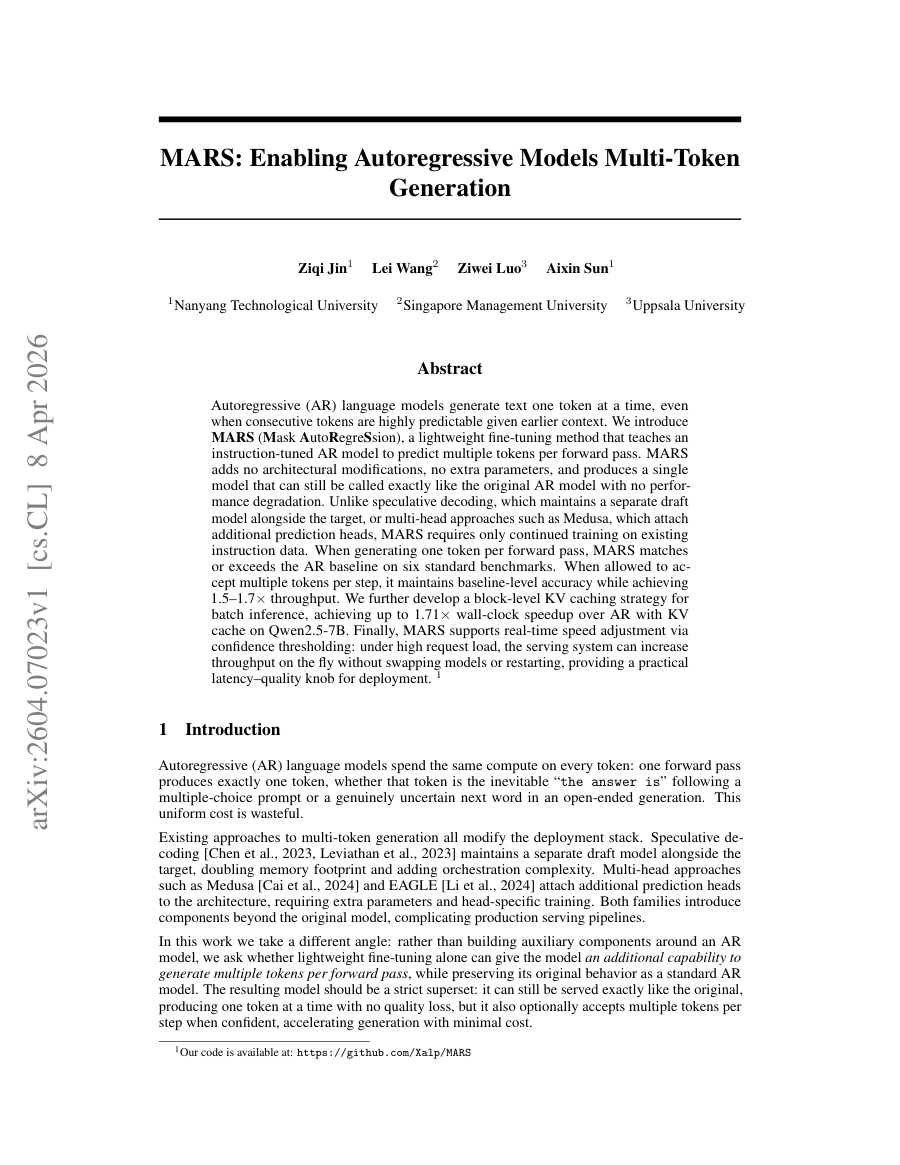
MARS: Enabling Autoregressive Models Multi-Token Generation
TL;DR: MARS is a fine-tuning method that enables autoregressive language models to predict multiple tokens per forward pass without architectural changes, maintaining accuracy while improving throughput and supporting...
MARS is a fine-tuning method that enables autoregressive language models to predict multiple tokens per forward pass without architectural changes, maintaining accuracy while improving throughput and supporting dynamic speed adjustment. Autoregressive (AR) language models...
MARS is a fine-tuning method that enables autoregressive language models to predict multiple tokens per forward pass without architectural changes, maintaining accuracy while improving throughput and supporting dynamic speed adjustment.
We introduce MARS (Mask AutoRegreSsion), a lightweight fine-tuning method that teaches an instruction-tuned AR model to predict multiple tokens per forward pass.
MARS is a fine-tuning method that enables autoregressive language models to predict multiple tokens per forward pass without architectural changes, maintaining accuracy while improving throughput and supporting dynamic speed adjustment.
The summary does not include concrete numbers, so the practical size of the gain and the tradeoff against latency or data cost are still unclear.
- Problem framing: MARS is a fine-tuning method that enables autoregressive language models to predict multiple tokens per forward pass without architectural changes, maintaining accuracy while improving throughput and supporting dynamic speed adjustment.
- Method signal: We introduce MARS (Mask AutoRegreSsion), a lightweight fine-tuning method that teaches an instruction-tuned AR model to predict multiple tokens per forward pass.
- Evidence to watch: MARS is a fine-tuning method that enables autoregressive language models to predict multiple tokens per forward pass without architectural changes, maintaining accuracy while improving throughput and supporting dynamic speed adjustment.
- Read-through priority: the PDF is available, so this is a good candidate for checking tables, ablations, and scaling tradeoffs beyond the abstract from Hugging Face Papers / arXiv.
- Problem: MARS is a fine-tuning method that enables autoregressive language models to predict multiple tokens per forward pass without architectural changes, maintaining accuracy while improving throughput and...
- Approach: We introduce MARS (Mask AutoRegreSsion), a lightweight fine-tuning method that teaches an instruction-tuned AR model to predict multiple tokens per forward pass.
- Result signal: MARS is a fine-tuning method that enables autoregressive language models to predict multiple tokens per forward pass without architectural changes, maintaining accuracy while improving throughput and...
- Community traction: Hugging Face Papers shows 13 votes for this paper.
- The summary does not include concrete numbers, so the practical size of the gain and the tradeoff against latency or data cost are still unclear.
Everything selected into the run.
The complete analyzed stream for the issue, useful when you want to scan the entire run instead of only the curated front page.
Boomi calls it “data activation” and says it’s the missing step in every AI deployment
The failure mode for enterprise AI in 2026 is not what most people expected. It is not that the models are wrong, or that agents cannot reason, or that the technology is overhyped. The failure mode is that the data feeding those systems is fragmented, inconsistently labelled,...
Boomi calls it “data activation” and says it’s the missing step in every AI deployment matters because it signals momentum in agent, agents, model and may shift how teams prioritize models, tooling, or deployment choices.
- Primary signals: agent, agents, model.
- Source context: AI News published or updated this item on 2026-04-07.
ALTK‑Evolve: On‑the‑Job Learning for AI Agents
A Blog post by IBM Research on Hugging Face
ALTK‑Evolve: On‑the‑Job Learning for AI Agents matters because it signals momentum in agent, agents and may shift how teams prioritize models, tooling, or deployment choices.
- Primary signals: agent, agents.
- Source context: Hugging Face Blog published or updated this item on 2026-04-08.
Z.AI Introduces GLM-5.1: An Open-Weight 754B Agentic Model That Achieves SOTA on SWE-Bench Pro and Sustains 8-Hour Autonomous Execution
Z.AI Introduces GLM-5.1: An Open-Weight 754B Agentic Model That Achieves SOTA on SWE-Bench Pro and Sustains 8-Hour Autonomous Execution MarkTechPost
Z.AI Introduces GLM-5.1: An Open-Weight 754B Agentic Model That Achieves SOTA on SWE-Bench Pro and Sustains 8-Hour Autonomous Execution matters because it signals momentum in agent, model and may shift how teams prioritize models, tooling, or deployment choices.
- Primary signals: agent, model.
- Source context: MarkTechPost published or updated this item on 2026-04-08.
AI 101: Hermes Agent – OpenClaw’s Rival? Differences and Best Use Cases
AI 101: Hermes Agent – OpenClaw’s Rival? Differences and Best Use Cases Turing Post
AI 101: Hermes Agent – OpenClaw’s Rival? Differences and Best Use Cases matters because it signals momentum in agent and may shift how teams prioritize models, tooling, or deployment choices.
- Primary signals: agent.
- Source context: Turing Post published or updated this item on 2026-04-09.
As AI agents take on more tasks, governance becomes a priority
AI systems are starting to move beyond simple responses. In many organisations, AI agents are now being tested to plan tasks, make decisions, and carry out actions with limited human input. It is no longer just about whether a model gives the right answer. It is about what...
As AI agents take on more tasks, governance becomes a priority matters because it signals momentum in agent, agents, model and may shift how teams prioritize models, tooling, or deployment choices.
- Primary signals: agent, agents, model.
- Source context: AI News published or updated this item on 2026-04-06.
Gemma 4: Byte for byte, the most capable open models
Gemma 4: Our most intelligent open models to date, purpose-built for advanced reasoning and agentic workflows.
Gemma 4: Byte for byte, the most capable open models matters because it signals momentum in agent, model, reasoning and may shift how teams prioritize models, tooling, or deployment choices.
- Primary signals: agent, model, reasoning.
- Source context: DeepMind Blog published or updated this item on 2026-04-02.
KiloClaw targets shadow AI with autonomous agent governance
With the launch of KiloClaw, enterprises now have a tool to enforce governance over autonomous agents and manage shadow AI. While businesses spent the last year securing large language models and formalising vendor agreements, developers and knowledge workers started moving...
KiloClaw targets shadow AI with autonomous agent governance matters because it signals momentum in agent, agents, model and may shift how teams prioritize models, tooling, or deployment choices.
- Primary signals: agent, agents, model.
- Source context: AI News published or updated this item on 2026-04-02.
Introducing the Child Safety Blueprint
Introducing the Child Safety Blueprint OpenAI
Introducing the Child Safety Blueprint matters because it signals momentum in safety and may shift how teams prioritize models, tooling, or deployment choices.
- Primary signals: safety.
- Source context: OpenAI Research published or updated this item on 2026-04-08.

Safetensors is Joining the PyTorch Foundation
We’re on a journey to advance and democratize artificial intelligence through open source and open science.
Safetensors is Joining the PyTorch Foundation matters because it signals momentum in foundation and may shift how teams prioritize models, tooling, or deployment choices.
- Primary signals: foundation.
- Source context: Hugging Face Blog published or updated this item on 2026-04-08.
RightNow AI Releases AutoKernel: An Open-Source Framework that Applies an Autonomous Agent Loop to GPU Kernel Optimization for Arbitrary PyTorch Models
RightNow AI Releases AutoKernel: An Open-Source Framework that Applies an Autonomous Agent Loop to GPU Kernel Optimization for Arbitrary PyTorch Models MarkTechPost
RightNow AI Releases AutoKernel: An Open-Source Framework that Applies an Autonomous Agent Loop to GPU Kernel Optimization for Arbitrary PyTorch Models matters because it signals momentum in agent, model and may shift how teams prioritize models, tooling, or deployment choices.
- Primary signals: agent, model.
- Source context: MarkTechPost published or updated this item on 2026-04-06.
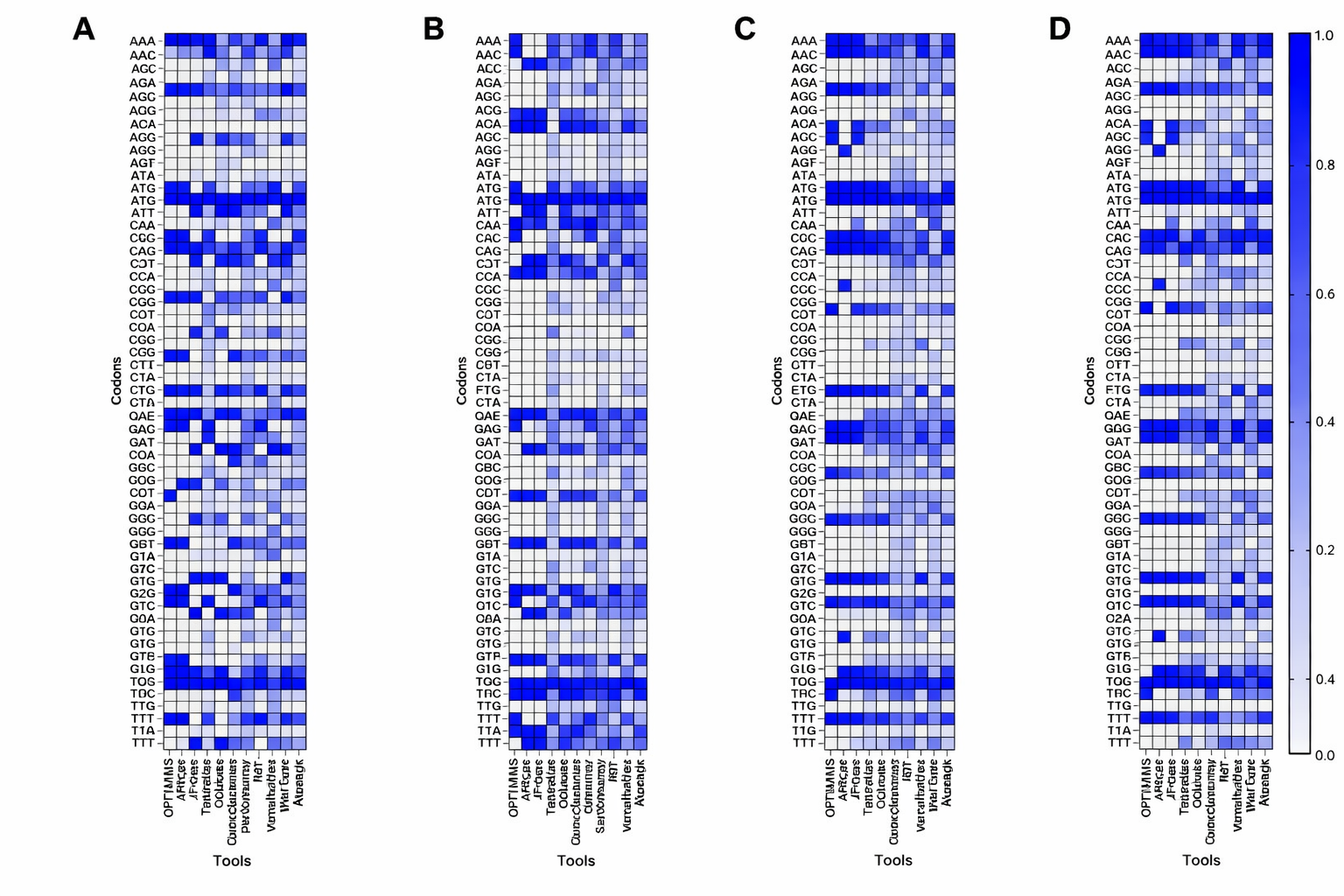
Training mRNA Language Models Across 25 Species for $165
A Blog post by OpenMed on Hugging Face
Training mRNA Language Models Across 25 Species for $165 matters because it signals momentum in model, training and may shift how teams prioritize models, tooling, or deployment choices.
- Primary signals: model, training.
- Source context: Hugging Face Blog published or updated this item on 2026-03-31.
Welcome Gemma 4: Frontier multimodal intelligence on device
We’re on a journey to advance and democratize artificial intelligence through open source and open science.
Welcome Gemma 4: Frontier multimodal intelligence on device matters because it signals momentum in frontier, multimodal and may shift how teams prioritize models, tooling, or deployment choices.
- Primary signals: frontier, multimodal.
- Source context: Hugging Face Blog published or updated this item on 2026-04-02.
Enabling agent-first process redesign
Enabling agent-first process redesign MIT Technology Review
Enabling agent-first process redesign matters because it signals momentum in agent and may shift how teams prioritize models, tooling, or deployment choices.
- Primary signals: agent.
- Source context: MIT Tech Review AI published or updated this item on 2026-04-07.
Meta AI Releases EUPE: A Compact Vision Encoder Family Under 100M Parameters That Rivals Specialist Models Across Image Understanding, Dense Prediction, and VLM Tasks -...
Meta AI Releases EUPE: A Compact Vision Encoder Family Under 100M Parameters That Rivals Specialist Models Across Image Understanding, Dense Prediction, and VLM Tasks MarkTechPost
Meta AI Releases EUPE: A Compact Vision Encoder Family Under 100M Parameters That Rivals Specialist Models Across Image Understanding, Dense Prediction, and VLM Tasks -... matters because it signals momentum in model and may shift how teams prioritize models, tooling, or deployment choices.
- Primary signals: model.
- Source context: MarkTechPost published or updated this item on 2026-04-07.
Mustafa Suleyman: AI development won’t hit a wall anytime soon—here’s why
Mustafa Suleyman: AI development won’t hit a wall anytime soon—here’s why MIT Technology Review
Mustafa Suleyman: AI development won’t hit a wall anytime soon—here’s why matters because it signals momentum in the broader AI ecosystem and may shift how teams prioritize models, tooling, or deployment choices.
- Primary signals: AI platforms and product execution.
- Source context: MIT Tech Review AI published or updated this item on 2026-04-08.
The next phase of enterprise AI
The next phase of enterprise AI OpenAI
The next phase of enterprise AI matters because it signals momentum in the broader AI ecosystem and may shift how teams prioritize models, tooling, or deployment choices.
- Primary signals: AI platforms and product execution.
- Source context: OpenAI Research published or updated this item on 2026-04-08.
Why is Anthropic Not Releasing Claude Mythos to the Public?
Why is Anthropic Not Releasing Claude Mythos to the Public? AI Magazine
Why is Anthropic Not Releasing Claude Mythos to the Public? matters because it signals momentum in the broader AI ecosystem and may shift how teams prioritize models, tooling, or deployment choices.
- Primary signals: AI platforms and product execution.
- Source context: AI Magazine published or updated this item on 2026-04-08.
A “diff” tool for AI: Finding behavioral differences in new models
A “diff” tool for AI: Finding behavioral differences in new models Anthropic
A “diff” tool for AI: Finding behavioral differences in new models matters because it signals momentum in model and may shift how teams prioritize models, tooling, or deployment choices.
- Primary signals: model.
- Source context: Anthropic Research published or updated this item on 2026-03-13.

Protecting people from harmful manipulation
Google DeepMind researches AI's harmful manipulation risks across areas like finance and health, leading to new safety measures.
Protecting people from harmful manipulation matters because it signals momentum in safety and may shift how teams prioritize models, tooling, or deployment choices.
- Primary signals: safety.
- Source context: DeepMind Blog published or updated this item on 2026-03-25.

Gemini 3.1 Flash Live: Making audio AI more natural and reliable
Our latest voice model has improved precision and lower latency to make voice interactions more fluid, natural and precise.
Gemini 3.1 Flash Live: Making audio AI more natural and reliable matters because it signals momentum in model and may shift how teams prioritize models, tooling, or deployment choices.
- Primary signals: model.
- Source context: DeepMind Blog published or updated this item on 2026-03-26.
Anthropic leak reveals new model "Claude Mythos" with "dramatically higher scores on tests" than any previous model
Anthropic leak reveals new model "Claude Mythos" with "dramatically higher scores on tests" than any previous model the-decoder.com
Anthropic leak reveals new model "Claude Mythos" with "dramatically higher scores on tests" than any previous model matters because it signals momentum in model and may shift how teams prioritize models, tooling, or deployment choices.
- Primary signals: model.
- Source context: The Decoder published or updated this item on 2026-03-28.

Granite 4.0 3B Vision: Compact Multimodal Intelligence for Enterprise Documents
A Blog post by IBM Granite on Hugging Face
Granite 4.0 3B Vision: Compact Multimodal Intelligence for Enterprise Documents matters because it signals momentum in multimodal and may shift how teams prioritize models, tooling, or deployment choices.
- Primary signals: multimodal.
- Source context: Hugging Face Blog published or updated this item on 2026-03-31.
LWiAI Podcast #238 - GPT 5.4 mini, OpenAI Pivot, Mamba 3, Attention Residuals
OpenAI ships GPT-5.4 mini and nano, faster and more capable but up to 4x pricier, DLSS 5 looks like a real-time generative AI filter for video games | The Verge, and more!
LWiAI Podcast #238 - GPT 5.4 mini, OpenAI Pivot, Mamba 3, Attention Residuals matters because it signals momentum in gpt and may shift how teams prioritize models, tooling, or deployment choices.
- Primary signals: gpt.
- Source context: Last Week in AI published or updated this item on 2026-04-01.
The gig workers who are training humanoid robots at home
The gig workers who are training humanoid robots at home MIT Technology Review
The gig workers who are training humanoid robots at home matters because it signals momentum in training and may shift how teams prioritize models, tooling, or deployment choices.
- Primary signals: training.
- Source context: MIT Tech Review AI published or updated this item on 2026-04-01.
Emotion concepts and their function in a large language model
Emotion concepts and their function in a large language model Anthropic
Emotion concepts and their function in a large language model matters because it signals momentum in model and may shift how teams prioritize models, tooling, or deployment choices.
- Primary signals: model.
- Source context: Anthropic Research published or updated this item on 2026-04-02.
Netflix AI Team Just Open-Sourced VOID: an AI Model That Erases Objects From Videos — Physics and All
Netflix AI Team Just Open-Sourced VOID: an AI Model That Erases Objects From Videos — Physics and All MarkTechPost
Netflix AI Team Just Open-Sourced VOID: an AI Model That Erases Objects From Videos — Physics and All matters because it signals momentum in model and may shift how teams prioritize models, tooling, or deployment choices.
- Primary signals: model.
- Source context: MarkTechPost published or updated this item on 2026-04-04.
How to Build a Netflix VOID Video Object Removal and Inpainting Pipeline with CogVideoX, Custom Prompting, and End-to-End Sample Inference
How to Build a Netflix VOID Video Object Removal and Inpainting Pipeline with CogVideoX, Custom Prompting, and End-to-End Sample Inference MarkTechPost
How to Build a Netflix VOID Video Object Removal and Inpainting Pipeline with CogVideoX, Custom Prompting, and End-to-End Sample Inference matters because it signals momentum in inference and may shift how teams prioritize models, tooling, or deployment choices.
- Primary signals: inference.
- Source context: MarkTechPost published or updated this item on 2026-04-05.
AI-Centric Data Centres Drive Profitable Period for Samsung
AI-Centric Data Centres Drive Profitable Period for Samsung AI Magazine
AI-Centric Data Centres Drive Profitable Period for Samsung matters because it signals momentum in the broader AI ecosystem and may shift how teams prioritize models, tooling, or deployment choices.
- Primary signals: AI platforms and product execution.
- Source context: AI Magazine published or updated this item on 2026-04-07.
Meta employees compete for token consumption on an internal AI leaderboard
Meta employees compete for token consumption on an internal AI leaderboard the-decoder.com
Meta employees compete for token consumption on an internal AI leaderboard matters because it signals momentum in the broader AI ecosystem and may shift how teams prioritize models, tooling, or deployment choices.
- Primary signals: AI platforms and product execution.
- Source context: The Decoder published or updated this item on 2026-04-07.
Why Iran is Threatening OpenAI's Stargate Project
Why Iran is Threatening OpenAI's Stargate Project AI Magazine
Why Iran is Threatening OpenAI's Stargate Project matters because it signals momentum in the broader AI ecosystem and may shift how teams prioritize models, tooling, or deployment choices.
- Primary signals: AI platforms and product execution.
- Source context: AI Magazine published or updated this item on 2026-04-07.
AI is changing how small online sellers decide what to make
AI is changing how small online sellers decide what to make MIT Technology Review
AI is changing how small online sellers decide what to make matters because it signals momentum in the broader AI ecosystem and may shift how teams prioritize models, tooling, or deployment choices.
- Primary signals: AI platforms and product execution.
- Source context: MIT Tech Review AI published or updated this item on 2026-04-06.
Exploring Infosys' Essential Steps to AI Readiness
Exploring Infosys' Essential Steps to AI Readiness AI Magazine
Exploring Infosys' Essential Steps to AI Readiness matters because it signals momentum in the broader AI ecosystem and may shift how teams prioritize models, tooling, or deployment choices.
- Primary signals: AI platforms and product execution.
- Source context: AI Magazine published or updated this item on 2026-04-06.
Telehealth startup Medvi generated billions in revenue with AI-powered fake advertising
Telehealth startup Medvi generated billions in revenue with AI-powered fake advertising the-decoder.com
Telehealth startup Medvi generated billions in revenue with AI-powered fake advertising matters because it signals momentum in the broader AI ecosystem and may shift how teams prioritize models, tooling, or deployment choices.
- Primary signals: AI platforms and product execution.
- Source context: The Decoder published or updated this item on 2026-04-06.
The one piece of data that could actually shed light on your job and AI
The one piece of data that could actually shed light on your job and AI MIT Technology Review
The one piece of data that could actually shed light on your job and AI matters because it signals momentum in the broader AI ecosystem and may shift how teams prioritize models, tooling, or deployment choices.
- Primary signals: AI platforms and product execution.
- Source context: MIT Tech Review AI published or updated this item on 2026-04-06.
The Org Age of AI
The Org Age of AI Turing Post
The Org Age of AI matters because it signals momentum in the broader AI ecosystem and may shift how teams prioritize models, tooling, or deployment choices.
- Primary signals: AI platforms and product execution.
- Source context: Turing Post published or updated this item on 2026-03-22.

Last Week in AI #339 - DLSS 5, OpenAI Superapp, MiniMax M2.7
DLSS 5 looks like a real-time generative AI filter for video games, OpenAI Reportedly Pivoting to a Focus on Business and Productivity Only, and more!
Last Week in AI #339 - DLSS 5, OpenAI Superapp, MiniMax M2.7 matters because it signals momentum in the broader AI ecosystem and may shift how teams prioritize models, tooling, or deployment choices.
- Primary signals: AI platforms and product execution.
- Source context: Last Week in AI published or updated this item on 2026-03-23.
Vibe physics: The AI grad student
Vibe physics: The AI grad student Anthropic
Vibe physics: The AI grad student matters because it signals momentum in the broader AI ecosystem and may shift how teams prioritize models, tooling, or deployment choices.
- Primary signals: AI platforms and product execution.
- Source context: Anthropic Research published or updated this item on 2026-03-23.
Anthropic Economic Index report: Learning curves
Anthropic Economic Index report: Learning curves Anthropic
Anthropic Economic Index report: Learning curves matters because it signals momentum in the broader AI ecosystem and may shift how teams prioritize models, tooling, or deployment choices.
- Primary signals: AI platforms and product execution.
- Source context: Anthropic Research published or updated this item on 2026-03-24.
Lyria 3 Pro: Create longer tracks in more
Introducing Lyria 3 Pro, which unlocks longer tracks with structural awareness. We’re also bringing Lyria to more Google products and surfaces.
Lyria 3 Pro: Create longer tracks in more matters because it signals momentum in the broader AI ecosystem and may shift how teams prioritize models, tooling, or deployment choices.
- Primary signals: AI platforms and product execution.
- Source context: DeepMind Blog published or updated this item on 2026-03-25.
14 JEPA Milestones as a Map of AI Progress
14 JEPA Milestones as a Map of AI Progress Turing Post
14 JEPA Milestones as a Map of AI Progress matters because it signals momentum in the broader AI ecosystem and may shift how teams prioritize models, tooling, or deployment choices.
- Primary signals: AI platforms and product execution.
- Source context: Turing Post published or updated this item on 2026-03-29.
BMW: Harnessing Amazon's AI Architecture for Next-Gen Cars
BMW: Harnessing Amazon's AI Architecture for Next-Gen Cars AI Magazine
BMW: Harnessing Amazon's AI Architecture for Next-Gen Cars matters because it signals momentum in the broader AI ecosystem and may shift how teams prioritize models, tooling, or deployment choices.
- Primary signals: AI platforms and product execution.
- Source context: AI Magazine published or updated this item on 2026-03-31.
How Australia Uses Claude: Findings from the Anthropic Economic Index
How Australia Uses Claude: Findings from the Anthropic Economic Index Anthropic
How Australia Uses Claude: Findings from the Anthropic Economic Index matters because it signals momentum in the broader AI ecosystem and may shift how teams prioritize models, tooling, or deployment choices.
- Primary signals: AI platforms and product execution.
- Source context: Anthropic Research published or updated this item on 2026-03-31.

Any Custom Frontend with Gradio's Backend
We’re on a journey to advance and democratize artificial intelligence through open source and open science.
Any Custom Frontend with Gradio's Backend matters because it signals momentum in the broader AI ecosystem and may shift how teams prioritize models, tooling, or deployment choices.
- Primary signals: AI platforms and product execution.
- Source context: Hugging Face Blog published or updated this item on 2026-04-01.

Falcon Perception
A Blog post by Technology Innovation Institute on Hugging Face
Falcon Perception matters because it signals momentum in the broader AI ecosystem and may shift how teams prioritize models, tooling, or deployment choices.
- Primary signals: AI platforms and product execution.
- Source context: Hugging Face Blog published or updated this item on 2026-04-01.
OpenAI acquires TBPN
OpenAI acquires TBPN OpenAI
OpenAI acquires TBPN matters because it signals momentum in the broader AI ecosystem and may shift how teams prioritize models, tooling, or deployment choices.
- Primary signals: AI platforms and product execution.
- Source context: OpenAI Research published or updated this item on 2026-04-02.
Anthropic cuts off third-party tools like OpenClaw for Claude subscribers, citing unsustainable demand
Anthropic cuts off third-party tools like OpenClaw for Claude subscribers, citing unsustainable demand the-decoder.com
Anthropic cuts off third-party tools like OpenClaw for Claude subscribers, citing unsustainable demand matters because it signals momentum in the broader AI ecosystem and may shift how teams prioritize models, tooling, or deployment choices.
- Primary signals: AI platforms and product execution.
- Source context: The Decoder published or updated this item on 2026-04-04.
Microsoft open-source toolkit secures AI agents at runtime
A new open-source toolkit from Microsoft focuses on runtime security to force strict governance onto enterprise AI agents. The release tackles a growing anxiety: autonomous language models are now executing code and hitting corporate networks way faster than traditional...
Microsoft open-source toolkit secures AI agents at runtime matters because it affects the policy, supply-chain, or security constraints around AI development, especially across policy, security, agent.
- Primary signals: policy, security, agent.
- Source context: AI News published or updated this item on 2026-04-08.
Asylon and Thrive Logic bring physical AI to enterprise perimeter security
Exciting times are ahead in the world of enterprise perimeter security with a new partnership between Thrive Logic, an AI agent-driven security and operational intelligence platform, and Asylon, a security robotics company. Together, the companies are to introduce physical AI...
Asylon and Thrive Logic bring physical AI to enterprise perimeter security matters because it affects the policy, supply-chain, or security constraints around AI development, especially across security, agent, robotics.
- Primary signals: security, agent, robotics.
- Source context: AI News published or updated this item on 2026-04-07.
Anthropic’s refusal to arm AI is exactly why the UK wants it
The Anthropic UK expansion story is less about diplomatic courtship and more about what happens when a government punishes a company for having principles. In late February, US Defence Secretary Pete Hegseth gave Anthropic CEO Dario Amodei a stark ultimatum: remove guardrails...
Anthropic’s refusal to arm AI is exactly why the UK wants it matters because it affects the policy, supply-chain, or security constraints around AI development, especially across defence, government.
- Primary signals: defence, government.
- Source context: AI News published or updated this item on 2026-04-07.
AI’s software development success and central management needs
A survey carried out by OutSystems, The State of AI Development 2026 [email wall], argues that AI has moved into early production phase for many enterprises, primarily inside the IT function. The survey was based on the responses of 1,879 IT leaders, and warns that adoption...
AI’s software development success and central management needs matters because it affects the policy, supply-chain, or security constraints around AI development, especially across state.
- Primary signals: state.
- Source context: AI News published or updated this item on 2026-04-08.
5 best practices to secure AI systems
A decade ago, it would have been hard to believe that artificial intelligence could do what it can do now. However, it is this same power that introduces a new attack surface that traditional security frameworks were not built to address. As this technology becomes embedded...
5 best practices to secure AI systems matters because it affects the policy, supply-chain, or security constraints around AI development, especially across defense, security.
- Primary signals: defense, security.
- Source context: AI News published or updated this item on 2026-04-02.
Holo3: Breaking the Computer Use Frontier
A Blog post by H company on Hugging Face
Holo3: Breaking the Computer Use Frontier matters because it affects the policy, supply-chain, or security constraints around AI development, especially across compute, frontier.
- Primary signals: compute, frontier.
- Source context: Hugging Face Blog published or updated this item on 2026-04-01.
Industrial policy for the Intelligence Age
Industrial policy for the Intelligence Age OpenAI
Industrial policy for the Intelligence Age matters because it affects the policy, supply-chain, or security constraints around AI development, especially across policy.
- Primary signals: policy.
- Source context: OpenAI Research published or updated this item on 2026-04-06.
RAGEN-2: Reasoning Collapse in Agentic RL
TL;DR: Research identifies template collapse in multi-turn LLM agents as a hidden failure mode undetectable by entropy, proposing mutual information proxies and SNR-aware filtering to improve reasoning quality and task...
Research identifies template collapse in multi-turn LLM agents as a hidden failure mode undetectable by entropy, proposing mutual information proxies and SNR-aware filtering to improve reasoning quality and task performance. RL training of multi-turn LLM agents is inherently...
Research identifies template collapse in multi-turn LLM agents as a hidden failure mode undetectable by entropy, proposing mutual information proxies and SNR-aware filtering to improve reasoning quality and task performance.
To address this, we propose SNR-Aware Filtering to select high-signal prompts per iteration using reward variance as a lightweight proxy.
Research identifies template collapse in multi-turn LLM agents as a hidden failure mode undetectable by entropy, proposing mutual information proxies and SNR-aware filtering to improve reasoning quality and task performance.
The summary does not include concrete numbers, so the practical size of the gain and the tradeoff against latency or data cost are still unclear.
- Problem framing: Research identifies template collapse in multi-turn LLM agents as a hidden failure mode undetectable by entropy, proposing mutual information proxies and SNR-aware filtering to improve reasoning quality and task performance.
- Method signal: To address this, we propose SNR-Aware Filtering to select high-signal prompts per iteration using reward variance as a lightweight proxy.
- Evidence to watch: Research identifies template collapse in multi-turn LLM agents as a hidden failure mode undetectable by entropy, proposing mutual information proxies and SNR-aware filtering to improve reasoning quality and task performance.
- Read-through priority: the PDF is available, so this is a good candidate for checking tables, ablations, and scaling tradeoffs beyond the abstract from Hugging Face Papers / arXiv.
- Problem: Research identifies template collapse in multi-turn LLM agents as a hidden failure mode undetectable by entropy, proposing mutual information proxies and SNR-aware filtering to improve reasoning quality and...
- Approach: To address this, we propose SNR-Aware Filtering to select high-signal prompts per iteration using reward variance as a lightweight proxy.
- Result signal: Research identifies template collapse in multi-turn LLM agents as a hidden failure mode undetectable by entropy, proposing mutual information proxies and SNR-aware filtering to improve reasoning...
- Community traction: Hugging Face Papers shows 30 votes for this paper.
- The summary does not include concrete numbers, so the practical size of the gain and the tradeoff against latency or data cost are still unclear.
Think in Strokes, Not Pixels: Process-Driven Image Generation via Interleaved Reasoning
TL;DR: Process-driven image generation decomposes synthesis into iterative steps involving textual planning, visual drafting, textual reflection, and visual refinement, with step-wise supervision ensuring consistency and...
Process-driven image generation decomposes synthesis into iterative steps involving textual planning, visual drafting, textual reflection, and visual refinement, with step-wise supervision ensuring consistency and interpretability. Humans paint images incrementally: they plan...
A core challenge of process-driven generation stems from the ambiguity of intermediate states: how can models evaluate each partially-complete image?
In this paper, we introduce process-driven image generation, a multi-step paradigm that decomposes synthesis into an interleaved reasoning trajectory of thoughts and actions.
To validate proposed method, we conduct experiments under various text-to-image generation benchmarks.
The summary does not include concrete numbers, so the practical size of the gain and the tradeoff against latency or data cost are still unclear.
- Problem framing: A core challenge of process-driven generation stems from the ambiguity of intermediate states: how can models evaluate each partially-complete image?
- Method signal: In this paper, we introduce process-driven image generation, a multi-step paradigm that decomposes synthesis into an interleaved reasoning trajectory of thoughts and actions.
- Evidence to watch: To validate proposed method, we conduct experiments under various text-to-image generation benchmarks.
- Read-through priority: the PDF is available, so this is a good candidate for checking tables, ablations, and scaling tradeoffs beyond the abstract from Hugging Face Papers / arXiv.
- Problem: A core challenge of process-driven generation stems from the ambiguity of intermediate states: how can models evaluate each partially-complete image?
- Approach: In this paper, we introduce process-driven image generation, a multi-step paradigm that decomposes synthesis into an interleaved reasoning trajectory of thoughts and actions.
- Result signal: To validate proposed method, we conduct experiments under various text-to-image generation benchmarks.
- Community traction: Hugging Face Papers shows 27 votes for this paper.
- The summary does not include concrete numbers, so the practical size of the gain and the tradeoff against latency or data cost are still unclear.
SEVerA: Verified Synthesis of Self-Evolving Agents
TL;DR: Formally Guarded Generative Models enable safe and correct agentic code generation by combining formal specifications with soft objectives, ensuring reliability in autonomous agent systems.
Formally Guarded Generative Models enable safe and correct agentic code generation by combining formal specifications with soft objectives, ensuring reliability in autonomous agent systems. Recent advances have shown the effectiveness of self-evolving LLM agents on tasks such...
Recent advances have shown the effectiveness of self-evolving LLM agents on tasks such as program repair and scientific discovery.
We introduce Formally Guarded Generative Models (FGGM), which allow the planner LLM to specify a formal output contract for each generative model call using first-order logic .
In this paradigm, a planner LLM synthesizes an agent program that invokes parametric models , including LLMs, which are then tuned per task to improve performance.
The summary does not include concrete numbers, so the practical size of the gain and the tradeoff against latency or data cost are still unclear.
- Problem framing: Recent advances have shown the effectiveness of self-evolving LLM agents on tasks such as program repair and scientific discovery.
- Method signal: We introduce Formally Guarded Generative Models (FGGM), which allow the planner LLM to specify a formal output contract for each generative model call using first-order logic .
- Evidence to watch: In this paradigm, a planner LLM synthesizes an agent program that invokes parametric models , including LLMs, which are then tuned per task to improve performance.
- Read-through priority: the PDF is available, so this is a good candidate for checking tables, ablations, and scaling tradeoffs beyond the abstract from Hugging Face Papers / arXiv.
- Problem: Recent advances have shown the effectiveness of self-evolving LLM agents on tasks such as program repair and scientific discovery.
- Approach: We introduce Formally Guarded Generative Models (FGGM), which allow the planner LLM to specify a formal output contract for each generative model call using first-order logic .
- Result signal: In this paradigm, a planner LLM synthesizes an agent program that invokes parametric models , including LLMs, which are then tuned per task to improve performance.
- Community traction: Hugging Face Papers shows 8 votes for this paper.
- The summary does not include concrete numbers, so the practical size of the gain and the tradeoff against latency or data cost are still unclear.
INSPATIO-WORLD: A Real-Time 4D World Simulator via Spatiotemporal Autoregressive Modeling
TL;DR: INSPATIO-WORLD presents a real-time framework for generating high-fidelity dynamic scenes from single videos using spatiotemporal autoregressive architecture and joint distribution matching distillation.
INSPATIO-WORLD presents a real-time framework for generating high-fidelity dynamic scenes from single videos using spatiotemporal autoregressive architecture and joint distribution matching distillation. Building world models with spatial consistency and real-time...
Building world models with spatial consistency and real-time interactivity remains a fundamental challenge in computer vision.
To address these challenges, we propose INSPATIO-WORLD, a novel real-time framework capable of recovering and generating high-fidelity, dynamic interactive scenes from a single reference video.
Extensive experiments demonstrate that INSPATIO-WORLD significantly outperforms existing state-of-the-art (SOTA) models in spatial consistency and interaction precision, ranking first among real-time interactive methods on the WorldScore-Dynamic benchmark , and establishing a practical pipeline for navigating 4D...
The reported improvement still needs a closer check on benchmark scope, ablations, and whether the method keeps working outside the authors' evaluation setup.
- Problem framing: Building world models with spatial consistency and real-time interactivity remains a fundamental challenge in computer vision.
- Method signal: To address these challenges, we propose INSPATIO-WORLD, a novel real-time framework capable of recovering and generating high-fidelity, dynamic interactive scenes from a single reference video.
- Evidence to watch: Extensive experiments demonstrate that INSPATIO-WORLD significantly outperforms existing state-of-the-art (SOTA) models in spatial consistency and interaction precision, ranking first among real-time interactive methods on the...
- Read-through priority: the PDF is available, so this is a good candidate for checking tables, ablations, and scaling tradeoffs beyond the abstract from Hugging Face Papers / arXiv.
- Problem: Building world models with spatial consistency and real-time interactivity remains a fundamental challenge in computer vision.
- Approach: To address these challenges, we propose INSPATIO-WORLD, a novel real-time framework capable of recovering and generating high-fidelity, dynamic interactive scenes from a single reference video.
- Result signal: Extensive experiments demonstrate that INSPATIO-WORLD significantly outperforms existing state-of-the-art (SOTA) models in spatial consistency and interaction precision, ranking first among real-time...
- Community traction: Hugging Face Papers shows 4 votes for this paper.
- The reported improvement still needs a closer check on benchmark scope, ablations, and whether the method keeps working outside the authors' evaluation setup.
MARS: Enabling Autoregressive Models Multi-Token Generation
TL;DR: MARS is a fine-tuning method that enables autoregressive language models to predict multiple tokens per forward pass without architectural changes, maintaining accuracy while improving throughput and supporting...
MARS is a fine-tuning method that enables autoregressive language models to predict multiple tokens per forward pass without architectural changes, maintaining accuracy while improving throughput and supporting dynamic speed adjustment. Autoregressive (AR) language models...
MARS is a fine-tuning method that enables autoregressive language models to predict multiple tokens per forward pass without architectural changes, maintaining accuracy while improving throughput and supporting dynamic speed adjustment.
We introduce MARS (Mask AutoRegreSsion), a lightweight fine-tuning method that teaches an instruction-tuned AR model to predict multiple tokens per forward pass.
MARS is a fine-tuning method that enables autoregressive language models to predict multiple tokens per forward pass without architectural changes, maintaining accuracy while improving throughput and supporting dynamic speed adjustment.
The summary does not include concrete numbers, so the practical size of the gain and the tradeoff against latency or data cost are still unclear.
- Problem framing: MARS is a fine-tuning method that enables autoregressive language models to predict multiple tokens per forward pass without architectural changes, maintaining accuracy while improving throughput and supporting dynamic speed adjustment.
- Method signal: We introduce MARS (Mask AutoRegreSsion), a lightweight fine-tuning method that teaches an instruction-tuned AR model to predict multiple tokens per forward pass.
- Evidence to watch: MARS is a fine-tuning method that enables autoregressive language models to predict multiple tokens per forward pass without architectural changes, maintaining accuracy while improving throughput and supporting dynamic speed adjustment.
- Read-through priority: the PDF is available, so this is a good candidate for checking tables, ablations, and scaling tradeoffs beyond the abstract from Hugging Face Papers / arXiv.
- Problem: MARS is a fine-tuning method that enables autoregressive language models to predict multiple tokens per forward pass without architectural changes, maintaining accuracy while improving throughput and...
- Approach: We introduce MARS (Mask AutoRegreSsion), a lightweight fine-tuning method that teaches an instruction-tuned AR model to predict multiple tokens per forward pass.
- Result signal: MARS is a fine-tuning method that enables autoregressive language models to predict multiple tokens per forward pass without architectural changes, maintaining accuracy while improving throughput and...
- Community traction: Hugging Face Papers shows 13 votes for this paper.
- The summary does not include concrete numbers, so the practical size of the gain and the tradeoff against latency or data cost are still unclear.
Issue routing and exits.
The daily edition stays aligned with the rest of the site while keeping the full issue readable end to end.
Navigation
Public desks
Issue
- 04/09/2026
- 58 total analyzed
- Readable issue route